
Walkaide for foot drop
What is a Walkaide for foot drop?
A Walkaide is a small, wearable medical device that helps people with foot drop.
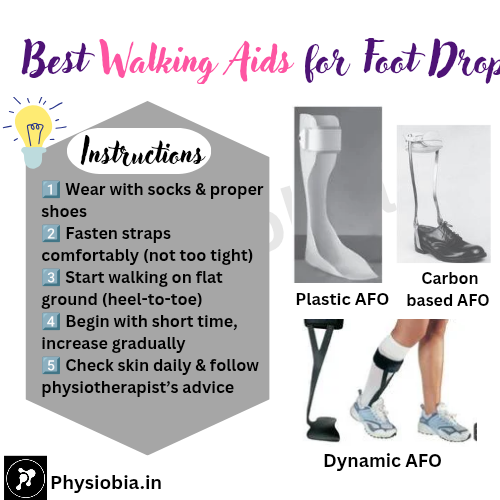
Various types of walking aid used for patients with Foot drop.
1. Ankle-Foot Orthosis (AFO)
This is a type of brace made light weight and worn on the lower leg and foot. It helps to keep the ankle proper alignment. Most common and affordable option.
2. Functional Electrical Stimulation (FES) Devices
Example: Walkaide, Bioness L300.
Send mild electrical signals to the leg muscles, helping the foot lift naturally during each step.
More advanced and allows smoother, natural walking.
3. Foot-Up Devices
Simple strap systems that lift the foot using elastic support.Worn with shoes and easy to put on. It is Less bulky but not as supportive as AFO.
4. Canes or Walkers (Supportive Aids)
Used when foot drop affects balance and stability.
Provide extra safety and prevent falls.
5. Custom Orthopedic Shoes / Inserted
Designed with ankle and arch support.Help improve balance and reduce risk of tripping
What is the FES Walkaide?
Walkaide for foot drop is a wearable functional electrical stimulation (FES) system. Instead of holding the ankle still like a brace, it sends small, timed electrical pulses to the nerves that activate your ankle dorsiflexors. The goal is simple: lift the toes at the precise moment you need clearance, then relax at heel strike, so your steps feel more natural.
What it’s made of
- A lightweight cuff worn just below the knee
- Built-in sensors that detect when you start a step
- Electrodes placed over the common peroneal nerve/motor points
- A controller that times the stimulation automatically
How Walkaide for foot drop works—step by step
1. Positioning: A clinician places the cuff and electrodes on your leg where stimulation produces visible toe lift.
2. Setup: The device is programmed to your walking pattern so it knows when your foot is in swing and stance.
3. During walking: At toe-off, a gentle current triggers dorsiflexion so your toes clear the ground.
4. At heel strike: Stimulation stops, allowing normal stance and weight acceptance.
5. Repeat: The sequence runs on its own every step.
Benefits you may notice
More natural gait mechanics: Encourages active ankle movement rather than immobilization.
Fewer stumbles: Better toe clearance reduces tripping risk.
Muscle engagement: Regularly recruits dorsiflexors, which can support conditioning when paired with therapy.
Comfort and footwear flexibility: Works with many everyday shoes; no rigid shell around the ankle.
Community mobility: Many users report smoother, more confident walking with less fatigue.
Results vary by diagnosis, skin tolerance, spasticity, and training time. A trial with a qualified clinician is essential.
Who is a good candidate?
The benefit from Walkaide in foot drop can be :
- Have an upper motor neuron–type condition (e.g., stroke, MS, cerebral palsy, incomplete SCI).
- Can feel and tolerate mild stimulation on the skin.
- Show visible dorsiflexion when a therapist tests electrical stimulation.
- Can manage device care independently or with a caregiver’s help.
- Have healthy skin where the cuff and electrodes sit.
When it may not be suitable
- Complete denervation of dorsiflexors (no response to stimulation).
- Implanted cardiac devices without cardiology clearance.
- Uncontrolled epilepsy, active DVT, open skin lesions at electrode sites.
- Fixed contractures severely limiting ankle movement.
- Always confirm suitability with a physiotherapist or rehabilitation physician.
If your muscles respond to stimulation, the Walkaide for foot drop can provide a more natural gait. If they do not, a well-fitted AFO—or a combined approach—might be the better solution.
What does training look like?
Assessment day: Your therapist checks for a clear toe-lift response and safe walking with the device.
Parameter tuning: Intensity, pulse width, ramp, and timing are customized to your gait.
Therapy block: Begin with short, supervised walks; progress to turns, stairs, uneven ground, and dual-task walking.
Home program: Increase wear time gradually and pair use with exercise (see below).
Follow-ups: Expect periodic adjustments as your speed, stamina, and symmetry improve.
Exercises that pair well with FES
- Resistance-band dorsiflexion (2–3 sets, 8–12 reps)
- Calf stretching to maintain ankle range
- Hip abductor and extensor work (bridges, side-lying lifts) for pelvic stability
- Step-ups and obstacle practice for clearance and confidence
- Balance drills near stable support (eyes open → eyes closed, foam, etc.)
Day-to-day tips for success
Skin care: Keep the area clean and dry. Rotate electrode placement slightly to minimize irritation.
Electrode maintenance: Replace pads on schedule; poor contact leads to hot spots or inconsistent lift.
Battery habits: Charge routinely and carry spares if you’ll be out for long periods.
Footwear: Start with supportive, flat shoes; avoid thick ankle padding where the cuff sits.
Progression: Build wear time and walking distance gradually to avoid soreness or fatigue.
Environment: Practice indoors first, then add curbs, grass, ramps, and community routes.
Safety and possible side effects
Most people describe the sensation as tingling or tapping. Temporary redness where electrodes sit is common. Stop and seek professional advice if you notice
