
Rheumatoid arthritis
Rheumatoid arthritis (RA) is a disease of synovium (a thin, soft connective tissue membrane that lines the inner surface of synovial joints) characteristics of inflammation in various parts of body. Any Patient with Rheumatoid arthritis typically experience joint pain and other symptoms like.
In early RA, synovial inflammation leads to pain, stiffness, and restricted range of motion (ROM).
How Rheumatoid arthritis Progress day by day?
In early RA, synovial inflammation leads to pain, stiffness, and restricted range of motion (ROM).
In later RA, Chronic inflammation weakens the joint capsule and it’s supporting ligamentous structures, altering joint structure and function. Tendon rupture and fraying tendon sheaths produce imbalanced muscle pull on pathologically altered joints resulting in the characteristic musculoskeletal deformities seen in advanced RA.
How do people have Rheumatoid arthritis?
Rheumatoid arthritis is an autoimmune disease of unknown complex etiology. RA is presently believed to have a genetic basis demonstrated by the increased disease risk and clustering in families.
Current theory and research on the cellular basis of autoimmunity suggest that aberrant functioning of cell-mediated immunity and defective T lymphocytes may trigger the autoimmune response that underlies Rheumatoid arthritis.
A specific etiological agent for Rheumatoid arthritis has not been identified, even though specific external agents may trigger disease expression. Such as
- Infections (e.g., Epstein–Barr virus, Mycoplasma, gut microbiota alterations)
- Smoking (strongly associated with RA, especially anti-CCP–positive RA)
- Hormonal factors
- Occupational exposures (silica dust)
- Stress and environmental influences
Rheumatoid arthritis has no single known cause, but external agents can act as triggers in susceptible individuals, leading to disease expression.
Pathology of Rheumatoid arthritis is when an antigen is a substance, usually
Foreign to the host, that provokes the immune system into action. The immune system may respond to the antigen directly (cellular immunity) or by the production of antibodies that circulate in the serum (humoral immunity). These responses involve two general
Types of lymphocytes: T cells, which are responsible for cellular immunity, and B cells, which produce circulating antibodies specific to the antigen. Antibodies are immunoglobulins, a type of serum protein. Given that individuals with Rheumatoid arthritis produce antibodies to their own immunoglobulins, such as rheumatoid factor (RF) and anti–citrullinated protein antibody (ACPA), and these antibodies precede the clinical presentation of Rheumatoid arthritis by years. Rheumatoid arthritis is considered an autoimmune disease.
Which test is performed to diagnose Rheumatoid arthritis?
- CRP and ESR Test
Elevated erythrocyte sedimentation rate (ESR) and C-reactive protein (CRP) are acute phase reactants that indicate the presence of active inflammation. Although
Patients with RA characteristically have active inflammation up to 40% may have normal values for these tests despite clinical evidence of inflammation. Normal ESR and CRP values are nonspecific and alone cannot confirm or refute a diagnosis of RA.
- CBC Test
A complete blood count (CBC) is routinely ordered because a number of findings are commonly associated with RA. Red blood cell counts are often decreased, indicating
the anemia of chronic disease found in approximately 20% of individuals with RA. By comparison, the white blood cell count is generally normal. chrombocytosis, a
high platelet count, is not uncommon in active RA.
- Synovial fluid analysis
Synovial fluid analysis can greatly enhance the process of differential diagnosis. Normal synovial fluid is transparent, yellowish, viscous, and without clots. Synovial fluid from inflamed joints is cloudy, less viscous owing to a change in hyaluronate proteins, and will clot.
- Mucin clot test
A mucin clot test (a measure of viscosity) of the synovial fluid can be used to discriminate between acute infectious arthritis and inflammatory arthritis, such as RA. Poor clotting accompanies acute infectious arthritis whereas RA produces fair mucin clotting.
- X-ray
Radiographic study is essential in a diagnostic workup for RA. Physical therapists practicing in rheumatology should develop a basic proficiency in identifying abnormalities in joint structure and the surrounding soft tissues as these abnormalities influence the course and outcome of rehabilitation.
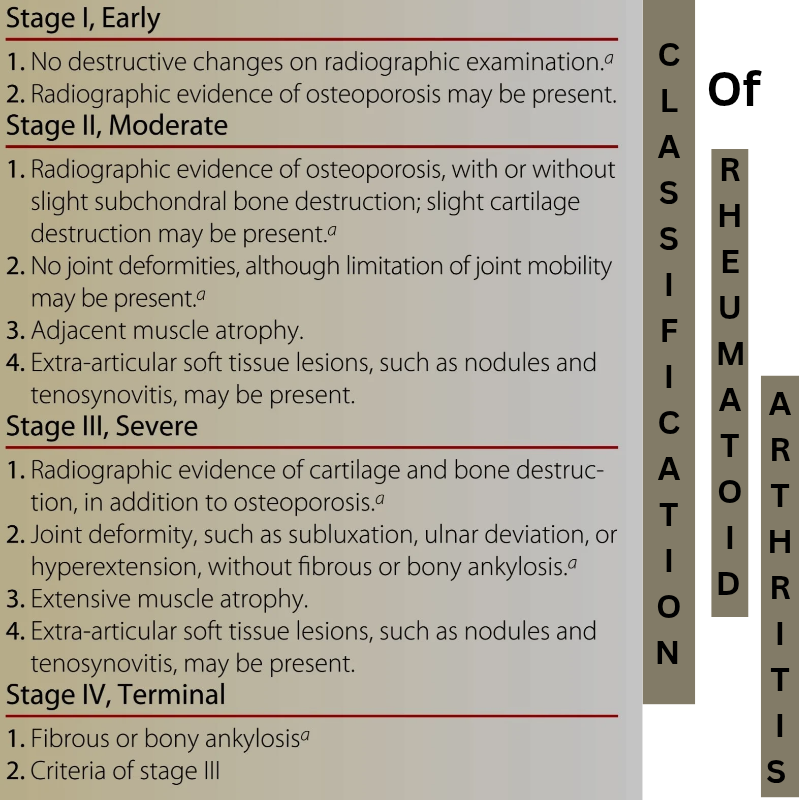
Classification of Progression of Rheumatoid Arthritis
The 2010 American college of Rheumatology give Classification of Rheumatoid Arthritis. The 1987 revised criteria of classification of Rheumatoid Arthritis.
Signs of RA
Patients present with limited mobility and signs of inflammation including pain, redness, swelling, and warm joints.
- Persistent joint pain with an inflammatory nature
- Morning stiffness lasting more than one hour, before maximal improvement .
- Swelling, warmth, and tenderness of affected joints
- Symmetrical involvement of joints on both sides of the body
- Predominant involvement of small joints of hands, wrists, and feet
- Pain that improves with movement and worsens after rest
- Reduced grip strength and difficulty performing daily activities
- Restricted range of motion due to pain and swelling
- Muscle wasting around chronically affected joints
- Development of joint deformities in long-standing disease
- Fatigue and generalized weakness
- Occasional low-grade fever and malaise
- Presence of rheumatoid nodules near pressure points
- Anaemia-related symptoms such as tiredness and pallor
- Possible dry eyes and dry mouth due to associated autoimmune conditions.
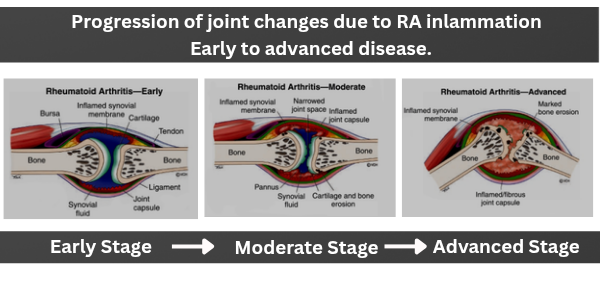
Progression of joint changes in RA
RA is a joint diseases which progress from early to moderate and advance .
Early Stage (Initial Stage)
Early stage shows early signs of rheumatoid arthritis.
- The inner lining of the joint becomes inflamed, causing mild swelling and pain.
- Morning stiffness lasts for a long time, usually more than 30 minutes.
- There is little or no visible joint damage on X-ray at this stage.
Moderate Stage
- Continuous inflammation begins to damage the cartilage inside the joint.
- Pain, swelling, and tenderness increase, and joints may feel warm.
- Movement becomes more difficult due to reduced flexibility.
Advanced Stage
- The inflammation starts damaging the bones, leading to joint deformity.
- Severe pain and long-lasting stiffness are present.
- Daily activities become hard because joint function is greatly reduced.
Deformity seen in Rheumatoid Arthritis
Some common deformity seen in Patient with Rheumatoid arthritis
- Ulnar Drift Deformity
- Boutonniere Deformity
- Hallux valgus
- Swan neck deformity
- Mutilans Deformity
- pes planus (flatfoot)
- Cock-up or Claw toes.
To know more about these deformity then click on this link –

Which treatment is used for Rheumatoid arthritis?
Disease Modifying drugs are the drugs divided into Conventional oral medication and Biological medication. Rheumatoid arthritis Initial Treatment are Conventional oral medication because they are less expensive
Some side effects of conventional oral medications include:
- Gastrointestinal disturbances such as nausea, vomiting, acidity, diarrhea, or constipation
- Irritation or damage to the gastric mucosa, leading to gastritis or peptic ulcers with long-term use
- Liver strain or toxicity due to hepatic metabolism of drugs
- Kidney impairment, especially with prolonged or unsupervised consumption
- Drowsiness, dizziness, or reduced alertness affecting daily activities
- Allergic reactions ranging from mild rashes to severe hypersensitivity responses
- Drug dependency or tolerance in certain medications when used continuously
- Interactions with other drugs, potentially reducing effectiveness or increasing adverse effects
Many a times a combination of both are given to patient.
Lifestyle modification
Diet
Diet may not cure Rheumatoid arthritis but Anti-inflammatory diet can help you to relieve the various signs and symptoms of Rheumatoid arthritis.
Let me tell you about Anti-inflammatory diet.
Core Principles of an Anti-Inflammatory Diet
- Plant-forward nutrition: A high intake of vegetables and fruits provides antioxidants, polyphenols, and fiber that help neutralize inflammatory compounds.
- Quality carbohydrates: Whole grains such as oats, millets, and brown rice promote stable blood sugar levels and support gut health, which plays a key role in inflammation control.
- Healthy fats: Unsaturated fats, particularly omega-3 fatty acids from sources like flaxseeds, chia seeds, walnuts, and olive oil, help balance inflammatory responses.
- Clean protein sources: Legumes, lentils, beans, and plant-based proteins provide essential amino acids without contributing to inflammatory stress.
- Functional herbs and spices: Natural ingredients such as turmeric, ginger, garlic, and cinnamon have bioactive compounds known to modulate inflammation.
Foods That May Worsen Inflammation
- Refined sugars and sweetened beverages
- Highly processed and packaged foods
- Refined grains and excess white flour products
- Trans fats and frequent intake of deep-fried food