
GBS Syndrome (Guillain-Barré Syndrome): Causes, Symptoms & Physiotherapy Treatment
-
 Dr.
Arpita Biswas
Dr.
Arpita Biswas
- Dr.Rahul Kr. Jha
- Disclaimer

Table of Contents


SUBSCRIBE
subscribe to our newsletter and stay updated
What is Guillain-Barré syndrome (GBS)?
Guillain-Barré syndrome (GBS) is a rare neurological disorder in which the body’s immune system attacks the peripheral nerves, leading to muscle weakness and paralysis. The GBS condition often follows bacterial or viral infections. According to a study, the seasonal epidemiology of Campylobacter jejuni gastroenteritis has been investigated in different regions of India, showing that Campylobacter jejuni is the most frequently implicated pathogen. It is a type of polyradiculoneuropathy in which a variable degree of weakness reaches its maximal severity within 4 weeks, resulting in dysfunction of the upper and lower limbs.
Types of Guillain-Barré syndrome (GBS)
GBS is divided into two types on the basis of the spread into the body of the patient.
- Ascending paralysis: Weakness starts from the lower limb to the upper limb.
- Desending paralysis: Weakness starts from the upper limb to the lower limb.
Ascending Paralysis is further divided into 3 types
- AIDP ( Acute Inflammatory Demyelinating Polyneuropathy)
- AMAN (acute motor axonal neuropathy)
- AMSAN(Acute Motor & Sensory Axonal Neuropathy)
Descending Paralysis is further divided into 2 types
- Para paretic GBS
- Miller Fisher Syndrome (MFS)
What are the causes of Guillain-Barré syndrome?
Bacterial Infections
Campylobacter infection is transmitted mainly through the fecal–oral route. The important ways of spread include:
- Contaminated Food
- Eating undercooked or raw poultry (the most frequent source).
- Consuming unpasteurized milk or dairy products.
- Eating meat or food items that have been cross-contaminated during handling.
- Contaminated Water
- Drinking untreated or poorly treated water.
- Swallowing contaminated recreational water while swimming.
- Animal Contact
- Direct contact with infected pets, such as puppies or kittens with diarrhea.
- Exposure to farm animals like poultry and cattle.
- Person-to-Person Transmission
- Less common, but can occur when proper hand hygiene is not followed after using the toilet, changing diapers, or caring for an infected person.
Viral Infections
According to the study conducted in the French center on Guillain-Barré Syndrome and Influenza Virus Infection. In winter, cases of GBS syndrome are commonly preceded by respiratory tract infection or influenza-like illness.
Food Poisoning
The bacterial infection causing GBS syndrome can spread through contaminated food after food poisoning
What are the clinical feature Guillain-Barré syndrome?
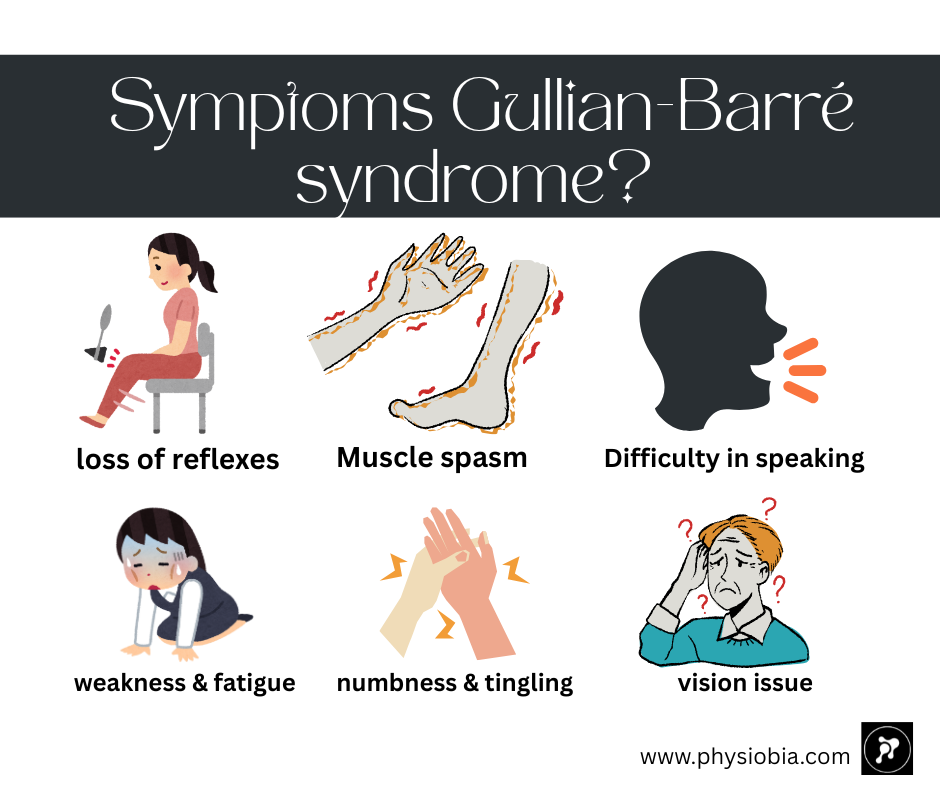
- Numbness and weakness in the lower and & upper limbs
- Facial movements such as speaking, chewing, or swallowing are affected
- Respiratory muscles may be compromised in later stages of GBS, necessitating ventilator support.
- Muscle spasm, all passive motions are restricted
- Fatigue in the upper and lower limbs
- He was not able to stand on two feet independently. He had difficulty maintaining balance.
- Rigidity in both upper and lower extremities.
- Paraesthesia
- Loss of reflexes
- Loss of muscle tone
- Vision issue
- Fear
What is Physiotherapy treatment for GBS syndrome?
Short-term goal
- Increase muscle strength
- Mobility
- Reduce muscle stiffness
- Spasm and pain
- Retrain normal patterns of movement
- Improving posture
- Reduce secondary complications such as chest infection and muscle contractures
- Increased ability to relax
- To enhance functional abilities
- Increase independence
Long-term goal
- Maintenance of range of motion
- Maintenance of muscle properties
- Balance training
- Gait training
- Promoting everyday tasks and independence
- Improving everyday living habits and quality of life
Acute phase (week 1- week 4)
- Chest physiotherapy techniques like breathing exercises, postural drainage, and external tracheal stimulation were given to maintain good bronchial hygiene.
- Passive movement was started to all joint to reduce weakness along with joint approximation
Phase of rehabilitation (week 4 – week 20)
- Passive movements were given at least three times a day across the full range of motion, particularly on the hip, shoulder, wrist, ankle, and feet.
- To avoid pressure sores, the 2-hour change in patient’s position from supine to side-lying.
- Extreme pain, which was handled with the use of TENS and other modalities to relieve pain.
- Functional tasks of daily living like walking, sitting continuously, turning over, and going up and down in bed, putting on clothes, and taking them off.
- The proprioceptive neuromuscular facilitation (PNF) was given it helps in gaining motor function and increased motor control.
- As the patient progresses, isometric and isotonic exercises can be used in strengthening exercises.
Ongoing treatment (after week 20)
- Parallel bar gait & balance training Progression to balance on unstable surfaces, to facilitate safe and efficient ambulation.
Hughes Functional Grading Scale (GBS Disability Scale)
The Hughes Functional Disability Scale, often used for Guillain-Barré Syndrome (GBS), is a simple clinical tool that helps doctors and physiotherapists measure how much a patient’s daily function is affected. It grades the level of disability from no symptoms to the most severe stage, and is very useful for tracking changes over time or evaluating the effectiveness of treatment and rehabilitation.
Grading System
Grade 0 – The person is completely healthy, with no signs or symptoms of disease.
Grade 1 – Only mild symptoms are present; the patient can still run without difficulty.
Grade 2 – The patient can walk independently for at least 5 meters but cannot run.
Grade 3 – The patient requires support (such as a cane, crutch, or assistance from another person) to walk 5 meters.
Grade 4 – The patient is not able to walk even with help and is confined to a bed or wheelchair.
Grade 5 – Breathing assistance is required, usually with a ventilator.
Grade 6 – Death.
How much time is needed for a GBS patient to walk independently?
The recovery timeline for a patient with Guillain-Barré Syndrome (GBS) varies greatly and depends on the severity of nerve damage, age, overall health, and the quality of medical and rehabilitative care received.
In most cases, muscle weakness caused by GBS reaches its peak within 2 to 4 weeks of onset. Recovery then begins gradually, but regaining the ability to walk independently often takes several weeks to months.
Mild to moderate cases: Some patients may begin walking with assistance in about 6 to 12 weeks and may regain independent walking ability by 3 to 6 months.
Severe cases: If paralysis and nerve damage are extensive, full independent walking may take 6 months to 1 year or longer, and in rare situations, residual weakness can persist.
Rehabilitation factor: Early and consistent physiotherapy, strength training, balance retraining, and gait training significantly reduce recovery time and improve outcomes.
According to studies , about 80% of patients can walk independently within 6 months, while around 10–15% may continue to have long-term difficulties.
Case Study of GBS Syndrome
Ramesh Kumar, a 38-year-old office employee from Lucknow, led an active and balanced life. He was known for his punctuality and enthusiasm, rarely missing a workday. Everything was normal until one morning when he developed a mild sore throat and fever. It felt like a regular viral infection — nothing alarming. He took a few medicines, rested for a couple of days, and recovered completely… or so he thought.
A few days later, while climbing stairs at the office, Ramesh noticed his legs felt unusually heavy. He brushed it off, assuming it was just fatigue. But by evening, a tingling sensation had appeared in his feet, as though small pins were pricking them. Within two days, the tingling started creeping up his legs and into his hands.
The Onset
By the fourth day, Ramesh could hardly lift his feet. He stumbled while walking, and even buttoning his shirt became difficult. His wife, Meena, became worried when she noticed his legs giving way. She immediately took him to a nearby hospital for evaluation.
At the hospital, the doctor examined him and found that his muscle tone was low, his reflexes were absent, and he couldn’t lift his limbs properly. The neurologist suspected Guillain-Barré Syndrome (GBS) — a rare disorder in which the body’s immune system attacks the peripheral nerves.
To confirm the diagnosis, doctors performed a nerve conduction study, which showed delayed nerve signals, and a lumbar puncture (CSF test), which revealed high protein levels with normal cell count — a key indicator of GBS.
The Struggle Begins
Over the next two days, Ramesh’s weakness worsened. He couldn’t walk without support and found it hard to move his hands. His facial muscles weakened slightly, affecting his smile. Thankfully, his breathing muscles remained unaffected.
The medical team started him on Intravenous Immunoglobulin (IVIG) therapy for five days, aiming to stop the immune attack on his nerves. He was closely monitored in the hospital for any signs of respiratory distress.
That’s when Neha, a physiotherapist, entered his recovery journey. Her goal was to maintain his joint flexibility and prevent muscle stiffness. Each morning, she gently moved his limbs through passive range of motion exercises, ensuring his body stayed prepared for recovery.
Step by Step Recovery
After two weeks, the rapid progression of weakness finally stopped. Ramesh began to feel small twitches in his fingers — a sign of nerve regeneration. Neha gradually introduced active-assisted exercises to help his muscles wake up again. Breathing exercises were added to keep his lungs strong and active.
He spent the next few weeks focusing on small milestones — sitting up without support, moving his hands freely, and regaining control of his trunk muscles.
By the fourth week, he started electrical stimulation for his weak leg muscles and slowly began balance training. Though each movement took effort, Ramesh stayed motivated, encouraged by his family’s daily visits.
A Turn Toward Strength
At the sixth week, Ramesh took his first few assisted steps using a walker. His legs trembled, but his determination didn’t. He smiled at Neha and said, “Even a few steps feel like running a marathon today.”
With continuous physiotherapy — including strengthening, stretching, and gait training — his power improved from 2/5 to 4/5 in the lower limbs. Over the following weeks, he practiced walking with parallel bars, then with a cane, until he finally regained his balance and walked independently.
Recovery and Reflection
After about ten weeks, Ramesh returned for his follow-up visit walking without assistance. His strength had nearly returned to normal, his smile was back, and he thanked the entire rehabilitation team.
As he handed a box of sweets to Neha, he said,
“I never realized how precious movement is until I lost it. Now, every step feels like a blessing.”