
Long wave diathermy
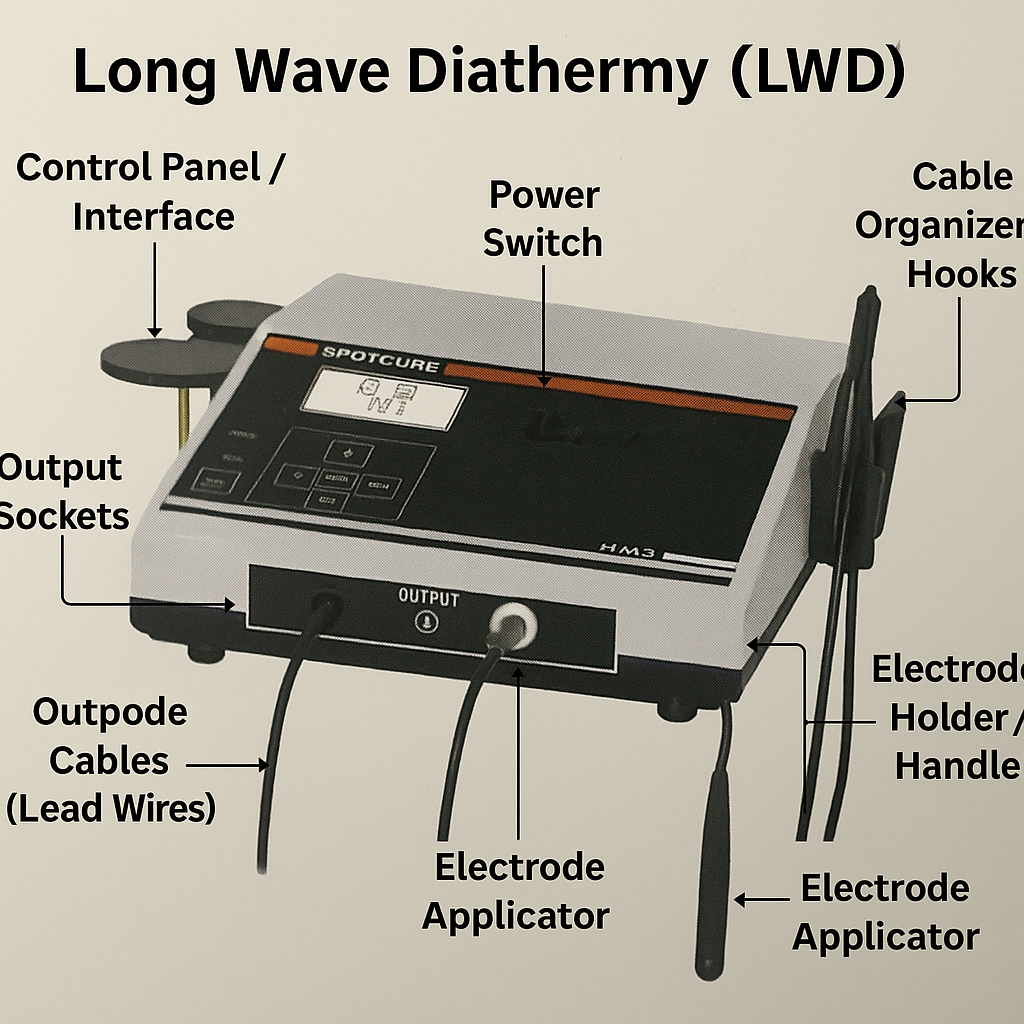
What is Long wave diathermy?
Long wave diathermy (LWD) is a deep heating modality that produces high frequency electromagnetic waves of the frequency 1MHz (1 million cycles per second) and wavelength 300 m to generate heat within body tissues.
Unlike Short Wave Diathermy (SWD) which operates at higher frequencies (27.12 MHz), Long wave diathermy penetrates deeper with less risk of superficial burns and is considered safer and more comfortable for many patients.
LWD have minimal loss of energy. The power output required for long wave diathermy is 25–75 watts only, whereas short wave diathermy generates 250–1000 watts of power.
The major advantage in long wave diathermy is that they can be used even with patients having metal implants in body . Also the machine is much more cheaper than SWD and easily transfer from one place to another.
Parts of a Long Wave Diathermy Machine
Understanding the long wave diathermy machine structure helps in both exams and practical use.
1. Main Unit – Houses the frequency generator and control panel.
2. Electrode Wires – Connects the main unit to the treatment electrodes.
3. Applicator/Electrodes – Pads placed on the treatment area. They can be single or dual.
4. Timer and Intensity Control – Allows therapists to set duration and power output (measured in Watts).
Basic Principle of LWD
Long Wave Diathermy works on the principle of resistive heating. When high-frequency waves pass through tissues, they encounter resistance, which causes the tissues to heat up. This process is especially effective in: Muscles, Tendons, Ligaments, Joints.
The heat generated from LWD:
- Increases metabolism
- Enhances blood flow
- Reduces muscle spasms
- Promotes tissue healing
Placement of Electrodes
Mono planar tech : For localized pain
Coplanar tech : For radiating pain
Spacing : Narrow
Dosage
Acute – Sub thermal
Subacute – Mild thermal
Chronic – Thermal
Duration
Acute – 10 to 15 minutes
Subacute – 15 to 20 minutes
Chronic – 20 to 30 minutes
LWD is mainly recommended in sub-acute and chronic phases of injuries, not during the acute inflammation phase.
Why Use Long Wave Diathermy? Key Benefits
Here’s why long wave diathermy is widely used in clinics and recommended in physiotherapy:
Deeper Penetration
LWD can reach tissues up to 4-5 cm deep, making it useful for deep-seated muscle or joint conditions, especially where superficial heating agents like hot packs fail.
Patient Comfort
The treatment is painless and non-invasive, with no sensation of shock or discomfort, which increases patient compliance.
No Metal Interference
Unlike Short wave diathermy, Long wave diathermy does not interfere with metallic implants, making it safer for post-surgical patients with screws or plates.
Lower Risk of Burns
Because of the low frequency and longer wavelength, the risk of superficial skin burns is minimized.
Major conditions treated by Long wave diathermy
1. Cervical spondylosis
2. Periarthritis shoulder
3. Low back ache
4. Lumbar spondylosis
5. Short Wave Diathermy (SWD) to hip joint
6. Sciatica
7. Osteoarthritis knee
8. Ligament injuries
Medial collateral ligament injuries of knee
Lateral collateral ligament injuries of knee
Lateral ligament of ankle
Medial ligament of ankle
9. Plantar fasciitis
10. Salpingitis
Indications of Long Wave Diathermy (LWD)
Long Wave Diathermy is primarily used in physiotherapy to reduce pain, improve blood circulation, and promote healing in deep tissues. Below are the most common clinical indications:
1. Chronic musculoskeletal pain
- Low back pain
- Cervical spondylosis
- Fibromyalgia
- Myofascial pain syndrome
LWD helps relax muscles and improves deep circulation, reducing pain and stiffness.
2. Osteoarthritis & Rheumatoid Arthritis
- Knee, hip, shoulder joints
- Improves joint flexibility
- Reduces morning stiffness and pain
Ideal for chronic inflammatory conditions (in non-acute phase).
3. Muscle Spasm & Contractures
- Post-exercise spasm
- Trigger points
- Muscle tightness
4. Ligament & Tendon Injuries
- Tendinitis
- Ligament sprains (subacute/chronic phase)
- Rotator cuff injuries
Promotes tissue repair by improving blood supply
5. Bursitis (Subacute Stage)
- Shoulder, hip, or knee bursitis
- Reduces inflammation and pain in deeper bursae
Best when swelling has subsided but stiffness remains.
6. Joint Stiffness & Post-Immobilization Cases
- After fracture healing
- Post-cast or splint stiffness
Improves mobility by softening tissues around joints.
7. Sports Injuries (Chronic/Subacute)
- Hamstring strain
- Groin pull
- Calf tightness
Enhances recovery by increasing metabolism and reducing residual inflammation.
8. Scar Tissue or Adhesions
- Post-operative or traumatic scars
- Improves collagen extensibility
- Makes stretching and mobilization easier
Contraindications of LWD
As with any therapy, there are situations where Long wave diathermy should be avoided:
- Over malignancy or tumors
- Over pregnant uterus
- On areas with poor sensation
- Over infected or open wounds
- In pacemaker patients
- Over areas with active bleeding