
What is pain scale & how it works ?

What is a Pain scale?
A pain scale is a tool developed by therapists and doctors to measure the intensity of pain experienced by a patient. These scales provide an accurate and consistent way to communicate different levels of pain. They are especially helpful during patient assessment and in monitoring progress throughout treatment and recovery.
Why is it used?
Studies show that these scales are reliable and valid for assessing pain intensity in both acute and chronic conditions, and they help guide treatment decisions and monitor recovery. Research shows that regular pain assessment improves pain management outcomes and patient satisfaction.
In simple terms, a pain scale works by allowing the patient to select a number or description that best matches how they feel, enabling accurate assessment and appropriate clinical care.
Let’s understand with example.
When a patient comes to the clinic complaining of elbow pain, pain scales are used to understand how severe the pain is and to guide treatment decisions.
- Numeric Rating Scale (NRS):
The healthcare provider asks the patient to rate their elbow pain using numbers from 0 to 10. A score of 0 indicates no pain, while 10 represents extreme pain. For example, the patient may describe their pain as 5 out of 10 during elbow movement and 2 out of 10 while resting. This helps the clinician assess pain severity and evaluate changes over time. - Visual Analog Scale (VAS):
With this scale, the patient is given a horizontal line with “no pain” written at one end and “worst possible pain” at the other. The patient marks a point on the line that best matches their elbow pain. For instance, the mark may fall in the middle of the line, suggesting moderate pain. The clinician then measures the distance from the “no pain” end to quantify the pain level.
What is a Numeric Rating scale?
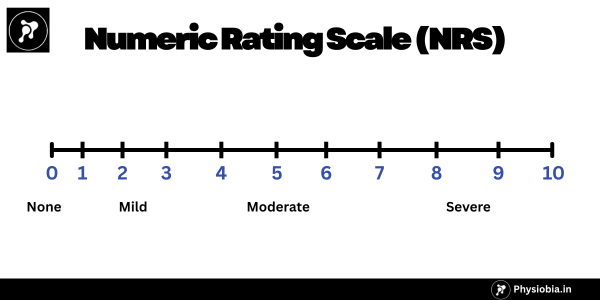
The Numeric Rating Scale is one of the most commonly used tools for measuring pain intensity in clinical practice. It asks the patient to rate their pain using a number, usually from 0 to 10.
- 0 indicates no pain
- 1–3 indicates mild pain
- 4–6 indicates moderate pain
- 7–10 indicates severe pain
The pain scale can be used verbally, in written form, or visually. It is easy to understand, quick to administer, and suitable for most adults and older children. Clinicians often use the NRS to assess pain at rest, during movement, and to monitor changes in pain over time.
Fig. 1.1. shows the Numeric Rating Scale which is a Pain scale used in healthcare.
Reliability of the Numeric Rating Scale
Reliability refers to the consistency of a measurement tool. Research evidence shows that the Numeric Rating Scale has good to excellent reliability.
Studies assessing test–retest reliability have reported intraclass correlation coefficient (ICC) values ranging approximately from 0.70 to 0.95, which indicates that patients tend to give similar pain scores when their pain level has not changed. This consistency has been demonstrated across various conditions, including musculoskeletal pain, postoperative pain, and chronic pain.
These findings support that the NRS is a reliable tool for repeatedly measuring pain intensity in clinical and research settings.
Validity of the Numeric Rating Scale
Validity refers to how well a tool measures what it is intended to measure. Research has shown that the Numeric Rating Scale has strong validity as a measure of pain intensity.
Evidence demonstrates that NRS scores correlate highly with other established pain assessment tools, such as the Visual Analog Scale (VAS) and the Verbal Rating Scale (VRS). This strong correlation confirms that the NRS accurately reflects a patient’s perceived level of pain. Additionally, studies have shown that the NRS is sensitive to change, meaning it can detect improvements or worsening of pain following treatment.
Because of these findings, the NRS is considered a valid measure of pain intensity in both acute and chronic conditions.
What is Visual Analogue (Analogy) Rating Scale (VAS) ?
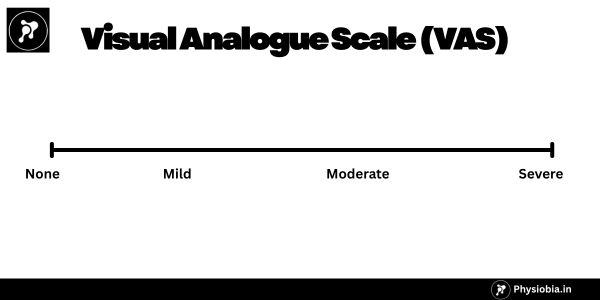
The Visual Analogue Rating Scale is a widely used tool for measuring pain intensity. It consists of a straight horizontal line, usually 10 cm long, with two endpoints:
- One end represents “no pain”
- The other end represents “worst pain imaginable”
The patient is asked to mark a point on the line that best reflects the intensity of pain they are experiencing at that moment. The clinician then measures the distance from the “no pain” end to the patient’s mark, which provides a numerical value for pain intensity.
The VAS is commonly used in both clinical practice and research because it allows pain to be measured on a continuous scale, offering greater sensitivity than simple numeric categories.
Fig. 1.2. shows the Visual Rating Scale which is a Pain scale used in healthcare.
Reliability of the Visual Analogue Rating Scale
Reliability refers to the consistency of a measurement when repeated under similar conditions. Research evidence shows that the Visual Analogue Scale has high reliability.
Studies evaluating test–retest reliability have reported intraclass correlation coefficient (ICC) values generally ranging from 0.80 to 0.95, indicating excellent consistency when pain levels remain stable. This reliability has been demonstrated across different populations, including patients with acute pain, chronic musculoskeletal conditions, and postoperative pain.
These findings support that the VAS produces stable and repeatable results, making it reliable for monitoring pain over time in pain scale.
Validity of the Visual Analogue Rating Scale
Validity refers to how accurately a tool measures what it is intended to measure. Research consistently supports the strong validity of the Visual Analogue Scale for assessing pain intensity.
VAS scores show high correlation with other established pain measures such as the Numeric Rating Scale and Verbal Rating Scale. This agreement confirms that the VAS accurately reflects a patient’s perceived pain level. Additionally, the VAS has been shown to be highly responsive to clinical change, meaning it can detect small improvements or increases in pain following treatment or disease progression.
Because of this sensitivity and strong correlation with other validated tools, the VAS is considered a valid measure of pain intensity.
How Pain Scale work in Various Healthcare?
Pain scale plays a vital role in healthcare because pain is a personal experience that cannot be measured through tests or machines. These scales give patients a voice and help healthcare professionals make informed clinical decisions. Their use may look simple, but their impact is significant across different healthcare settings.
Emergency Department
In emergency rooms, time is critical. When a patient arrives with sudden pain, such as a teenager who fell during sports and injured their elbow—the nurse may quickly ask them to rate their pain on a scale from 0 to 10. A high score alerts the medical team that immediate attention is needed. This quick assessment helps prioritize care and decide whether urgent pain relief or imaging is required.
Outpatient Clinics
In outpatient and physiotherapy clinics, pain scales help track progress over time. For example, a patient visiting a clinic for chronic elbow pain may initially rate their pain as 7/10 while moving the arm. After several therapy sessions, the same patient may report a 3/10. This change tells the therapist that the treatment plan is effective and supports decisions about continuing or modifying therapy.
Postoperative Care
After surgery, pain scales are used regularly to monitor recovery. A patient recovering from a minor orthopedic procedure may be asked to rate their pain several times a day. If pain scores suddenly increase, it can signal complications or the need for better pain control. In this setting, pain scales help ensure comfort and safety during healing.
Pediatric and Geriatric Care
In children or older adults who may have difficulty describing pain, adapted pain scales are used. For example, a child with arm pain may point to a face that best matches how they feel, while an older adult may give a number. These tools help caregivers understand pain even when communication is limited.
Home and Community Healthcare
Pain scales are also useful outside hospitals. Patients managing long-term conditions at home often use pain scales to report symptoms during follow-up visits or telehealth calls. For instance, a patient may tell their doctor that their pain stays below 4/10 most days, reassuring the clinician that the condition is under control.


