
Fracture
Table of Contents
A fracture is a break in continuity of bone.
CLASSIFICATION OF FRACTURES
It can be classified on the basis of aetiology,relationship of the fracture with the external
environment, the displacement of the fracture, and the pattern of the fracture.
ON THE BASIS OF AETIOLOGY
Traumatic fracture:
A fracture sustained due to trauma is called a traumatic fracture*.e.g., fractures caused by a fall, road traffic accident, fight etc
Pathological fracture:
A fracture through bone which has been made weak by some underlying disease is called a pathological fracture. e.g., a fracture through a bone weakened by metastasis
Stress Fracture:
This is a special type of fracture sustained due to chronic repetitive injury (stress) causing a break in bony trabeculae. These often present as only pain and may not be visible on X-ray.
ON THE BASIS OF DISPLACEMENTS
Undisplaced fracture:
These fracture are easy to identify by the absence of significant displacement.
Displaced fracture:
A fracture may be displaced. The factors responsible for displacement are:
(i) fracturing force;
(ii) muscle pull on the fracture fragments; and
(iii) gravity.
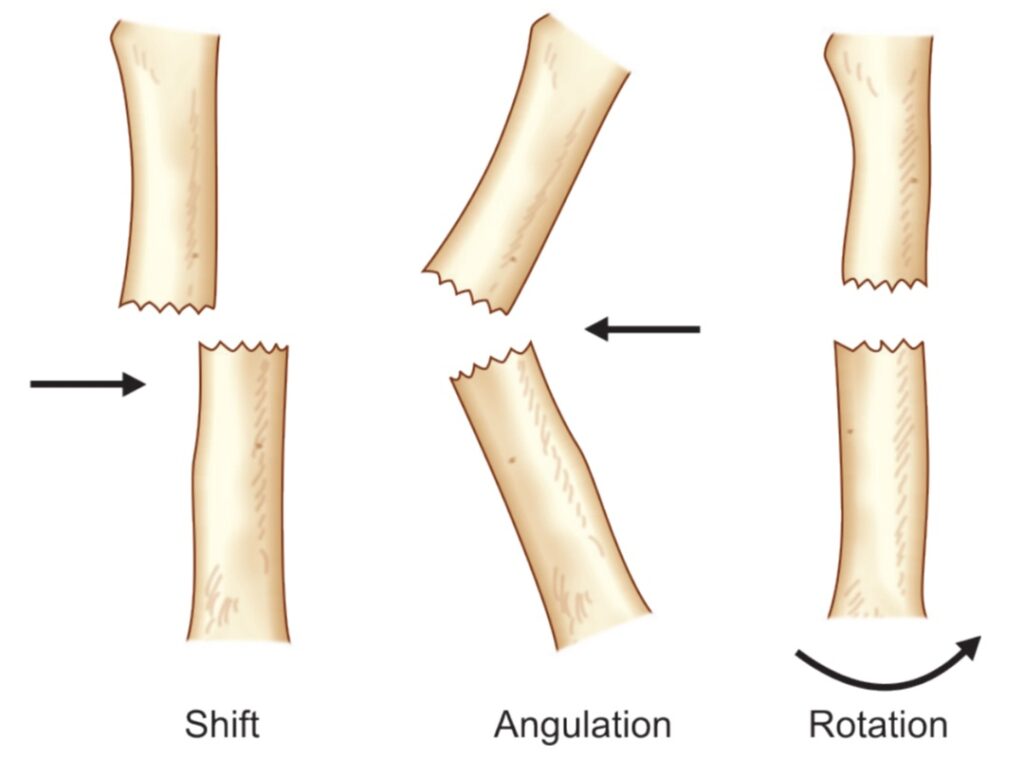
ON THE BASIS OF RELATIONSHIP WITH EXTERNAL ENVIRONMENT
Closed fracture
A fracture not communicating with external environment, i.e., the overlying skin and other soft tissues are intact, is called a closed fracture.
Open fracture:
A fracture with break in the overlying skin and soft tissues, leading to the fracture communicating with the external environment, is called an open fracture.
- Internally open (from within): The sharp fracture end pierces skin from within, resulting in an
open fracture. - Externally open (open from outside):The object causing the fracture lacerates the skin and soft
tissues over bone, as it breaks the bone, resulting in an open fracture.
ON THE BASIS OF COMPLEXITY OF TREATMENT
Simple fracture
A fracture in two pieces, usually easy to treat, is called simple fracture, e.g. a transverse fracture of humerus.
Complex fracture:
A fracture in multiple pieces, usually difficult to treat, is called complex fracture, e.g. a communited fracture of tibia.
ON THE BASIS OF QUANTUM OF FORCE CAUSING FRACTURE
High-velocity injury:
In these fractures, there is severe soft tissues injury (periosteal and muscle injury). Such fracture are often unstable, and slow to heal.
Low-velocity injury:
These fracture are sustained as a result of mild trauma force, as in a fall. There is little associated soft tissue injury, and hence these fracture often heal predictably.
ON THE BASIS OF PATTERN
Transverse fracture:
In this fracture, the fracture line is perpendicular to the long axis of the bone.
Oblique fracture
In this fracture, fracture line is oblique. Such fracture is caused by a bending force which, in addition, has a component along the long axis of bone.
Spiral fracture
This is a fracture with multiple fragments.
Comminuted fracture
A fracture may have a combinations of two or more patterns. For example, it may be a comminuted but primarily a transverse fracture.
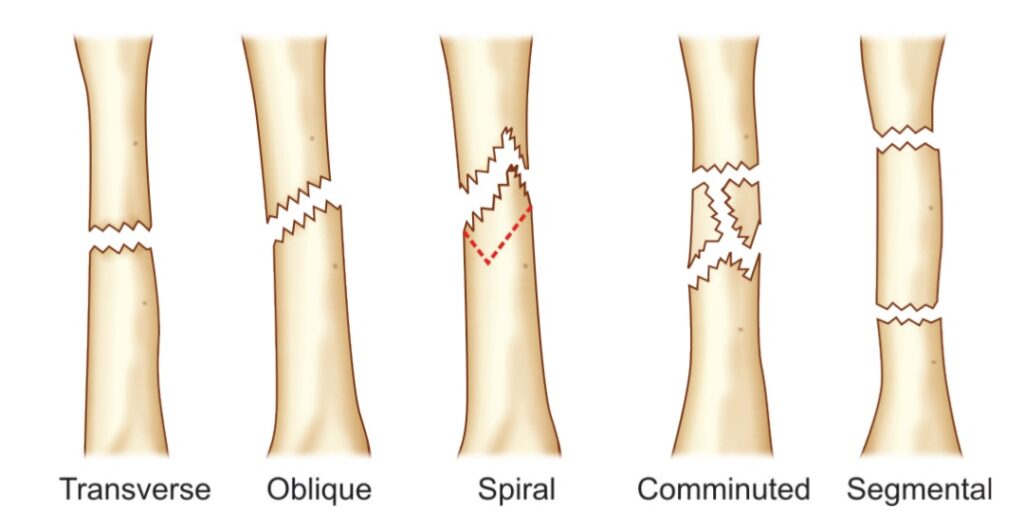
PATHOLOGICAL FRACTURES
A fracture is termed pathological when it’s occurs in a bone made weak by some disease . Often, bone breaks as a result of a trivial trauma, or even spontaneously.
Causes of pathological fractures
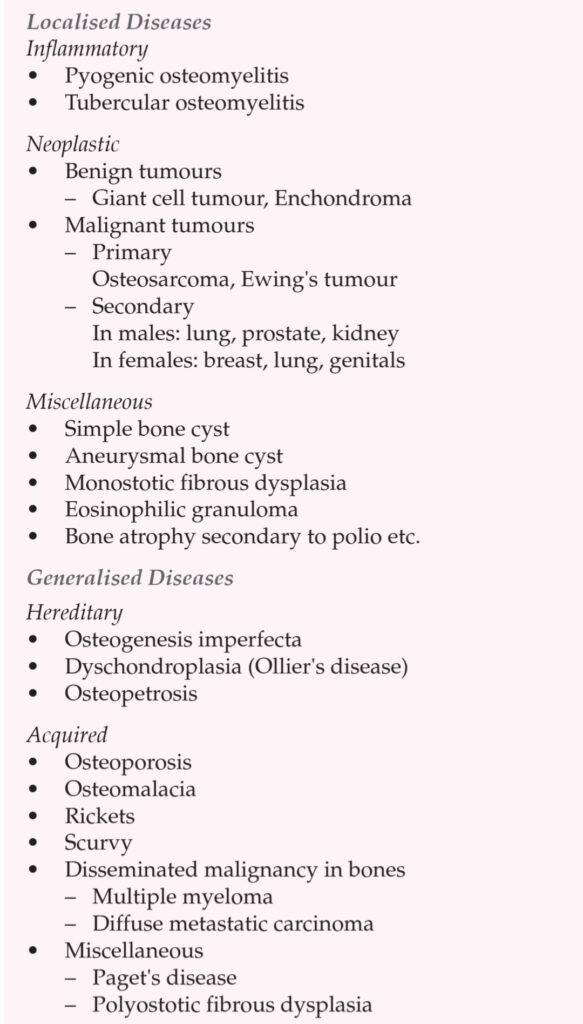
Causes of pathological fractures at different ages
