
Postural drainage
What is Postural drainage?
Postural drainage is a mechanical technique that involves lung segments such that gravity has a maximal effect of facilitating the drainage of broncho-pulmonary secretions from the tracheobronchial tree to mobilize bronchial secretions.
In simple language, Postural drainage is a physiotherapy technique used to clear mucus from the lungs by positioning the body so that gravity helps drain secretions.
Chest physical therapy (CPT) utilizes mechanical methods, specifically chest percussion, postural drainage, and vibration, for airway clearance of lung secretions.
The human lungs are divided into lobes, which are sections that help in breathing and gas exchange. Each lung is slightly different in structure due to the positioning of the heart. The right lung is larger and has three lobes: Upper (Superior) Lobe, Middle Lobe & Lower (Inferior) Lobe. The left lung is smaller because the heart is positioned slightly to the left. It has two lobes: Upper (Superior) Lobe & Lower (Inferior) Lobe.
To download the postural drainage positions PDF then continue read uptill end , we provide free pdfs at the end of article.
General guidelines to follow before performing Postural drainage
- Each position should be held for a minimum of five minutes.
- Positions can be done on a bed or the floor.
- In each position, the chest should be lower than the hips to allow mucus to drain.
- Use pillows, foam wedges, and other devices to make the patient as comfortable as possible.
- While in the positions, try to breathe in through the nose and out through the mouth for longer than you breathe in for maximum effectiveness.
- Do these positions in the morning to clear mucus that’s built up overnight or right before bed to prevent coughing during the night.
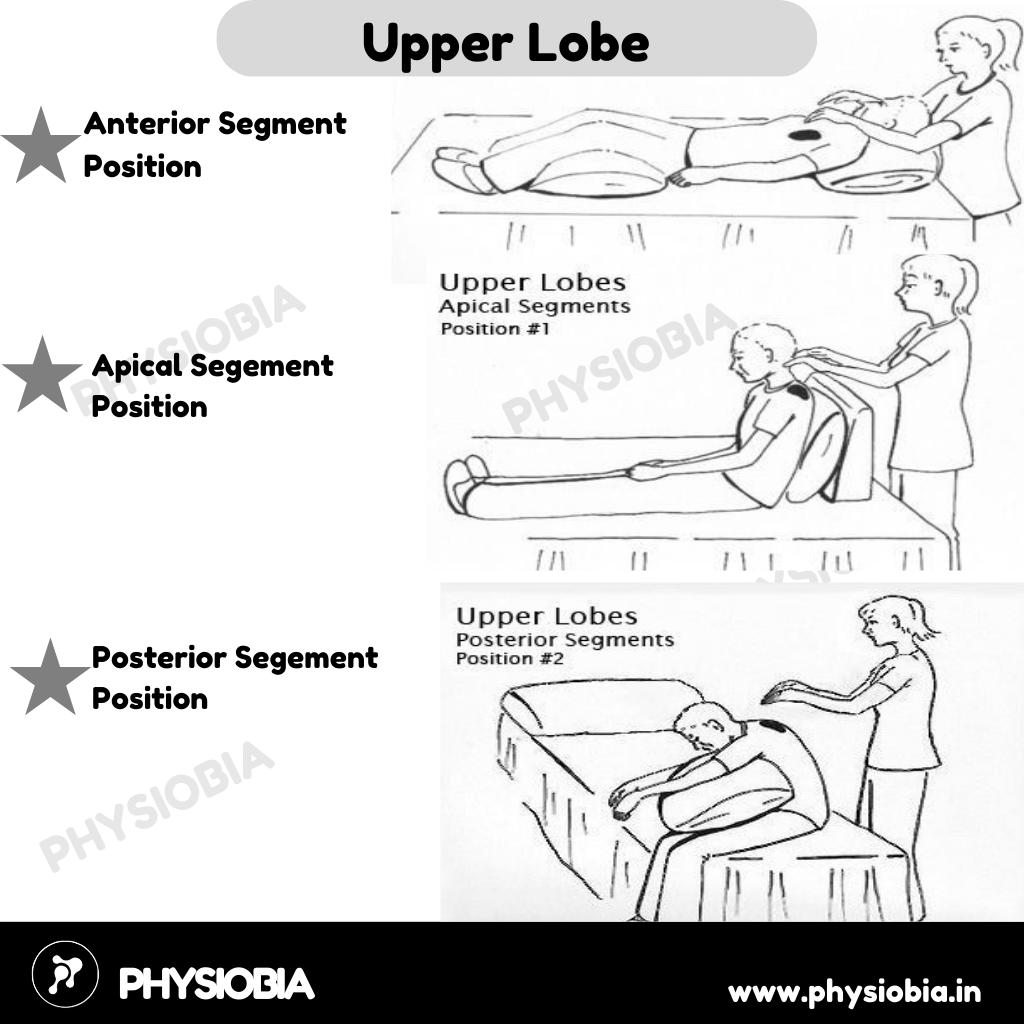
Upper lobes (apical segments)
In Postural drainage, the upright position is used to drain your upper respiratory tract, which is above the lower respiratory tract.
Patient Position: The patient should sit upright, with slight variations according to the position of the lesion. Sit upright or reclined at about 30–45 degrees.
Targeted Area: The uppermost parts of the lungs.
Technique: The therapist may perform percussion and vibration over the upper chest
After every positioning, in Postural drainage, mucus is expelled by three methods these are ;
- Coughing is the physiological method used for expelling secretions expelled from the bronchial tree. The patient should take deep breaths and then strongly exhale to stimulate the cough.
- Suctioning is used in a patient with a tracheostomy or an endotracheal tube (ETT) to clear secretions.
- Vibration is a gentle, oscillatory movement applied during exhalation to help mobilize secretions towards the larger airways for easier removal.
Upper lobes (posterior segments)
- Patient Position: Sit leaning forward about 45 degrees, resting on a pillow.
- Targeted Area: The back of the upper lobes.
- Technique: Percussion is performed on the upper back.
Upper lobes (anterior segments)
- Patient Position: Lie flat on your back with a pillow under your knees.
- Targeted Area: The front part of the upper lobes.
- Technique: Percussion and vibration are applied over the upper chest
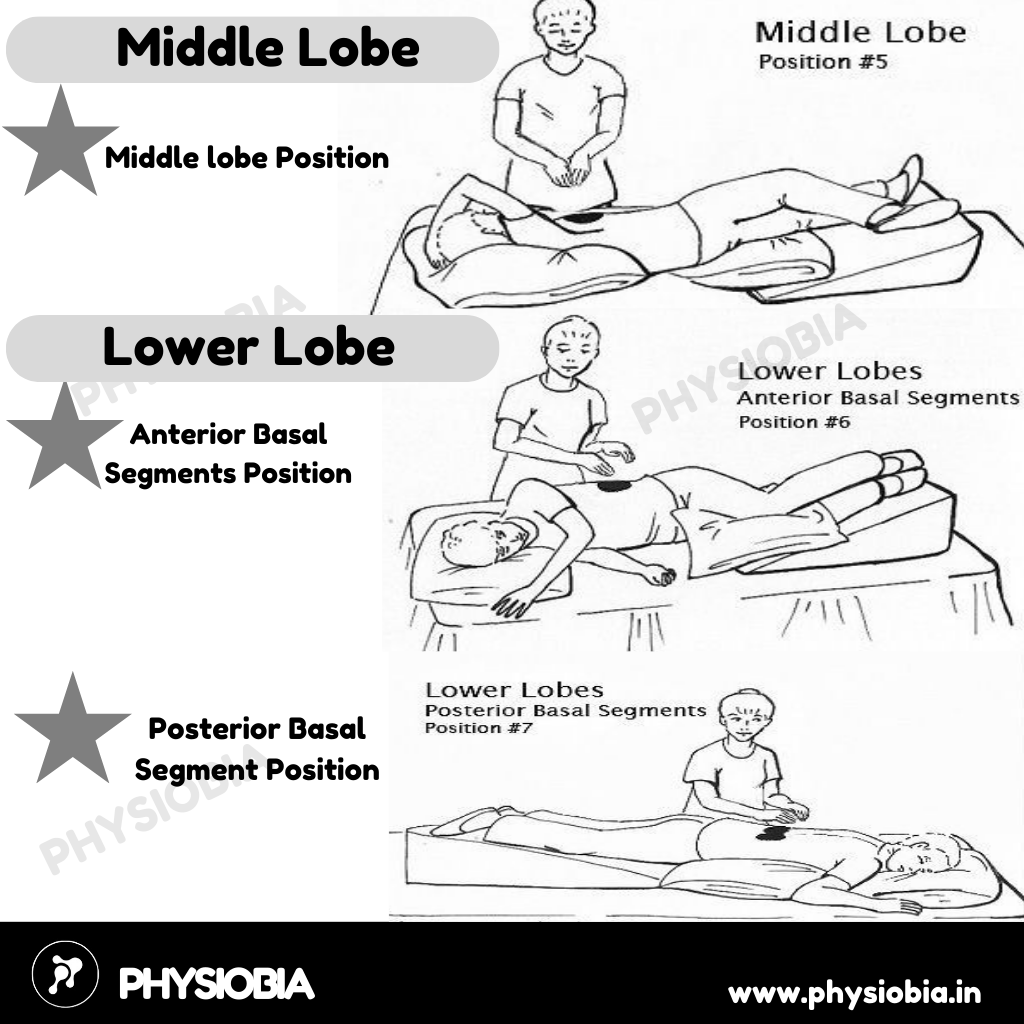
Middle lobe & lingula (left upper lobe equivalent)
- Position: Lie on your right side with your upper body tilted downward at about 15 degrees.
- Targeted Area: The middle lobe (right lung) or lingula (left lung).
- Technique: Clapping is done over the lower chest on the right or left side.
Lower lobes (anterior segments)
- Position: Lie flat on your back with the bed tilted downward at a 30-degree angle.
- Targeted Area: The lower lobes.
- Technique: Percussion is done over the lower chest.
Lower lobes (posterior segments)
- Position: Lie on your stomach with the bed tilted downward.
- Targeted Area: The back of the lower lobes.
- Technique: Clapping is performed on the lower back.
Lower lobes (lateral segments)
- Position: Lie on your side with the bed tilted downward.
- Targeted Area: The outer part of the lower lobes.
- Technique: Percussion is done on the side of the chest.
When do we perform?
Postural drainage is commonly performed or benefited by patients with respiratory conditions like cystic fibrosis, chronic bronchitis, bronchiectasis, and pneumonia.
- Patients with lung conditions have difficulty with secretion clearance, and expectorated sputum production greater than 25-30 mL/day (adult)
- Person with the presence of atelectasis.
- A person diagnosed with diseases such as cystic fibrosis, bronchiectasis, or cavitating lung disease.
- A patient with the presence of a foreign body in the airway might have excessive mucus secretion.
- COPD
- Pneumonia
When do we not perform?
Whenever we think of performing Postural drainage, every clinician should be aware of contraindications and precautions to ensure patient safety.
Postural drainage should not be used in patients who cannot tolerate the required Postural drainage position or have recent hemoptysis, recent rib or vertebral fracture, severe osteoporosis, or a high bleeding risk.
Patient with active tuberculosis, or conditions like stroke, with a great aspiration risk.
Unstable hemodynamics, acute respiratory distress syndrome, untreated pneumothorax, recent spinal surgery, acute spinal cord injury, active hemoptysis, and rib fractures are conditions advised not pto erform these positions.
Patients who do not require the removal of excess pulmonary mucus secretion.
Download the postural drainage positions PDF