
Bacteria
Table of Contents
Definition
The word bacterium (Gk. Bakterion = little rod) originally applied by microscopists for rod shaped organism, belonging to the lowest order of plant life or “microscopic unicellular plants without chlorophyll that reproduce by fission”.Antony Von Leuvenhoek (1632 – 1723), the dutch dry goods merchant of Holland, is credited with the discovery of bacteria. He observed bacteria in scum of teeth with the help of microscope constructed by himself. He named them as “tiny animalcules”. In 1695 he published his work “The secrets of the nature discovered by Antony Van Leeuvenhoek” for this discovery he has been c/a as “Father of Bacteriology”.
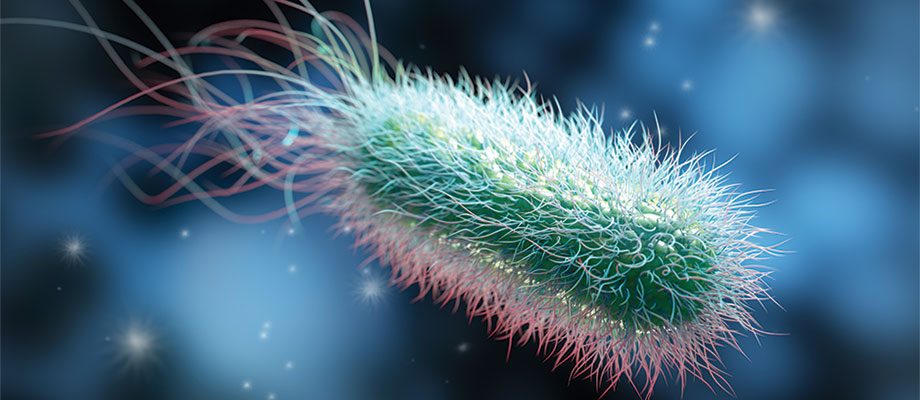
General Characters of Bacteria
- They are omnipresent i.e. present in soil, air and water.
- They are unicellular, prokaryotic microorganism.
- They have great variation in mode of nutrition i.e. may be autotrophic and heterotrophic. In heterotrophism mode of nutrition they may be parasite saprophyte or symbiotic in nature.
- The cell bears thick rigid cell wall outside plasma membrane (because of this character they are kept in plant kingdom).
- They lack true chlorophyll but few photosynthetic bacteria have special type of chlorophyll called bacteriochlorophyll.
- They lack mitochondria, golgi apparatus, plastid and endoplasmic reticulum.
- They lack basic protein histone in their DNA
- Ribosomes are of 70s type
- Asexual reproduction is by the conidia, motile spores and endospore
- Vegetative reproduction is generally by the binary fission, cyst, budding and gonidia.
- Both DNA and RNA are present in the bacterial cell. DNA is in form of single circular chromosome (therefore the ce.il is haploid)
- True sexual reproduction is absent in the bacteria but there are examples of genetic recombination which may be of following types viz. conjugation, transduction and transformation.
Structure of bacterial cell
Size: There is great variation in size of the bacteria. They are so minute which can’t be seen without help of microscope. On an average each cell of bacterium measures 1.25 – 2 mm in diameter and 2-10 mm in length.
Shape and form of bacteria
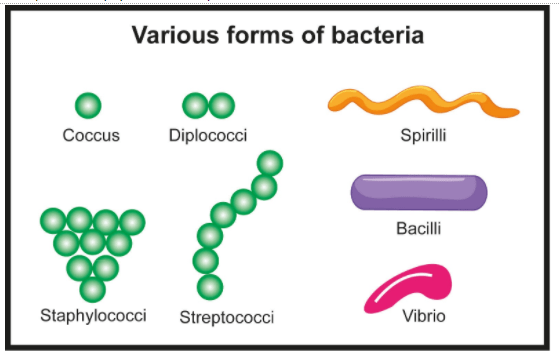
Bacterial cell differ in their shapes but usually three conventional shapes have been recognized. Initially classification of bacteria was based on their shapes but now it is not used. The various shapes are as follows:
Ellipsoida/Spherica/Cocci
The term cocci has originated from a greek word; kokkos = grain or kernel. It is simplest form of bacteria in which bacteria appears like a minute sphere (0.5~ – 1.25~ in diameter) they lack flagella. On the basis of arrangements cocci are further classified as follow:
Micrococci: When a bacterium appears singly e.g. Micrococcus agitis, M. aureus.
Diplococcus: When they appear in a pairs of cells e.g. Diplococcus pneumoniae.
Streptococci: When they appear in rows of cells or in chains e.g. Streptocoocus lactis.
Staphylococci: When they arrange in irregular clusters like bunches of the grapes e.g. Stapllyloccolls aureus.
Tetracoccus: When they arrange in sequence of four e.g. Neisseria.
Sarcinae: When they arrange in cuboidal or in different geometrical or packet arrangements e.g. Sarcillae lutea.
Rod Shaped Bacteria or Bacillus
The word bacillus originated from greek word, bacillii means rod or stick. There ends are rounded flat or pointed. There size ranges from 0.5-1.2~ in diameter and 3-7~ in length. They may be flagellated or non-flagellated.
Monobacillus: When they arrange singly.
Diplobacillus: When they are present in group of two e.g. Diplobacillus pncu/Iloniae.
Streptobacillus : When they appear in chains e.g. Bacillus tuberculosis.
Palisade: Very rarely the bacillus arrange in palisade arrangement.
Spiral or Helical
The origin of word is from greek word; spira means coiled. They appear like a cork screw. A single spirillum has more than one turn of the helix. Generally they are found as free living, unicellular entity. There size ranges from 10-50~ in length and 0.5 – 3u in diameter. They are flagellated e.g. Spirillum minus, S. volutans.
Vibrio or Coma
Bacteria of this group are like ‘coma or small curved rod. They bear flagella at their end. Their size ranges from 1.5-l.71u in diameter and upto lOu in length e.g. Vibrio cholarae.
Spirochaeta
These bacteria appears like cork screw and atrichous. Their length is more as compared to their diameter. Their body is more flexible.
Pleomorphic
Many bacteria change their shape and structure with the change in environmental condition. These bacteria which are found in various form are known as pleomorphic bacteria e.g. Acetobacter.
Budding Bacteria
These are of football shaped structure with a swollened part and a thin tube. This tube gradually increases in size and its terminal end swells up to form new cell which is globular and ultimately net work of cell is formed e.g. Rhodomicrobium.
Flagella
Bacteria can be motile or non motile. The motile form swim by means of the small flexible, whip like appendage called flagella (singular flagellum). They are much thinner than flagella or cilia of eukaryotes. The main function of flagellum is to provide motility to the bacterial cell.
Pili
These are hair like appendages present on the surface of most of the gram negative bacteria. They are smaller than flagella, have no role in motility of bacteria. They measure 0.2-20J in length and 30-140Ao in width.
Functions of Pili
- They help the bacteria to attach themselves to the natural substrate or to other organism due to its adhesive properties.
2.They bear antigenic properties.
3.Sex pili are helpful in chromosome transfer during conjugation by acting as conjugation tube
4.They act as bacteriophage receptor.
5.Capsules
Some bacterial cells are surrounded by viscous substance forming a covering layer or envelope around the cell wall called capsule.
Macrocapsule: It is about O.21mm thick and can be seen under light microscope.
Microcapsule: It can’t be seen under the light microscope but can be demonstrated immunologically.
Functions
They provide protection against temporary drying by binding water molecules.
They may be antiphagocytic i.e. they inhibit the engulfment of pathogenic bacteria by W.B.C. and contribute to invasive ability.
NUTRITION
All form of life from microorganism to human beings share certain nutritional requirements for growth and normal functioning. Generally the bacteria are classified in two nutritional types on the basis of their nutritions requirement:
Autotrophic
A very small group of bacteria possess this type of nutrition. Few bacteria possess photosynthetic pigment bacteriochlorophyll other than normal chlorophyll found in higher plant are called photosynthetic bacteria. Thus autotrophic bacteria are of two types: Photosynthetic bacteria ,Chemosynthetic bacteria
Photosynthetic Bacteria
This type of bacteria possess a special type of pigment called bacteriochlorophyll. Along with this other pigment viz. BactE~riviridin or chlorobium chlorophyll is also found. These pigments are found on spiral structures called chromatophores.
Chemosynthetic Bacteria
Many bacteria uses the energy released from different type of chemical reactions for the conversion of carbon dioxide into carbohydrate (because they cannot utilize the photo energy due to lack of chlorophyll). Therefore they use the energy released from the oxidation of certain substances sulphur and its compound. Ammonia, Nitrites, Iron, Hydrogen, Carbon monoxide, methane are certain chemical substances whose oxidation is carried out by certain bacteria and the energy released is used by these bacteria for the synthesis of food.
Heterotrophic
Most of bacterial species are hetrotrophic in nature i.e. utilize nutrition from other living being. Though they lack photosynthetic pigment they are unable to utilize solar energy. These bacteria with the help of enzymes convert complex organic compounds in soluble form and absorb them. These bacteria are classified into three types:
(a) Saprophytic (b) Symbiotic (c) Parasitic bacteria
Reproduction of bacteria
Bacteria generally reproduce very commonly by vegetative and asexual mode of reproduction. No sexual reproduction was reported by many microbiologist but electron microscopic study reports unidirectional genetic recombination among certain bacteria.
Recent Article post
What are infant primitive reflexes ?
What are infant primitive reflexes ? Infant primitive reflexes are automatic, involuntary movements that are naturally present during the early stages of a baby’s development.
How to Cure Insomnia Naturally ?
How to Cure Insomnia Naturally If you’re struggling with insomnia, the good news is that effective treatment doesn’t always require medication. Research shows that several

Understanding your back problems at once
Understanding your back Problems at once Introduction Because you clicked on this article, it is likely that you have had firsthand experience of how frustrating
What is the best diet to lower LDL cholesterol?
What is the best diet to lower LDL cholesterol? Introduction If you are concerned about high cholesterol, especially elevated LDL (Low-Density Lipoprotein) cholesterol, making the
What is best diet for high cholesterol ?
What is best diet for high cholesterol ? Maintaining healthy cholesterol levels is essential for protecting the heart and reducing the risk of cardiovascular

Best 25 Heart Healthy Foods to Eat
Best 25 Heart Healthy Foods to Eat Heart disease remains one of the leading health concerns worldwide, but many risk factors can be managed through