
Table of Contents
Bone tumors may be primary or metastatic. they are clinically quite significant since some of them are highly malignant. WHO has recommended a widely accepted classification of primary bone tumours based on both histogenesis and histologic criteria.
Classification of Tumour-like Lesions of Bone
- Fibrous dysplasia
- Fibrous cortical defect (metaphyseal fibrous defect, non-ossifying
fibroma) - Solitary bone cyst (simple or unicameral bone cyst)
- Aneurysmal bone cyst
- Ganglion cyst of bone (intraosseous ganglion)
- Brown tumour of hyperparathyroidism (reparative granuloma)
- Langerhansโ cell histiocytosis (Histiocytosis-X)
BONE-FORMING (OSTEOBLASTIC) TUMOURS
Benign bone forming tumours include: osteoma, osteoid osteoma and osteoblastoma, while the malignant counterpart is osteosarcoma (osteogenic sarcoma).
Osteoma
An osteoma is a rare benign, slow-growing lesion, regarded by some as hamartoma rather than a true neoplasm. Similar lesions may occur following trauma, sub periosteal haematoma or local inflammation.
Osteoma is almost exclusively restricted to flat bones of skull and face. It may grow into paranasal sinuses or protrude into orbit.
Osteoid Osteoma
Osteoid osteoma is small (usually less than 1 cm) and painful tumour, located in the cortex of a long bone.
Osteoblastoma,
Osteoblastoma, on the other hand, is larger in size (usually more than 1 cm), painless, located in the medulla, commonly in the vertebrae, ribs, ilium and long bones, and there is absence of reactive bone formation.
- ย
Osteosarcoma
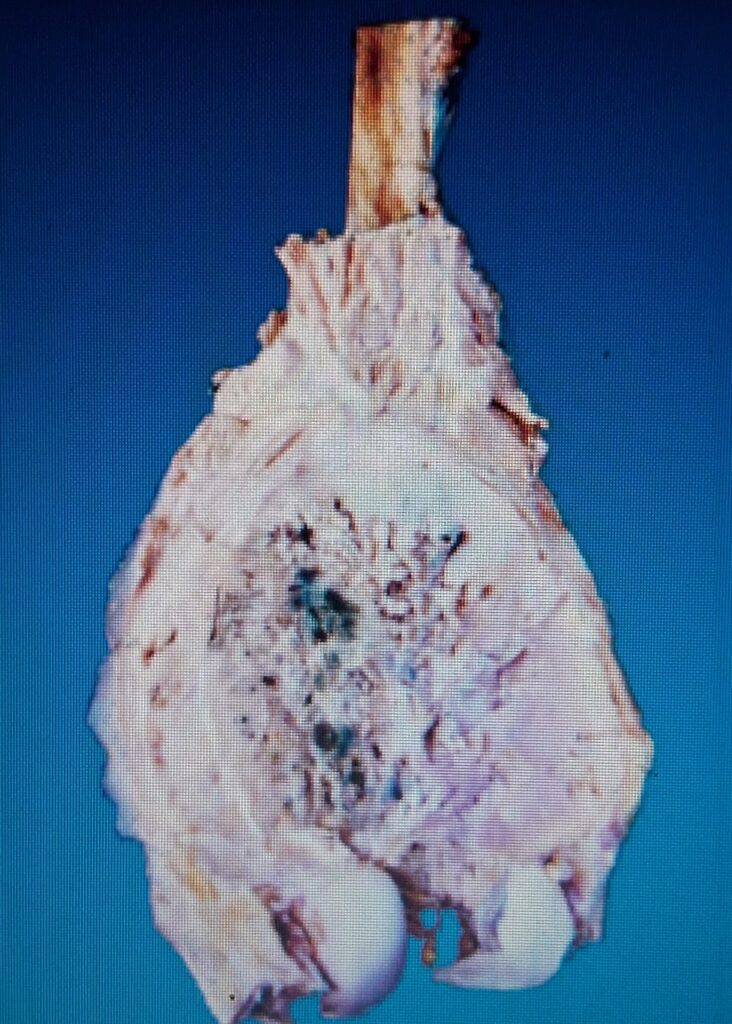
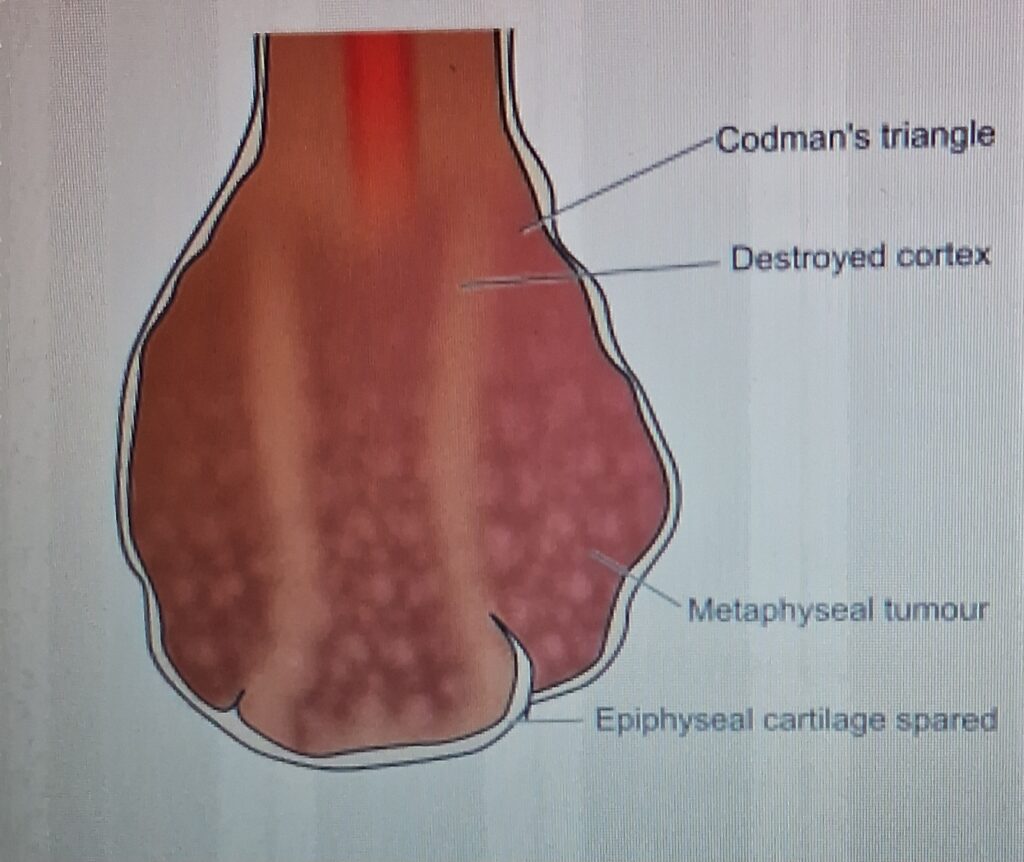
Osteosarcoma or osteogenic sarcoma is most common primary malignant tumour of bone. The tumour is characterised by formation of osteoid or bone, or both, directly by sarcoma cells
The tumour is thought to arise from the primitive osteoblast-forming mesenchyme. Depending upon their locations within the bone, osteosarcomas are classified into 2 main categories: central (medullary) and surface ( parosteal and perosteal)
- ย

Central (medullary)
This is the more common and classic type and is generally referred to as โosteosarcomaโ if not specified. The tumour occurs in young patients between the age of 10 and 20 years. Males are affected more frequently than females.
A few histologic variants of usual osteosarcoma have been described as under:
- Telangiectatic osteosarcoma. The tumour in this variant presents with pathological fractures. The tumour has a large, cavernous, dilated vascular channels. This variant has a more aggrieve course
- Small cell osteosarcoma. This variant has small, uniform tumour cells just like the tumour cells of Ewingโs sarcoma or lymphoma but osteogensis by these tumour cells is the distinguishing feature.
- Fibrohistiocytic osteosarcoma. This variant resembles malignant fibrous histiocytoma but having osteogenesis by the tumour cells.
- Anaplastic osteosarcoma. In this variant, tumour has so marked anaplasia that it may resemble any other type of pleomorphic sarcoma and is identified by presence of osteoid formed directly by the tumour cells.
- Well-differentiated osteosarcoma. Although generally classic form of osteosarcoma is a highly malignant tumour, rarely a well-differentiated variant having minimal cytologic atypia resembling parosteal osteosarcoma may be seen.
- ย
Surface ( parosteal and perosteal).
About 5% of osteosarcomas occur on surface of bone and are slow-growing tumor compared to medullary osteosarcomas. Surface osteosarcoma includes 2 variant: parosteal and periosteal.
Parosteal or juxtacortical osteosarcoma
- It is an uncommon form of osteosarcoma having its origin from the metaphysis
on the external surface of the bone (parosteal or juxtacortical means outer to cortex). - The tumour occurs in the older age group, has no sex predilection and is slow
growing. - Its common locations are metaphysis of long bones, most frequently lower end of the femur and upper end of the humerus. X-ray examination usually reveals a dense bony mass attached to outer cortex of affected long bone.
- It is an uncommon form of osteosarcoma having its origin from the metaphysis
Periosteal osteosarcoma
- Periosteal osteosarcoma is a rare form of osteosarcoma that arises between the cortex and the overlying periosteum
- Its common location is the diaphysis of the tibia or the femur.
Recent Post
Long wave diathermy
Long wave diathermy What is Long wave diathermy?ย Long wave diathermy (LWD) is a deep heating modality that produces high frequency electromagnetic waves of theย frequency
10 Knee Ligament : Attachment & Function
10 Knee Ligament: Attachment & Function Introductionย The knee is one of the strongest yet most vulnerable joints in our bodyโand its stability depends heavily
BPT course fees in India
Bpt course fees in India If you’re a Class 12 student exploring a career in healthcare, you’ve likely come across BPT โ Bachelor of Physiotherapy.
BPT Course After 12th: Colleges , Fees , Subjects .
BPT Course After 12th: Colleges , Fees , Subjects Are you passionate about healthcare and recently the 12th pass out. Then the BPT course (Bachelor
Gout Symptoms and Foods to Avoid
Gout Symptoms and Foods to Avoid ย Gout is a condition when your small joints have severe pain ,swelling and inflammation. Gout is caused by
Pain in the back of the Head : Common reasons and When to worry
Pain in the back of the Head : Common reason to and When to worry Pain in the back of the head, can be alarming