
Food
Table of Contents
Food
WE SPEND a number of hours each day to plan, purchase, prepare and enjoy food. A large part
of our income is utilised to purchase food for the family. Therefore, it is important to understand
personal preferences in food, for without attention to the sensory aspects of food, there can be no true enjoyment of it. Let us consider the factors which affect our food acceptance.
Colour in Food
Colour affects our acceptance of food. It is said we eat with our eyes, because the first impression of foods is formed by its appearance, which includes colour, shape and aroma. The initial attraction or rejection of food depends on its looks.
The colour of food is one way to judge quality of food. For example, a green colour is associated with
unripe fruit such as mango or orange, a brown banana is thought to be spoilt. In food purchase, colour is used as an important criteria of quality of food. For example, mature ripe mangoes have orange yellow colour. Hence, if the colour is not always a true indicator of quality. Some varieties of orange have a green colour even when these are mature, while orange coloured fruit may have sectionIt is observed that fruit preserve and vegetable pickles darken during storage, which are not juicy.
It is observed that fruit preserve and vegetable pickles darken during storage. Such darkening is
caused by oxidative changes. These changes can be minimised by reducing the oxygen in the top of the container by heat before sealing it. The presence of traces of metals such as iron, tin and copper, in foods also causes darkening and needs to be avoided.
Colour added to foods:
- Colouring materials used in foods belong to two groups—natural colouring material and synthetic coal-tar dyes.
- Some of the natural colouring matters, which we use in food preparation, are turmeric and
saffron. In addition to these, other natural colouring substances used in food preparations are annato, betain, caramel, carotene and chlorophyll.
Texture in Foods
Each food has a particular texture that we associate with it. Thus well-cooked rice is soft, potato
wafers are crisp and cucumber slices has a crunchy texture. We learn about foods texture very early in our eating experience.
A variety of qualities are included in texture, such as, crisp, soft, hard, sticky, elastic, tough,
gummy or stringy. If there is change in accepted, characteristic texture, we find the food unacceptable.
Thus we reject tough beans, hard rice, lumpy upma, and fibrous vegetables, because their texture is unlike the texture we associate with these food. On the other hand, we enjoy crisp toast, soft velvety halwas, flaky pastry and sticky jalebi. The textural qualities of food depend on ingredients, their proportion, the manner in which these are combined and the method of preparation.
Cereals: Texture is developed with meticulous care in cereal preparations such as chapati, bread, and cake. In preparation of chapati, we knead dough and set it aside for a few minutes to obtain a soft velvet textured chapati. In preparation of bread, dough is allowed to ferment after mixing with yeast, punched to ensure even, sponge-like structure. In making cakes, the sugar and fat are creamed, the flour is sifted to incorporate air, and mixed with the creamed sugar to obtain the desired structure, when baked.
Meal: As you know the texture of meat depends on the part of the animal from which the cut is
taken, age of the animal and method of preparation and the duration. The meat cuts with low content of connective tissue, can be cooked by dry methods, such as roasting or shallow frying. But meat cuts, which have a large amount of connective tissue, are prepared by use of moist methods of preparation, such as pressure-cooking, boiling or stewing, to make these cuts tender.
The texture of meat is very easily determined by number of times one needs to chew and how hard one has to bite to cut the piece. If it takes long to chew meat, it is a tough product. It is possible to improve texture of meat by treating tough meat with chemical tenderizers. These help to break down connective tissue partially and thus improve the texture of the product.
Flavour in Food
Flavour is the sum-total of sensory impression formed, when we eat food. It includes the
aroma, the taste and even the texture, and thus involves all our senses. It is most important aspect of food, which decides our choices of food. While an appropriate colour and texture may induce us to sample a foods, whether we will eat more of it, depends on its flavour. Thus flavour of food is as
important a quality as its nutritional composition.
- Odour:
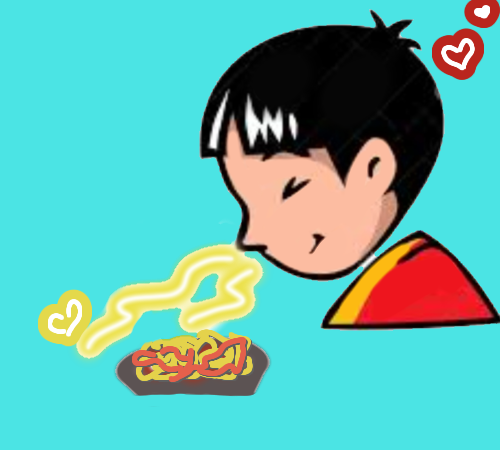
The odour or smell of food influence our food acceptance. The aroma of ripe mango attracts us, while smell of overripe fruit repels us. The substances, which are responsible for odour of food, are volatile, which means these evaporate and form vapours easily. The odours are carried by the air to our nose, and are transmitted by special nerves (olfactory nerves) to our brain. You can get odour even before you eat the food; you also perceive the odour when you eat food.
The odour affects our acceptance of foods, depending on whether it is liked or not. The primary odour are sweet or fragrant, sour or acid, burnt and rancid. You may have noticed that our sense of smell is far more acute than the sense of taste. Therefore anything that affect its function, impairs our enjoyment of food. For example, if you suffer from a cold, your sense of smell is impaired and you find that food does not taste as good as when you are well. Similarly, the function of sensory organs is impaired with age, which results in decreased enjoyment of food by the aged person.
- Touch:
The sense of touch contributes to our perception of foods. It identifies the textural qualities
of the food, such as softness and hardness. Similarly, we perceive the crisp, the crunchy or sticky texture by touching the food. When the touch conforms to the textural profile of the food in our memory, it enhances the anticipation and enjoyment of food. If it does not create a favourable image, we hesitate to taste the food. For example, a slimy touch indicates spoilage, be it a carrot or a bread slice.
- Taste:
Taste sensations are sum-total of the sensations created by food when it is put in the mouth. The sensation of taste is perceived when taste receptors (taste buds) are stimulated.
The food must be dissloved in liquid to enable us to perceive its taste. Hence we have to masticate dry foods such as roasted groundnuts mix these with saliva, so that we can taste these. We can perceive taste of liquids, such as tea, sherbet or lassi, immediately, as these can stimulate taste buds as soon as we drink these.
There are four primary taste sensations—sweet, sour, salty and bitter. The taste of the food is
determined by its chemical composition. Sugars present in food or added to foods are responsible for sweet taste, while salty taste is due to salts present in foods or added to food. Sour or acid taste is
contributed mainly by organic acids found in foods (such as citric acid in limes), added to foods (such as tamarind extract added to dal) or developed in food (lactic acid formed when milk is made into curd.
Flavouring Substances
Salt: Salt is the most widely used condiment. It is one of the few pure chemicals used in food preparation. It is obtained by evaporation of the sea water. It is used to season all food preparation except sweets. It is used in foods preservation to make pickles, chutneys and sauces. Salt has the unique property of enhancing the flavour of herbs and spices in food preparations.
Acids: tamarind, Lemon juice, cocum, amchur and vinegar are the acid substances very commonly used in Indian home. Lemon juices is used in salads and savoury preparations such as upma, batatepohe, bhel, etc.
Tamarind is soaked and the acid extract thus obtained is used in sambar, rasam, puliyore (tamarind rice), and many other vegetable preparations in the southern parts of India. In western India, where ratambi (the fruit from which cocum is made) is available, cocum is used in food preparation. Vinegar is dilute acetic acid. It is used to flavour salads, pickles, and sauces. Amchur, made from raw mangoes, is also used in some preparations to impart acidic taste.
Herbs and Spices: India is known as the ‘Home of Spices’. Spices and herbs form an indispensable part of our cultural food pattern. These impart a subtle flavour to foods. Their presence is evident by their irresistible aroma, which whets our appetite. They add zest to otherwise insipid foods. Hence these are the most important group of flavouring materials in the Indian cuisine.
Flavouring Extracts: Flavouring extracts are obtained from spices by extraction with alcohol, steam distillation or by expression in a press. These are normally solutions of the essential oils in alcohol. These are best stored in a cool place in tightly stoppered containers. As these are concentrated solution of flavour, very minute amount is needed to be added to impart the desired flavour. Some of the flavouring extracts available include ginger, cardamom, saffron, vanilla, orange, cinnamon, etc.
Use of Spices and Flavourings: These are added to food normally towards end of preparation. There is no set proportion, which is acceptable to all, as individual variation in tolerance to these is very great.
Spices may be used in the whole or powdered form. Whole spices are usually added to hot oil as a seasoning, before being dispersed in the food preparation. Oil acts as a solvent for the flavour components present in the spices. Ground spices may be added to the food directly, e.g., pepper, jeera
powder, spice mix, etc.
Use of Food in the Body
The use of food in body involves three processes — digestion, absorption and utilisation of nutrients in the body
Digestion is the process, which releases many nutrients in forms ,body can use, by breaking up food in the intestinal tract
Absorption is a process which carries these nutrients into circulation system and delivers them to cell.
Utilisation- Cell is functional unit of life. Hence a large number of the chemical reactions in cell utilise the nutrients absorbed to produce materials needed for our existence.
Mechanical processes involved in digestion include chewing of foods, swallowing of food, churning action in the stomach and rhythmic contraction of intestinal tract.
Chemical reactions in digestion process: The first reaction is hydrolysis or splitting with help of water. Carbohydrates, fats and proteins break up with addition of water into smaller molecules, which the tissues can use
Food Composition
Most food contain more than one nutrient. The nutrient contents of foods have been determined by analysing these in laboratory. The composition of over 650 Indian food has been determined. Of these, the nutritive value of about 160 foods is presented in Appendix F
The food composition tables give concentration of nutrients in 100 g of the edible portion (E.P.) of the food. Therefore it is important to know how much of food purchased is edible. In some food, such as milk, butter, sugar, the edible portion is 100 per cent. In fruits and vegetable, it varies from 65 per cent in bananas to 98 per cent in tomatoes.
The values for nutrients given in food composition tables are averages of results obtained by analysing a large number of samples of each food. Therefore figures in such tables give a fairly good idea of the composition of each food.
Foods are grouped in food value tables, on the basis of plant part from which the food is derived, for example, seeds, roots, leaves, fruits, etc. Animal foods are grouped on the basis of species and product used.
Indian Council of Medical Research published as the Nutritive Value of Indian Foods, by the Indian Council of Medical Research (ICMR). A number of new varieties of food with high contents of certain nutrients, have been developed at research centres under the auspices of Indian Council of Agricultural Research. You get a number of these foods in market and use these in your dietary. The nutritive value of these new varieties of food need to be included in the book on Nutritive Value of Indian Foods. There are two International Food Value tables published by the Food & Agriculture Organisation (FAO) (please refer to these books, which are listed in Further Reading at the end of this book).
Functions of Food
Physiological functions of food
The first function of body is to provide energy. The body needs energy to sustain involuntary processes essential for continuance of life, to carry out professional, household and recreational activities, to convert food ingested into usable nutrients in body, to grow and to keep warm. The energy needed is supplied by oxidation of the foods consumed
The third function of food is to regulate activities of body. It includes regulation of such varied activities as:
- Beating of the heart
- Maintenance of the body temperature
- Muscle contraction
- Control of water balance
- Clotting of blood
- Removal of waste products from the body
The fourth function of foods is to improve our body’s resistance to disease
The Social Functions of Food
Food has always been a central part of our social existence. It has been part of our community, social, cultural and religious life. Special food are distributed as a benediction or prasad in religious functions in homes, temples and churches.
laddus are associated with celebration of Deepavali and marriages, cakes are associated with Christmas and birthdays and tilgul with sankranti the festival of friendship .As food is an integral part of our social existence, this function is important in our daily life. Refreshments served at get-togethers or meetings create a relaxed atmosphere.
The Psychological Functions of Food
Sharing of food is token of friendship and acceptance. In a friendly gathering, we try unfamiliar food and thus enlarge our food experiences. It must be noted that even a nutritionally balanced meal may not be satisfying to individual if the foods included are unfamiliar or distasteful to him/her. With time and repeated experience, strange food become familiar and new taste are formed.