Goniometry of elbow joint

Table of Contents

Type of joint: Hinge joint (engagingly) with one degree of freedom allowing
for flexion and extension

Capsular pattern: Flexion > extension

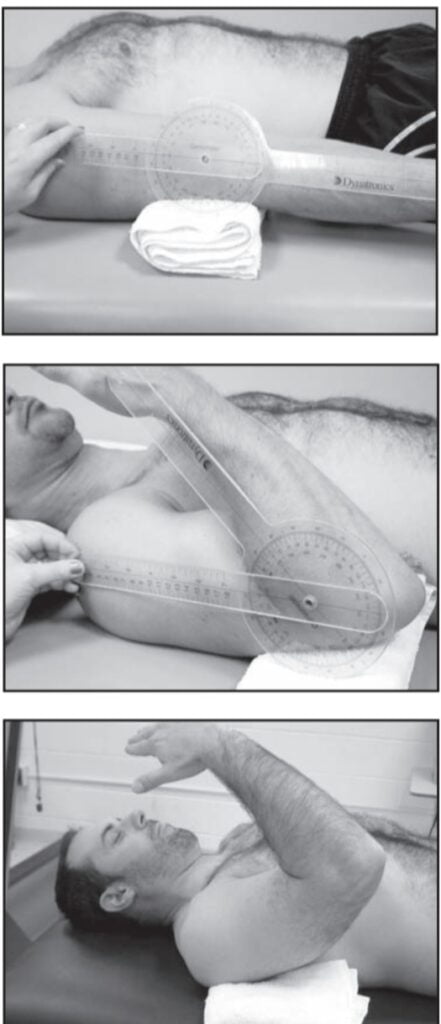
Elbow Flexion

Planes/axis of movement: Motion occurs in the sagittal plane around a
coronal axis.

Range of motion:

0 degrees to 145 degrees

Goniometric alignment:

Axis: Over the lateral epicondyle of the humerus

Stationary arm: Align along the lateral midline of the humerus, siting
the acromion process

Moving arm: Align along the lateral midline of radius, siting radial styloid

Stabilization:

The distal end of humerus should be stabilized against supporting surface to prevent shoulder flexion.

goniometry of elbow joint

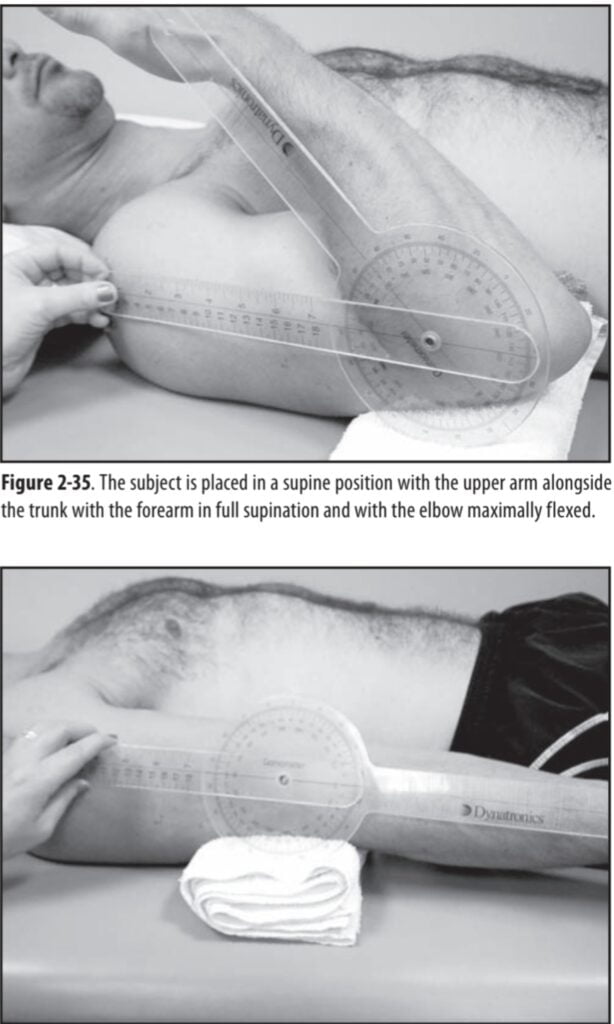
Elbow Extension

Planes/axis of movement: Movement occurs in sagittal plane around
a coronal axis.

Range of motion:

145 degrees to 0 degrees

Goniometric alignment:

Axis: On the lateral epicondyle of the humerus

Stationary arm: Align along the lateral midline of the humerus, siting
the acromion process

Moving arm: Align along lateral midline of radius, siting radial styloid.

Stabilization:

The proximal humerus should be stabilized anteriorly by the
clinician’s hand to the prevent scapular protraction and trunk extension.

Substitutions:

The subject may try to extend the trunk to enhance the
motion or move shoulder into flexion or extension to avoid pain with
testing

Elbow Extension

Forearm

Type of joint: The proximal radioulnar joint may be considered alone as a
uniaxial pivot joint with one degree of freedom.

Capsular pattern: Pronation = supination.

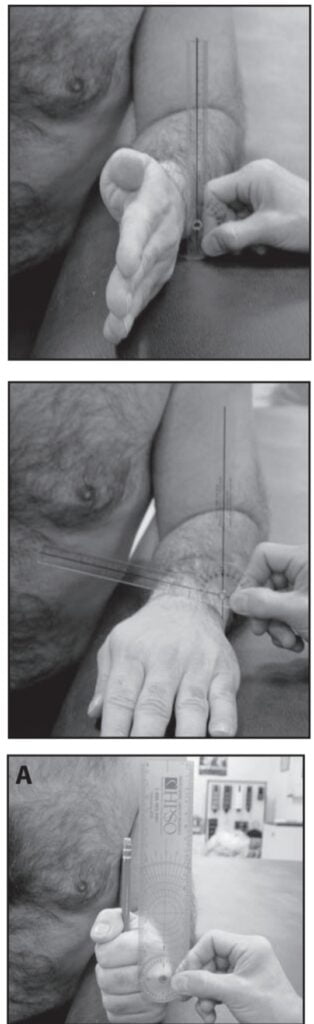
Forearm Pronation

Planes/axis of movement: Motion occurs in transverse plane around a
longitudinal axis in the anatomical position. Motion occurs in the frontal
plane while in the preferred testing position.

Range of motion:

0 degrees to 90 degrees

Goniometric alignment

  • Axis: Lateral to the ulnar styloid
  • Stationary arm: Align parallel to the anterior midline of the humerus
  • Moving arm: Align across dorsal aspect of the wrist, proximal to the
    styloid process of the ulna and radius

Stabilization:

The distal end of humerus must be stabilized on supporting surface to prevent internal rotation and abduction at the shoulder
joint. The subject may use the non tested hand to keep the humeral shaft
against the thorax

Substitutions:

The subject may try to laterally flex the trunk away from the
tested side or abduct/internally rotate the shoulder to increase the amount
of range of motion.

Goniometric alignment for alternate method:

  • Axis: The third metacarpal head, siting through the third metacarpal
    shaft
  • Stationary arm: Align perpendicular to the table surface
  • Moving arm: Align parallel to the midline of the pencil
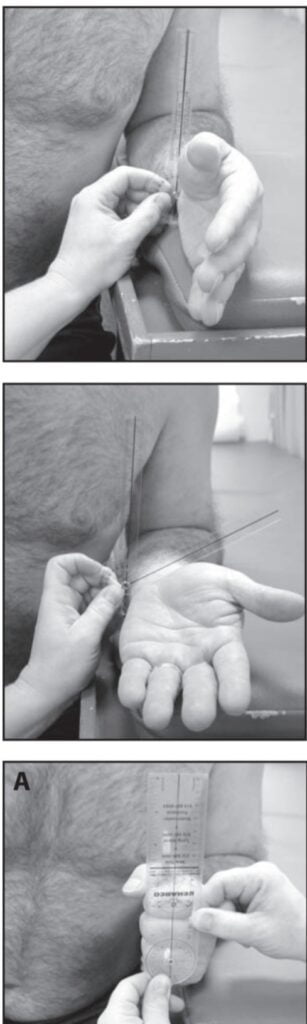
Forearm Pronation

Forearm Supination

Planes/axis of movement: Movement occurs in the transverse plane
around a longitudinal axis in the anatomical position. Motion occurs in the
frontal plane while in the preferred testing position.

Range of motion:

0 degrees to 90 degrees

Goniometric alignment:

  • Axis: Center medial to the ulnar styloid process
  • Stationary arm: Align on the anterior surface of the wrist parallel to the
    anterior midline of the humerus
  • Moving arm: Place on ventral surface of wrist, just proximal to styloid process of ulna and radius

Stabilization:

The humerus must be stabilized on a supporting surface to prevent external rotation of shoulder. The subject may use the non tested hand to keep humeral shaft against thorax.

Substitutions:

The subject may try to use shoulder external rotation to
avoid a painful motion. The examiner may also observe the subject laterally
flexing to tested side or extending elbow to obtain more movement.

Goniometric alignment for alternate method:

  • Axis: The third metacarpal head, siting through the third metacarpal
    shaft
  • Stationary arm: Align perpendicular to the table surface
  • Moving arm: Align parallel to the midline of the pencil
Forearm Supination

Recent Post