
No One Talks About Menopause
Aarushii,29
I’ve always been very affected by hormones. I used to have bad premenstrual symptoms such as cramps when I was younger. I had postpartum depression. So, when the frequency of my period started to change. I was worried. I asked my gynecologist if it would affect my ability to intimate, and she said, “You might notice vaginal changes and less eagerness to get intimate, but I can’t say for sure, because everyone is different.”
I’d notice vaginal dryness but the doctor recommended a treatment, which really helped.
There have certainly been times when I’ve lost interest in getting intimate, despite my husband’s affection and patience. He is really understanding, though, and empathetic to my moods. We’ve built deep compatibility over the decades and menopause has only strengthened our relationship. I’m lucky, as I’ve seen a side of him that’s even more compassionate.
Ciru, 48
It began with terrible headaches. I feel dizzy whenever I have my period. Then came the hot flashes and sweats. I can’t wear too many clothes now, because I get hot and my face turns red. All things considered, My symptoms aren’t quite as bad as a few of my friends who soak right through their clothes!
We talk about these things among ourselves, but never with our families. I can’t remember my mother ever mentioning menopause-she was always so busy that it probably never even crossed her mind. We indeed never discussed it.
As a little girl, I heard people saying with age they become unreasonable and hysterical, and I knew periods stopped around then. My flow got much lighter- but the rest all came as a surprise.
I have much less energy these days and get annoyed very easily, but I try to keep my emotions under control. To be honest all I really want to do is rest. I don’t enjoy new Year, buzzing noise in my head when the TV is too loud. I sometimes feel hot and suffocating.
I’m less sociable now. I don’t see as many of my friends and rarely go out. I’m more distant on the phone too. I take longer to reply to messages and sometimes don’t respond at all. I prefer my own company these days.
Some Real Stories of Women
Real stories always help a lot to understand than anything theoretical. By 2025, the number of women who experienced menopause is expected to rise to 1.1 billion worldwide. May these words inspire others to live their fullest lives . Before starting with these all stories are from a book called “The Next Chapter “ compiled by Karuna Ezara Parikh, Iris Epstein, Juliana Resebde, and Abby Young. I hope these stories give a clear insight about menopause
Major issue: Knowledge Gap
There are many women aren’t well informed about the symptoms, the physical changes, the medical concerns, or their treatment options. This information gap has been created by a toxic combination of medical provider being unable to meet the educational needs of their patient due to long history of neglecting women. Consequently, women have tier symptoms and health concerns related to menopause dismissed as being fabricated, unimportant, or just “part of being a woman”—Meaning something to endure.
In a variety of shows and books where the character had her period or wrested with bras but no such show or book talks about menopause issues. Nowaday period is well know and informed subject in every age group of people but a part of the other side is menopause is still unknown by us. We need to understand that as the period is a daunting period similarly a stressful period in women’s lives is menopause too.
Word has the POWER to convert any possible situation into a negative or positive . Every word gives us some feeling whether it is good or bad. The first issue is the pause, which in today’s world feels negative which gives a societal view that women should hold back. The term menopause came before we knew about hormones. It was never meant to signify pause. This doesn’t mean that changing a word will change a woman who has hot flushes or vaginal dryness but perhaps when a society publicly embraces menopause as a change rather than a dreadful disease, there are downstream effects. Imagine a situation where man’s erectile dysfunction related to age is said to be erectopause? Right.
It’s clear that many women want to talk about the change happening to their bodies from the first period of pregnancy to their last menstrual cycle.
“
God gave us the blessing to give birth so, it should never be an issue to talk about all the aspects of women’s lives. Women are the only species who are capable of giving birth happily facing all the changes in body. Don’t be embrace to talk speak up your problem find your solution.
“
Signs of menopause
- Abnormal menstrual bleeding (heavy and/or irregular periods bleeding in between periods)
- Hot flushes occur at any time of day and night
- Night sweats
- Sleep disturbance
- Temporary cognitive changes
- Vaginal dryness causes itching, burning and dyspareunia
- Pain with sex
- Decreased Libido
- Joint pain
- Sleep disorder or insomnia in both peri and post menopause
- Muscle pain
- Backache
- Sexual disorder
- Lack of concentration
- Fatigue
- Skin becomes thinner and wrinkled as its elasticity decreases.
- Nervousness
- Aggressiveness
- Irritability
- Depressive mood
- Anxiety and depression
- Low sexual desire
Menopause And Post-menopause
Final Menopause period (FMP) marked menopause –at this point, there are one hundred to one thousand primordial follicles remaining and they’re incapable of ovulation. For much time it isn’t possible to know which period is the final one until it is final; menopause is formally confirmed 12 months after FMP.
Post-menopause is the phase after the final menstrual cycle.
“
Researchers said that the ovary after menopause is also involved in hormone production to a lesser degree. This isn’t because some of the follicles have gone, the ovarian stroma (the actual tissue of the ovary) is able to make a hormone precursor called androstenedione that can be converted by other tissue into estrogen and testosterone.
“
Menopause Transition
Menopause transition duration varies from women to woman. African, American women tend to have longer menopause transitions, although the age of menopause is the same. It is divided into two phases: early and late. The major difference between the two phases is a change in the length of the menstrual cycle.
During the early phase, a women have her cycle lengthen by seven or more days whereas the late transition is characterized by more skipped periods meaning 60 days between the menstrual cycle. When any woman has 2 skipped periods there is a 95% chance that her final menstrual period will be within the next four years.
Physiologically: In the ovary, the primordial follicles themselves may be aging or the follicles that remain are not healthy. There is age-related reduction in the blood flow to the ovary, which affects the ability to produce hormones.
“
Some changes in brain signaling are in response to what is happening with hormone production in the follicles. Basically, it is a very complicated process involving multiple mechanisms.
“
What happens inside the body during menopause?
Menopause is a condition when there is no egg left in the ovary and one of the most important hormones, estrogen, progressively decreases in the body as the follicles are the main source of estrogen. It’s this drop in estrogen that causes the symptoms and medical concerns unique to menopause; however, new research suggests that other hormone changes are also important in these changes.
There are three stages: Menopause transition, Final Menopause period (FMP), Post-menopause
Medically speaking, the menopause transition is the time leading up to FMP, and FMP marks as menopause, and everything after is called post-menopausal.
“
Menopause results from a complex interaction between neuroendocrine changes that take place in the brain and reproductive hormones that help the ovaries function.
“
What is Menopause?
Menopause occurs when there are no more follicles (eggs) in the ovaries capable of ovulating meaning there are no more eggs for ovulation.
Menopause is expected in fifty to fifty-two years. It was conceived by Dr. Charles De Gardanne, a French physician, in 1812 who started with the word menopause, a combination of mines, from Greek for month, and pause, from the Greek for cessation.
In 1821, De Gardanne updated this term to “menopause”.This word has nothing to do with men but it’s very important to learn about this aspect of life.
“
Menopause results from a complex interaction between neuroendocrine changes that take place in the brain and reproductive hormones that help the ovaries function.
“
Table of Contents
How to manage Menopause Symptoms?
The first measure to take is to change lifestyle such as regular exercise, weight loss, and avoiding hot drinks and alcohol.
Slow and deep breathing has a positive impact. Some people believe that yoga and homeopathic therapy help but there is no evidence showing that it is effective for perimenopause symptoms.
Menopausal Hormone Therapy (MHT)
In women with frequent and severe hot flushes and night seats. MHT is the most efficient treatment available by Cochrane analysis published in 2004. Oral and transdermal 17beta-oestradiol are equally efficient in treating severe hot flushes. The estrogen dose recommended to treat perimenopause symptoms should be given to minimize side effects and risks.
Tibolone
A sexual steroid is efficient in reducing Perimenopause symptoms which works good alternative to MHT in women suffering from Menopause Translation. The daily dose is 2.5mg, though it is not that much effective than combined MHT. Tibolone prevents fragility fractures. If it is taken after menopause there are some incidences vaginal bleeding, so do not use it after menopause.
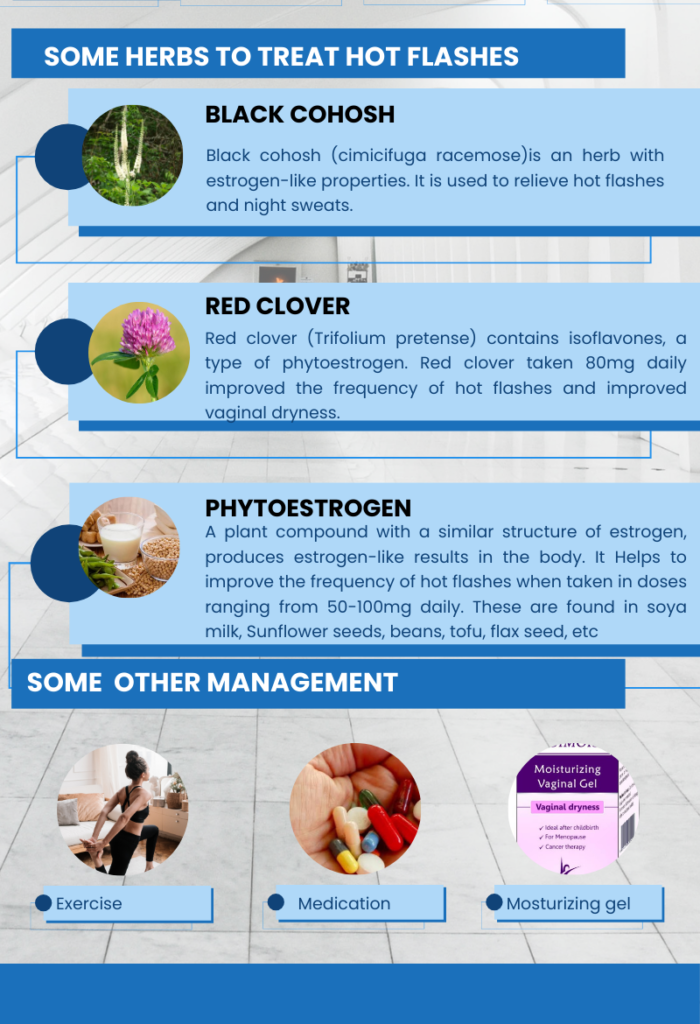
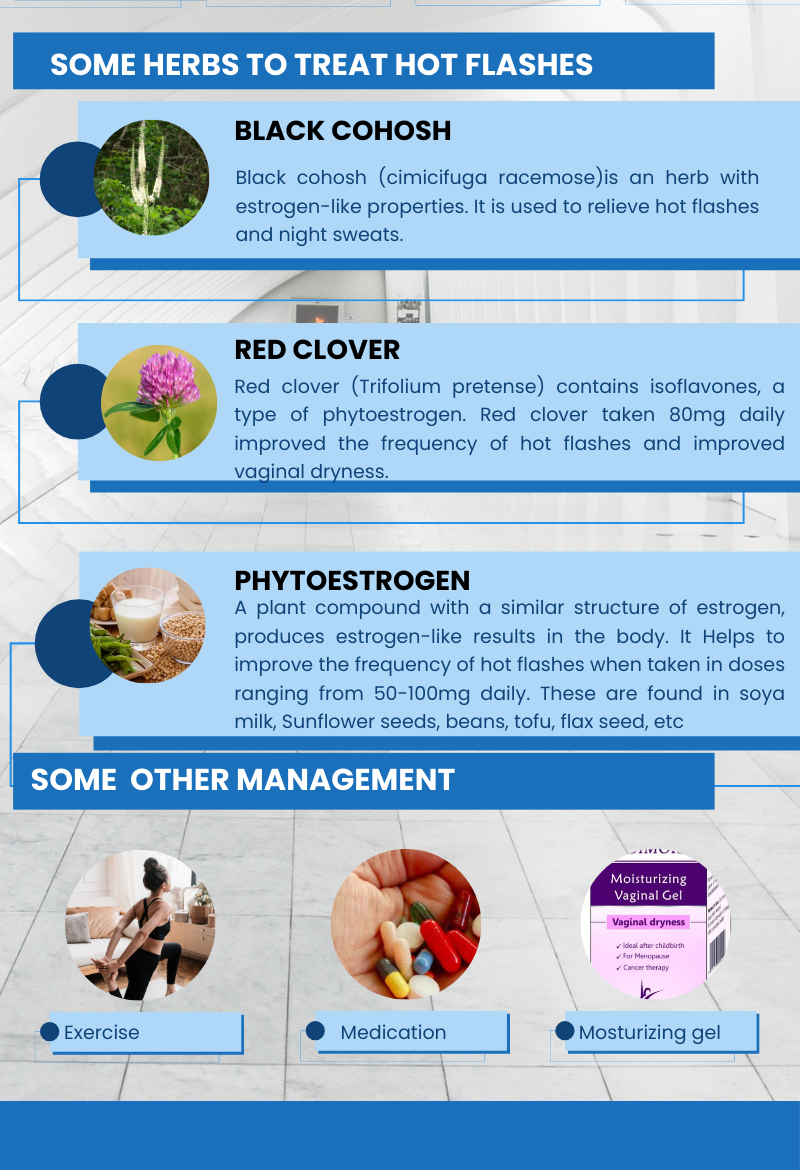
Black cohosh
Black cohosh (cimicifuga racemose)is an herb with estrogen-like properties. It is used to relieve hot flashes and night sweats. It works as mood stabilization and work as anti inflammatory properties that may help reduce inflammation. There is some side effects seen in the small number of women who have experienced liver problems while taking for prolonged use. If it is used for longer than 6 months has not been well-studied.
- Red clover (Trifolium pretense)
Red clover (Trifolium pretense) contains isoflavones, a type of phytoestrogen. A systematic review of 10 trials concluded that red clover taken 80mg daily improved the frequency of hot flashes and improved vaginal dryness. The side effects are rare.
Phytoestrogen
A plant compound with a similar structure of estrogen produces estrogen-like results in the body. It
Helps to improve the frequency of hot flashes when taken in doses ranging from 50-100mg daily.
Other herbal product
For herbs such as St.John’s wort, ginseng, Gingko Biloba, and dong quai, are Chinese herbs used widely by among Chinese.
Regular exercises
Though exercises do not have a direct impact on hot flashes it give a positive impact on good sleep and mood. Comfort sleep helps in a good mood which enhances the confidence level. Examples are high-intensity exercise ( Brisk walking, Swimming, Static cycling, Dancing, and weightlifting. )
Prescription medication
As soon as you feel some Perimenopause symptoms then consult a medical professional. Before using any medication consult a doctor, some common drugs prescribed by them are clonidine, gabapentin, a selective serotonin, reuptake inhibitor, or a serotonin-norepinephrine reuptake inhibitor (SNRI).
Vaginal Moisturizers
Decrease in estrogen levels in perimenopause cause vaginal dryness leading to irritation and painful intercourse. Many products and interventions can help such as vaginal moisturizers. Women should massage the product once a day for five minutes. Waiting two to four weeks after starting a vaginal moisturizing regimen may be necessary before resuming sexual intercourse.
Life Style Modification
Every day how you behave, pattern, and choose impact the way you feel. Be careful about what you use and misuse such as tobacco, drugs, and excessive alcohol intake. Support a healthy sleep–walk cycle and use light, loose-fitting clothing in layers to adjust to changing body temperatures. Try to use various methods of coping with stress like coping techniques, relaxation exercises, and mind-body practices.
Spirituality
Explore helpful things like meditation, chanting, or connecting with religious or spiritual communities. This helps these women in this phase of life meaning and purpose which give them