
Vegetarian and Non-Vegetarian
Table of Contents
Vegetarian Dietary Patterns
The word vegetarian is derived from Latin root ‘vigitore’, meaning giving strength and health.
According to the Concise Oxford Dictionary, a vegetarian is one, who uses or advocates the use of a diet of vegetable foods, usually with the addition of milk, eggs, to the exclusion of meat. A person, who includes an animal food such as milk in the diet, cannot be a vegetarian, in the strict sense of the word. Thus the word vegetarian, as used for the traditional Indian dietary, is a misnomer; and creates unnecessary misunderstanding about its identity and nutritional quality.
In recent years, there has been an increase is followers of vegetarian dietary pattern in the Western countries, as mentioned earlier. As a result; number of variations of vegetarian dietary
pattern have emerged. These fall into the following five groups:
- Lactovegetarians are those, who include milk and milk products, in addition to plant foods,
such as cereals, dals, vegetables ,legumes, and fruits in their diet. - Ovolactovegetarians include eggs, milk and milk products, in addition to all the foods mentioned
in (a) above. - Ovo-vegetarians include eggs, in addition to the plant foods.
- Fruitarians include grains, nuts and fruits, i.e., the parts of plants, which are obtained
without destruction of the plant itself - Vegans include only plant food in their diets, and abstain from all animal foods, even milk and milk products.
Non-Vegetarian Dietary Patterns
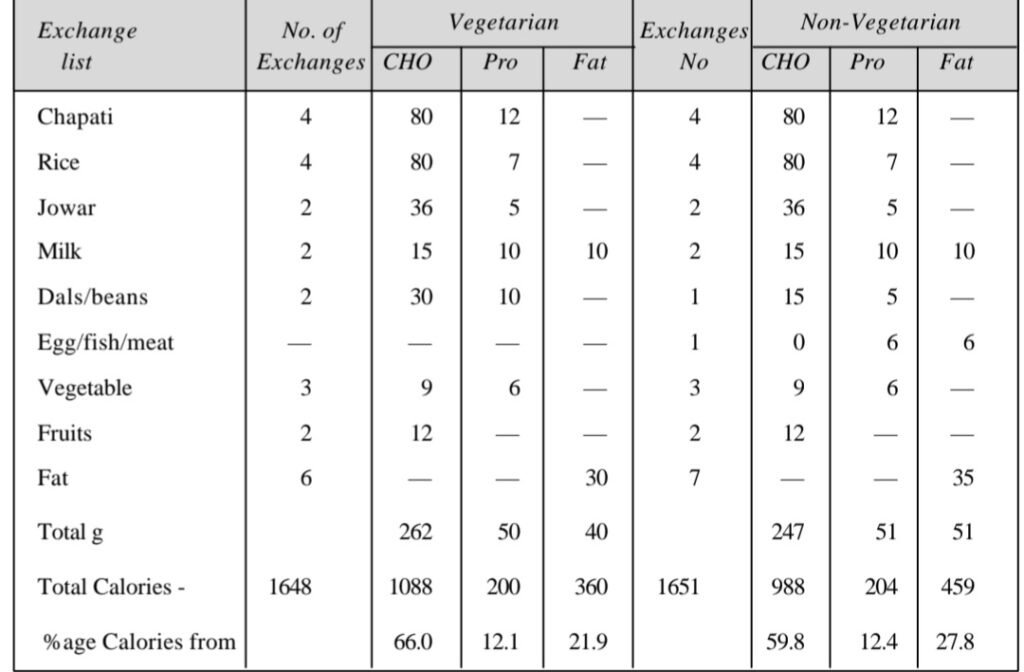
- It is good to remember that there are two distinct patterns of non-vegetarian diet observed around
the world. The first is the Indian non-vegetarian pattern, which has a cereal preparation as a main course with fish, poultry or meat dish as an accompaniment, in addition to vegetables, dal/pulse preparation and salad. - The fish or meat are served one to three times a week in meal. The amount of fish, poultry or meat served in such a diet is naturally smaller than when these foods are served as the main course.
- The second non-vegetarian pattern is that which is followed in Western countries such as U.K., U.S.A., Canada and Europe, which has meat, fish or poultry dish as the main course, with preparation of cereals, vegetables, fruits, as accompaniments to the main protein course.
- In such a meal, the animal foods such as chicken, fish or meat roast form the main course in each meal and thus are eaten at least twice a day.
- The total amount of animal protein consumed is several time that included by those, who follow traditional Indian non-vegetarian meal pattern, though both are designated as non-vegetarian dietaries.
Nutritional Adequacy of Indian Diets
Dietaires made up of predominantly plant foods, can be nutritionally adequate, if these are derived from natural foods belonging to the basic five groups, and meet the energy needs of the individual.
The Sherpas (in Himalayan expeditions), who follow a non-flesh dietary pattern, have demonstrated that their dietary is adequate to prepare them to endure the most severe stress that can be laid on human body-extreme altitude, almost unbearable cold, supreme endurance and elephantine strength.
The myths about magical qualities of proteins, especially animal proteins, have been perpetuated for generations. It is important to take stock of the hard facts about overconsumption of proteins, especially in the form of animal foods.
The dietary goals for the U.S.A. and U.K. have emphasised the need to reduce the animal foods, saturated fats and sugar in the diet, and increase the intake of whole grain unrefined cereals, vegetables and fruits in the diet
Plant foods are high in complex carbohydrates, which according to the U.S. dietary goals, need to be increased to account for 55–60 per cent of the total energy intake.
Animal foods such as fish meat, and eggs do not contain any carbohydrates
Important Nutritional Aspects of our Dietary Pattern
- chapaties, phulkas, or puri
- whole jowar, bajra, makka or ragi
- Idli, dhokla, curds, buttermilk and lassi,
- sarson-ka-sag (mustard greens) in Punjab, aluchee bhaji (colocaisa leaves) in Maharashtra and keere sambar (leafy vegetable soup) in Tamil Nadu.
- koshimbir, raita or bharta.