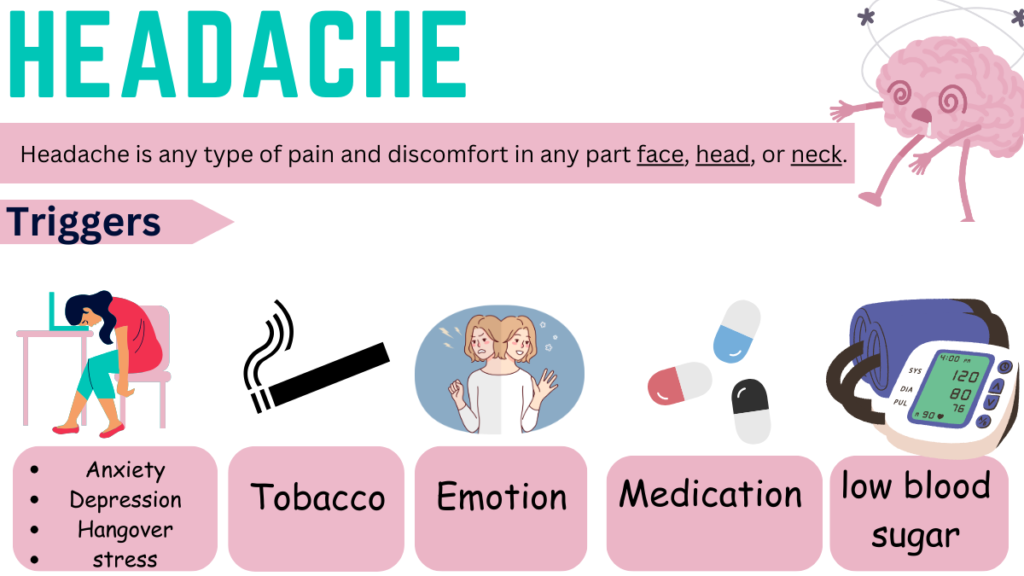
Pain can be caused due to different causes:
Migraine
Tension headaches
Cluster headaches
Epidemiology
Lifelong the total number of individuals with headaches is 96%, with a female predominance. The tension-type headache in individuals is approximately 40% and migraines 10%. Migraine occurs most commonly between ages of 25 and 55 years and is 3 time more common in females.
Trigeminal autonomic cephalgia is rare compared with migraine and tension-type headaches. The most common trigeminal autonomic cephalgia is cluster headache, with a population prevalence of 0.1% and a male/female ratio of 3.5-7:1.
Types of headache
Part one: the primary headaches
1. Migraine
2. Tension-type headache
3. Trigeminal autonomic cephalalgias
4. Other primary headache disorders
Part two: the secondary headaches
Introduction
5. Headache attributed to trauma or injury to head and /or neck
6. Headache attributed to a cranial or cervical vascular disorder
7. Headache attributed to non-vascular intracranial disorder
8. Headache attributed to substance or its withdrawal
9. Headache attributed to infection
10. Headache attributed to disorder of homeostasis
11. Headache or facial pain attributed to a disorder of cranium, neck, eyes, ears, nose, sinuses, teeth, mouth, or other facial or cervical structure
12. Headache attributed to psychiatric disorders
Part three: painful cranial neuropathies, other facial pain, and other headaches
13. Painful cranial neuropathies and other facial pain
14. Other headache disorders
Migraine
Migraine is a type of headache characterized by recurrent attacks of moderate to severe throbbing and pulsating pain on one side of the head. The pain is caused by the activation of nerve fibers within wall of brain blood vessels traveling inside the meninges (three layers of membranes protecting the brain and spinal cord).
The factor that trigger migraine headaches are as follows:
- Sudden changes in weather or environment
- Too much or not enough sleep
- Strong odors or fumes
- Emotion
- Stress
- Overexertion
- Loud or sudden noises
- Motion sickness
- Low blood sugar
- Skipped meals
- Tobacco
- Depression
- Anxiety
- Head trauma
- Hangover
- Some medications
- Hormonal changes
- Bright or flashing lights
Who will have migraine headaches more?
Adult women are more likely to have migraine-type headache which is often related to changes in hormones. The headaches may begin at the start of first menstrual cycle or during pregnancy. Most women see improvement after menopause, although surgical removal of ovaries usually worsens migraines. Migraine also sufferers have a family history of the disorder.
Tension headache
Tension-type headache is second most common headache type after migraine.
Cause: Tension headaches occur when face, neck, shoulder, and scalp muscles become tense or contract. The muscle contractions can be response to stress, head injury, depression, or anxiety.
Other triggers of tension headaches include:
- Physical or emotional stress
- Alcohol
- Caffeine (too much or withdrawal)
- Colds, the flu, or a sinus infection
- Dental problem such as jaw clenching or teeth grinding
- Eye strain
- Excessive smoking
- Fatigue or overexertion
Who will have Tension headaches more?
Tension headaches are most common in adults and older teens. It’s slightly more common in women and tends to run in families.
Cluster headache
Cluster headaches mainly occur in nose, eyes, and face with unilateral temporal or periorbital pain, Headaches often recur at the same time each day during the cluster period, which can last for weeks to months.
The various trigger cluster headaches:
- Alcohol use or smoking cigarettes.
- Change to a high altitude.
- Bright light.
- Exercise or exertion.
- Heat, either weather or a bath.
- Foods that contain nitrate, such as bacon or lunch meat.
- Cocaine use
Who will have cluster headaches more?
Cluster headache is more prevalent in men and typically begins between 20 and 40 years. Alcohol triggers cluster headaches which is more likely consumed by males( 54% versus 48% ).
Diagnosis
Various tests used to find the cause of a headache may include:
- Blood test
- MRI ( Magnetic resonance imaging)
- Sinus x-ray
- CT -scan
Treatment
Treatment is done according to the assessment and diagnosis by the doctor.
Migraine and cluster headaches may need specific medicine managements including:
Abortive medicines. Medicines prescribed by your healthcare provider act on specific receptors in nerves and blood vessels in head to stop a headache in progress.
Rescue medicines. Medicines bought over-the-counter, such as pain relievers, to stop headache.
Preventive medicines. Medicines prescribed by your healthcare provider are taken daily to reduce the onset of headaches.
Sometimes these headaches need immediate medical attention including hospitalization for observation, diagnostic testing, or even surgery. Full recovery depends on type of headache and other medical problems that may be present.