
Kidney

Table of Contents

Definition 

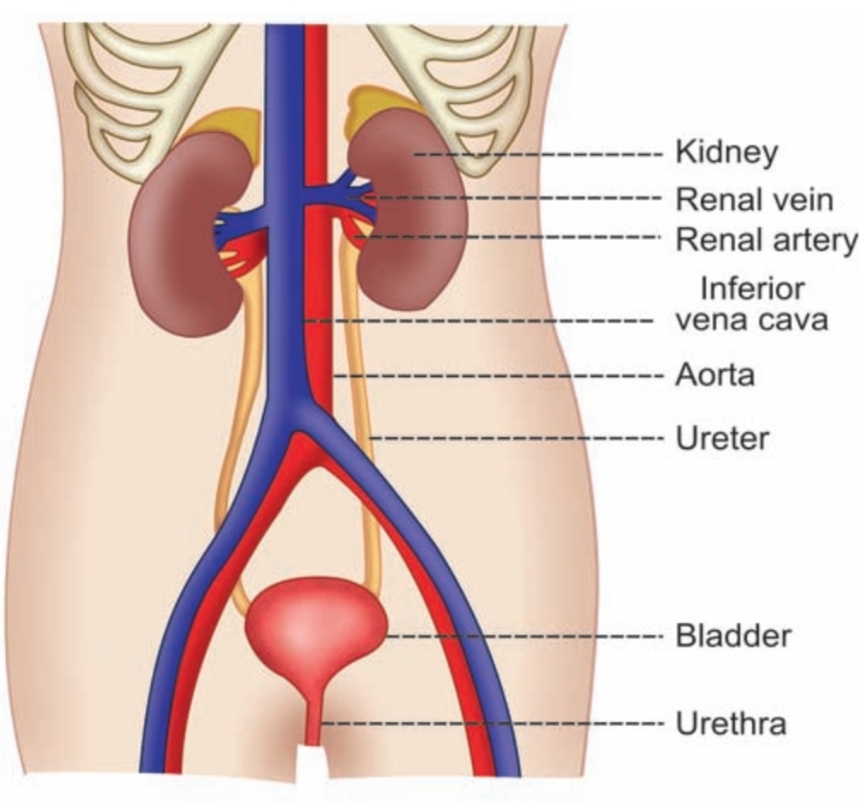
The kidney is the organ of body which helps to produce urine. Ureters transport the urine to urinary bladder. The urinary bladder stores urine until it is voided (emptied). Urine is voided from bladder through urethra .

Structure of Kidney

Structure of kidney

Kidney is a bean shape, reddish brown and retro peritoneal organ of body.

Length : 10 cm - 12 cm

Breath: 5 cm -7 cm

Thickness : 2 cm -3 cm

Weight : 120 g – 170 g

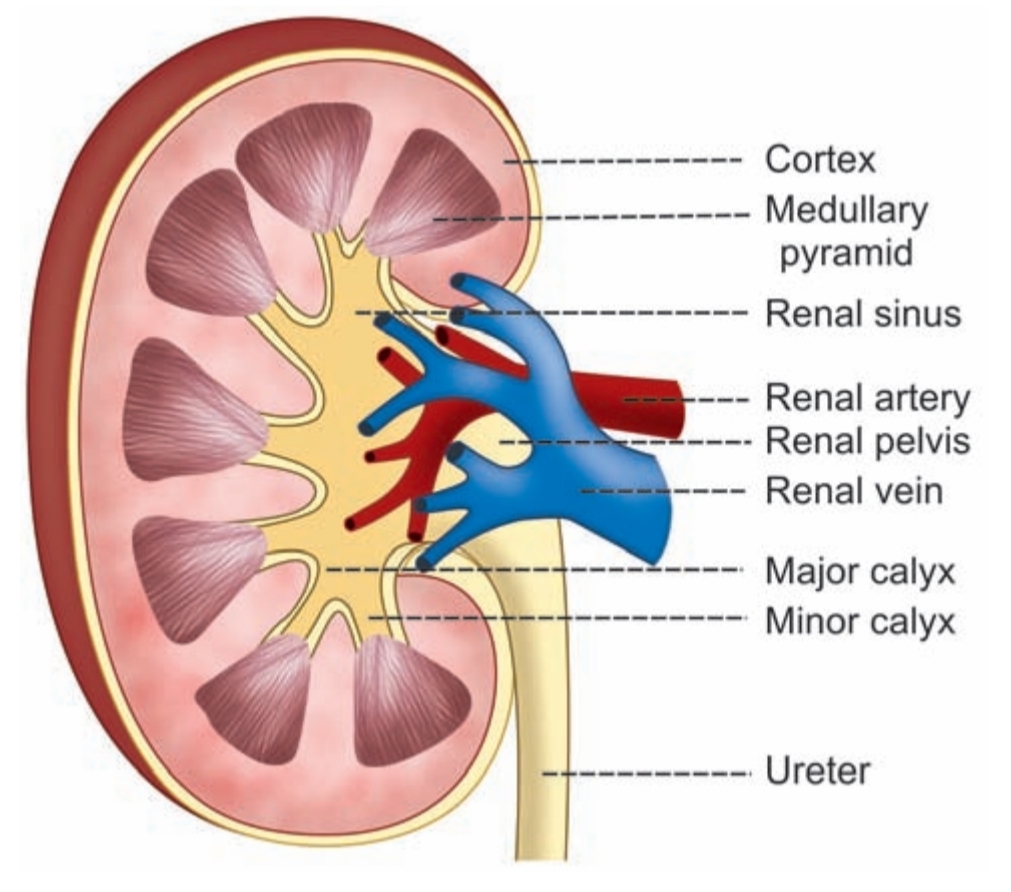
There is a depression on  medial border of kidney called hilum, through which renal artery, renal veins, nerves and ureter pass.

Layers of kidney

    • 1. Outer cortex

Cortex is dark and granular in appearance. It contains renal corpuscles and convoluted tubules. At intervals, cortical tissue penetrates medulla in form of columns, which are called renal columns or columns of Bertini.

    • 2. Inner medulla

The medulla contains tubular and vascular structures arranged in parallel radial lines. Medullary mass is divided into 8 to 18 medullary or Malpighian pyramid. A broad base of each pyramid is in contact with the cortex and the apex projects into a minor calyx.

    • 3. Renal sinus

Renal sinus consists of the following structures:

i. Upper expanded part of ureter called renal pelvis

ii. Subdivisions of the pelvis: 2 or 3 major calyces and about 8 minor calyces.

iii. Branches of nerves, arteries, and tributaries of veins

iv. Loose connective tissues and fat.

Blood vessels in the kidney

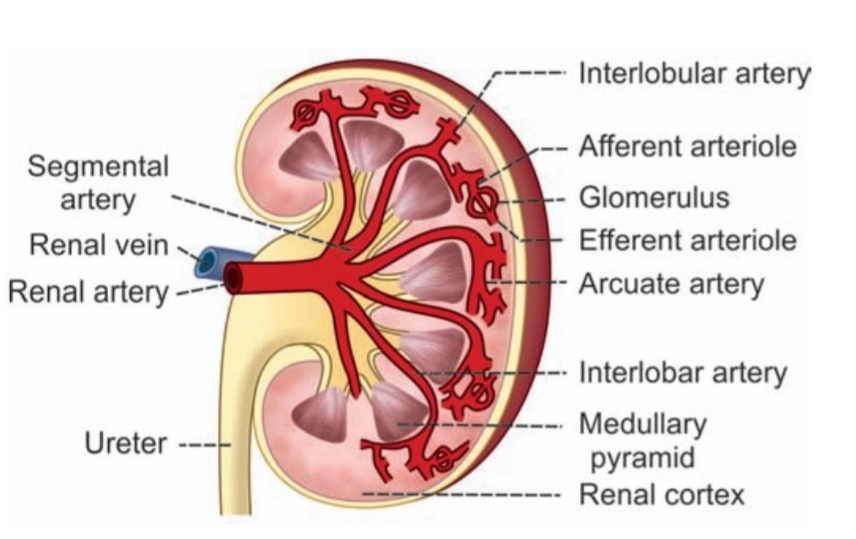
In adults, during resting conditions both kidneys receive 1,300 mL of blood per minute or about 26% of the cardiac output.

Renal blood vessels :
  • Renal Artery
  • Segmental Artery
  • Interlobar Artery
  • Arcuate Artery
  • Interlobular Artery
  • Afferent Arteriole
  • Glomerular Capillaries
  • Efferent Arteriole
  • Peritubular Capillaries and Vasa Recta
  • Venous System

Functions of Kidney

    • In Homeostasis

The primary function of kidneys is homeostasis. The formation of urine accomplishes it. During the
formation of urine, kidneys regulate various activities in body, which are concerned with homeostasis such as:

i. Excretion of Waste Products

Kidneys excrete unwanted waste products, which are formed during metabolic activities:

a. Urea (end product of amino acid metabolism)

b. Uric acid (end product of nucleic acids metabolism)

c. Creatinine (end product of metabolism in muscle)

d. Bilirubin (end product of hemoglobin degradation)

e. Products of metabolism of other substances.

Kidneys also excrete harmful foreign chemical substances such as toxins, drugs, heavy metal
pesticides, etc.

ii. Maintenance of Water Balance

Kidneys maintain water balance in body by conserving water when it is decreased and excreting water when it is excess in the body.

iii. Maintenance of Electrolyte Balance

Maintenance of electrolyte balance, especially the sodium is in relation to water balance. Kidneys retain sodium if osmolarity of body water decreases and eliminate sodium when osmolarity increases.

iv. Maintenance of Acid-Base Balance

The pH of blood and body fluids should be maintained within a narrow range for healthy living. It is
achieved by the function of the kidneys.

    • Hemopoietic function

Kidneys stimulate production of erythrocytes by secreting erythropoietin. Erythropoietin is the important stimulating factor for erythropoiesis. Kidney also secretes another factors called thrombopoietin, which stimulates the production of thrombocytes

    • Endocrine function

Kidneys secrete many hormonal substances in addition to the erythropoietin and thrombopoietin

    • Regulation of arterial blood pressure

By two ways

i. By regulating volume of extracellular fluid

ii. Through renin-angiotensin mechanism.

    • Regulation of blood calcium level

Kidneys play role in regulation of blood calcium level by activating 1,25 dihydroxycholecalciferol into vitamin D.

Leave a Reply

Your email address will not be published. Required fields are marked *