
Top 8 Fine Motor Skills
Table of Contents
What is Fine Motor Skills ?
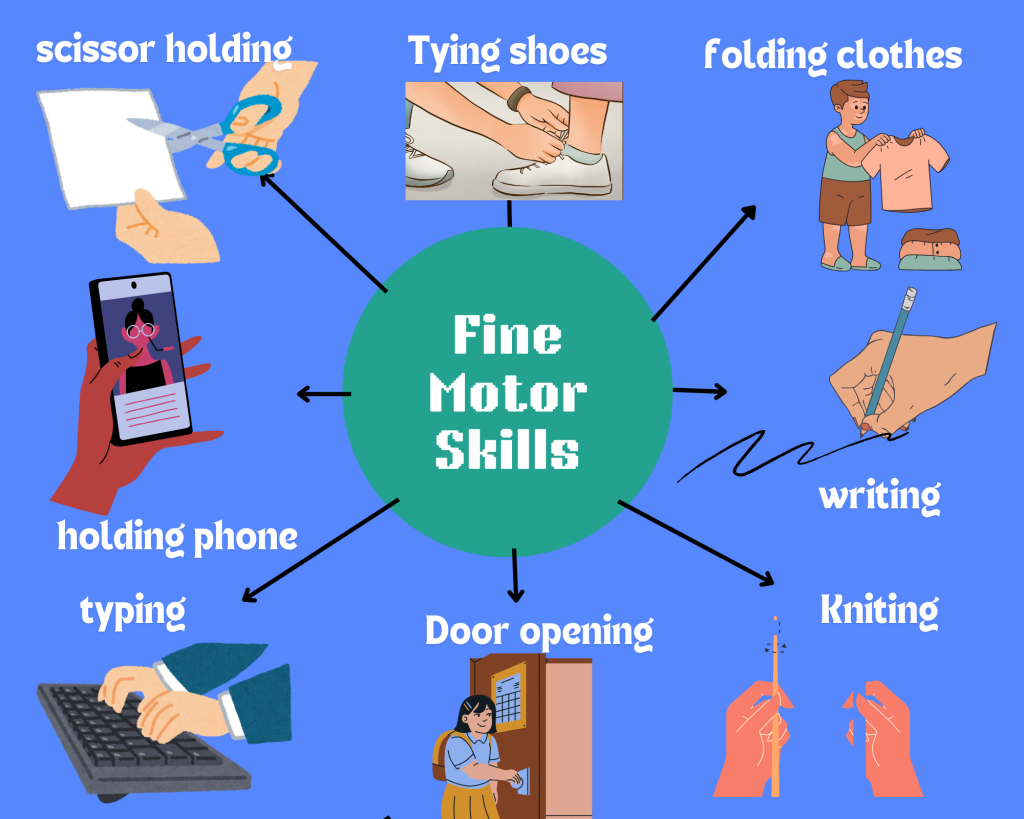
Fine Motor skills are the ability to perform key skills with your small muscles of body such as pencil grasp ,scissor skills ,set-up of desk/chair ,size and orientation to the line etc.
Examples of Fine Motor Skills
- Holding a pencil
- Writing or drawing
- Using scissors.
- Folding clothes.
- Typing on a keyboard.
- Fastening a button.
- Zipping a zipper.
- Tying your shoes.
- Twisting a doorknob.
How fine motor skills is impaired ?
Fine Motor skills are impaired majorly due to underline cause of brain-based motor disorder. It affects gross and fine motor skills, , and coordination.
Diseases causing Fine motor dysfunctioning are as follows :
- Dyspraxia
- Acquired brain injury.
- Cerebral Palsy.
- Developmental Co-ordination Disorder.
- Developmental Delay.
- Down’s Syndrome.
- Hydrocephalus (child)
- Multiple Sclerosis.
- Muscular Dystrophy.
Assessment of Fine Motor Skills
Assessment of Fine Motor Skills include the Motor Right Along Assessment, the McMaster Handwriting Assessment and the Beery-Buktenica Developmental Test of Visual Motor Integration (Visual Motor Integration, Visual Perception and Motor Coordination sub-tests).
What are the type of testing used for fine motor skills ?
The test used to evaluate the fine motor skills of upper extremities functioning , they help to analyse skills grasping :
Nine Hole Peg Test (NHPT)
The Nine-Hole Peg Test (NHPT) is used to measurer the ability to use finger in neurological disease .
Equipment used during Nine hole peg test :
- The wood or plastic equipment used with 9 holes (10 mm diameter, 15 mm depth), placed apart by 32 mm or 50 mm.
- A square box (100 x 100 x 10 mm) apart
- 9 pegs (7 mm diameter, 32 mm length)
- Stopwatch.
Method
Instruct the patient to take peg one by one from container and place them in the holes of board as fast as possible , then instruct the patient to remove the peg from board . The instructor should start the stopwatch as soon as he touch the peg and stop the stopwatch as soon as he complete the task .
Scoring
- The number of seconds it takes for patient to complete the test.
- Results are expressed as number of pegs placed per seconds.
Recent Post