
Herpes virus

Table of Contents

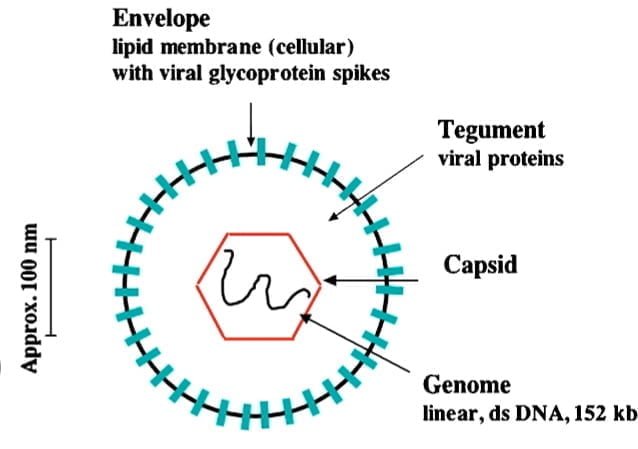
Β The herpes virus capsid is icosahedral. It is the composed of 162 capsomeres and encloses core containing a linear double-strandedΒ DNAΒ genome.

Family of herpes

Herpes family is subdivided into :

  • Alpha herpes viruses
  • Beta herpes viruses
  • Gamma herpes viruses

The herpes virus family has no common group antigen and the different herpes virus species do not show any significant antigenic cross-reaction, except between herpes simplex type 1 and 2.

Alpha herpes viruses

Alpha herpes viruses relatively short replicative cycle (12-18 hours), a variable host range, and a tendency to cause latent infection in sensory ganglia . In the culture, they are rapidly cytopathic, and infectious viruses may be released from the cells.

Beta herpes viruses

Beta herpes viruses replicate slowly (more than 24 hours),it have a narrow host range and grow best in fibroblasts with a tendency to produce enlargement of the infected cell. In culture, the cytopathic effect is slow and the virus remains cell-associated, for example, cytomegalovirus.

Gamma herpes viruses

Gamma herpes viruses have a narrow host range, replicate in lymphoblastic cells, are specific for B or T lymphocytes, and frequently cause latent infection in lymphoid tissue. For example: the Epstein-Barr virus.

Β Herpes simplex

The herpes simplex virus (HSV)

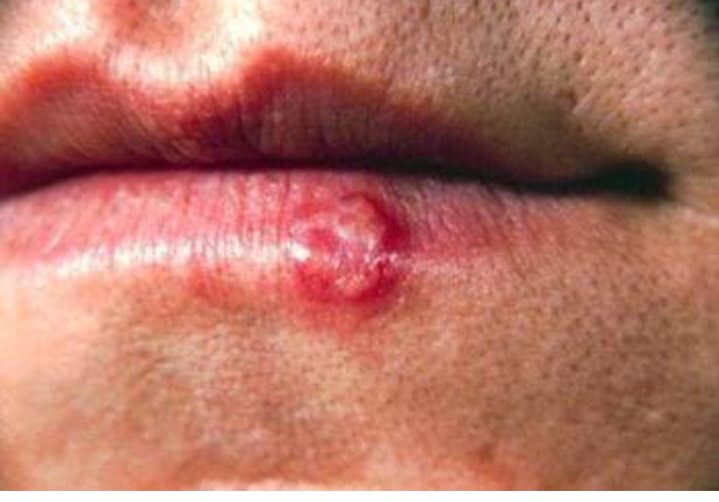
  • Type 1 (HSV-1)
  • It causes vesicular lesions on the skin, fever blister lips, and oral mucous membranes.
    • The infection spreads by close contact.
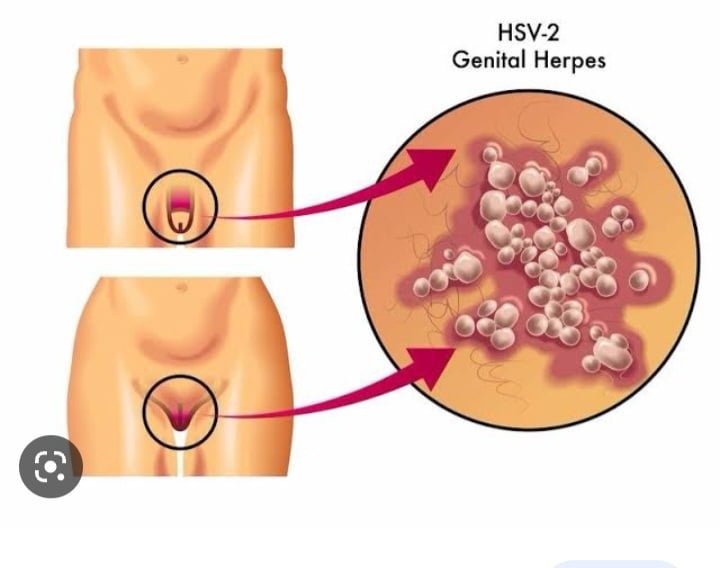
  • Type 2 (HSV-2)
  • It causes herpes genitals characterized by vesicular and necrotizing lesions on the cervix, vagina, and vulva.
  • The latency of HSV -2 infection is similar to HSV -1 and the organism is reactivated by stimuli such as menstruation and sexual intercourse.

Β  Β  Pathogenesis of Herpes

Humans are the natural hosts and the various sources of infection are saliva, akin lesions, or respiratory secretions. Transmission occurs by close content and may be general in genital herpes.

The virus enters through defects in the skin or mucous membranes and multiplies locally, with cell-to-cell spread. The virus enters the cutaneous nerve area with widespread ulceration.

Β  Β Laboratory diagnosis of Herpes

The diagnosis of herpes virus infection may be made by microscopy, antigen or DNA detection, virus isolation, or serology

herpes virus
Structure of Herpes simplex
herpes
Type 1 (HSV-1)
virus
Type 2 (HSV-2

Microscopy

Microscopy is a rapid, sensitive, and inexpensive diagnostic method. The smears are prepared from the lesions, preferably from the base of the vesicle and stained with 1 % aqueous solution of toluidine blue ‘0’ for 15 seconds. Multinucleated giant cells with faceted nuclei and homogeneously stained ‘ground-glass’ chromatin constitute a positive smear. Intranuclear type A inclusion bodies may be seen in Giemsa-stained smears.

The virus particle may also be demonstrated under electron microscope. it is not possible to differentiate between herpes simplex and varicella zoster by microscopy. The herpesvirus antigen may be demonstrated in smears or sections from lesions by fluorescent antibody technique. PCR-based DNA detection has replaced brain biopsy.

Virus isolation

In this method, vesicle fluid, spinal fluid, saliva, and swabs may be used. The Typical cytopathic changes appear as early as 24 – 48 hours but before 2 weeks cultures should be observed and declared negative.

Serology

Serological methods are useful in diagnosis of primary infections.Β 

Chemotherapy

  • Eye and skin infections – Idoxuridine
  • Deep and systemic infection – acyclovir and vidarabine
  • In oral and topical uses – valaciclovir and famciclovir

Herpesvirus similar : B virus

This virus was isolated by Sabin and Wright (1934) from the brain of a laboratory worker who developed fatal ascending myelitis after being bitten by a healthy monkey. it came to be known as the ‘B’ virus from the initials of this patient. the official name for B virus is cercopithecine herpesvirus 1 . Herpes virus similar infects old world monkeys in the same manner that herpes simplex infects humans, the infection is asymptomatic. The infection cases by monkey bites. Herpes virus is similar to herpes simplex virus in its properties. the two are antigenically related but the herpes simplex virus antibody does not protect against herpesvirus infection.

Recent Article post