
Wrist joint

Type of joint: This joint is classified as a condyloid joint with two degrees
of freedom (flexion and extension, radial and ulnar deviation). The articulation of the proximal and distal rows of metacarpals are of the same classification and also allow for flexion and extension.

Capsular pattern: Equal restriction of all motions

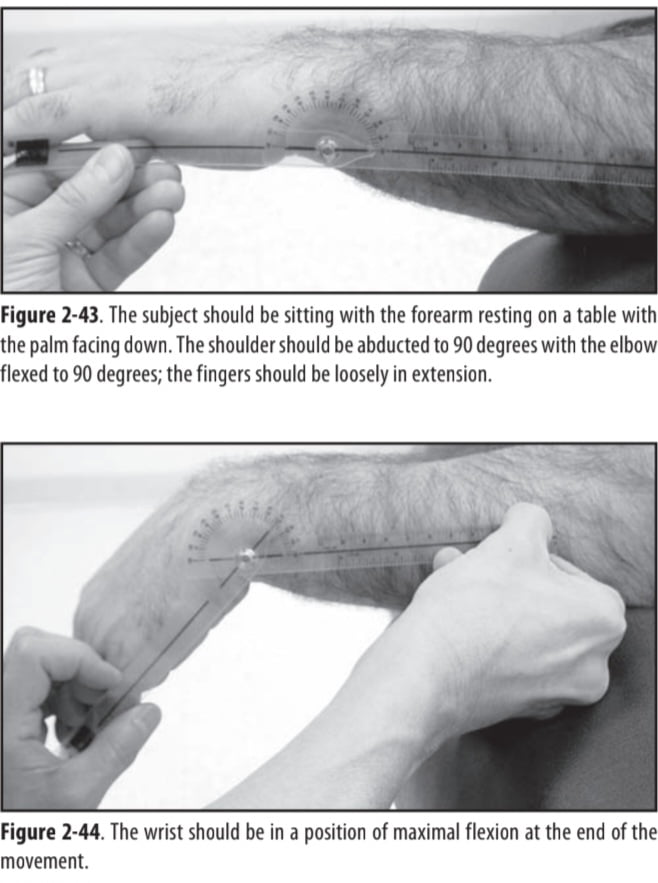
Wrist Flexion

Planes/axis of movement: Motion occurs in the sagittal plane around a
coronal axis primarily at the radiocarpal joint. Flexion also occurs at the
midcarpal joint to a lesser degree, while the proximal row of carpal bones glide posteriorly on the distal end of the radius.

Range of motion:

  • 0 degrees to 50 degrees (at the radiocarpal joint)
  • 0 degrees to 35 degrees (at the midcarpal joint)
  • 0 degrees to 90 degrees (from anatomical position)
Goniometric alignment:
  • Axis: Center over the lateral aspect of the wrist, just distal to the styloid
    process of the ulna
  • Stationary arm: Align with the lateral midline of the ulna, siting the
    olecranon process
  • Moving arm: Align with the lateral midline of fifth metacarpal bone

Stabilization: The forearm should be stabilized on a supporting surface .

Substitutions: The examiner must watch to make sure the forearm stays down on the table and the wrist does not drift into ulnar/radial deviation to avoid pain or gain more flexion.

Wrist flexion

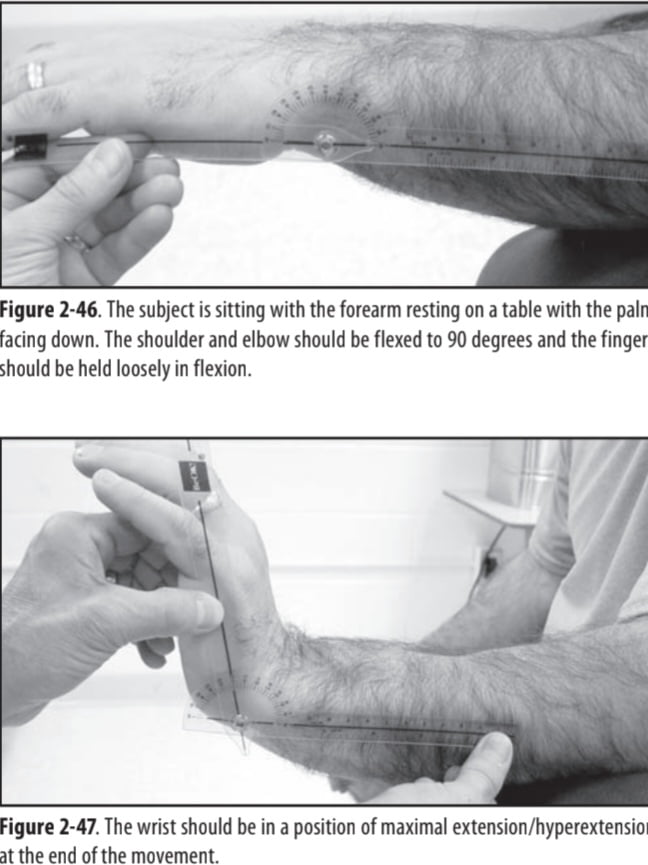
Wrist Extension

Planes/axis of movement: Motion occurs in the sagittal plane around a
coronal axis at both the radiocarpal and midcarpal joint, with extension
occurring more extensively at the latter.

Range of motion:
  • 90 degrees to 0 degrees (from full flexion)
  • 0 degrees to 70 degrees (hyperextension)
Goniometric alignment:
  • Axis: At the lateral aspect of the wrist, just distal to the ulnar styloid
  • Stationary arm: Align with the lateral midline of the ulna, siting the
    olecranon process
  • Moving arm: Align with the lateral midline of the fifth metacarpal bone.

Stabilization: The forearm should be stabilized against a supporting surface.

Substitutions: The examiner should watch to make sure the forearm does not rise off the table or the wrist does not drift into ulnar/radial deviation to avoid a painful movement or to gain more extension.

Wrist Extension

ย 

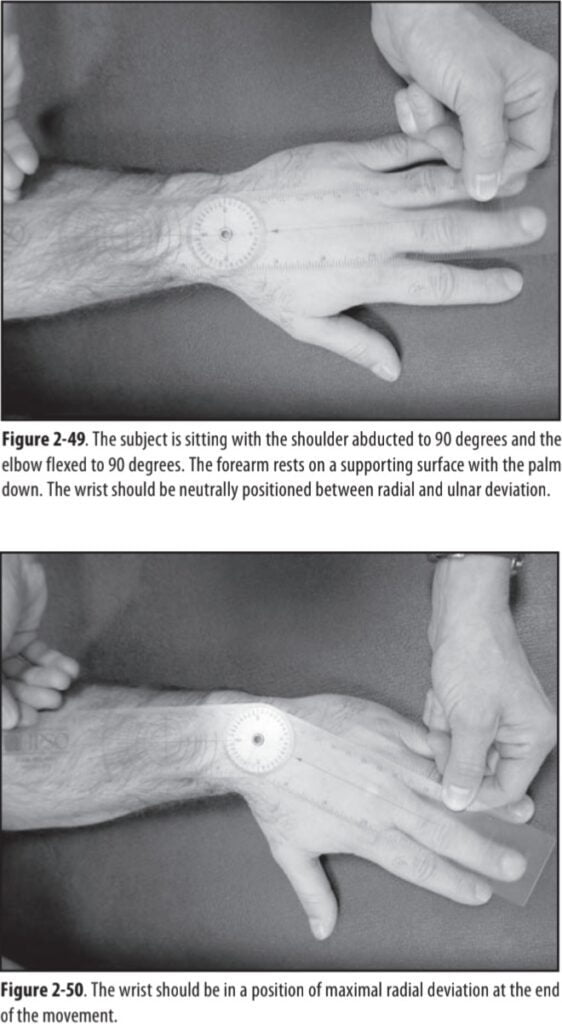
Wrist Radial Deviation

Planes/axis of movement: Motion occurs in frontal/coronal plane in
the anatomic position around an anterior/posterior axis. In the testing
position, motion occurs in the transverse plane around a vertical axis. The motion occurs between the radiocarpal joint and the intercarpal bones

Range of motion:

0 degrees to 25 degrees

Goniometric alignment:
  • Axis: Align over the middle of the dorsal surface of the wrist, over the
    capitate
  • Stationary arm: Align with the dorsal midline of the forearm, siting the lateral epicondyle of the humerus
  • Moving arm: Align with the midline of dorsal surface of third metacarpal

Stabilization: The distal ends of radius and ulna must be stabilized against supporting surface.

Substitutions: The subject may try to flex or extend the wrist or move the forearm into supination or pronation to avoid pain or gain more radial
deviation.

Wrist radial deviation

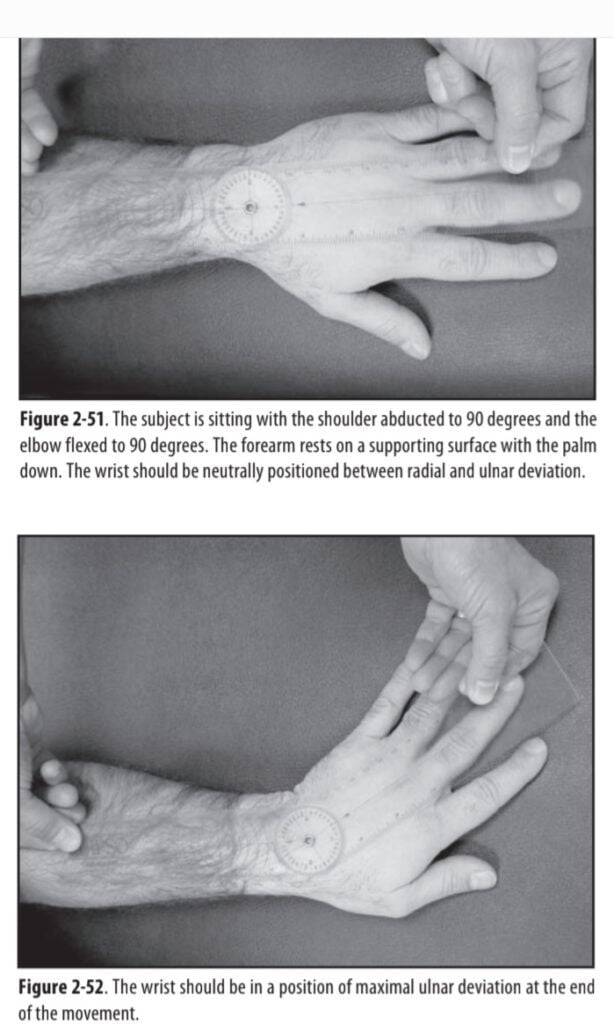
Wrist Ulnar Deviation

Planes/axis of movement: Motion occurs in frontal/coronal plane in anatomic position around an anterior/posterior axis. In the testing position, motion occurs in transverse plane around vertical axis. The motion occurs between the radiocarpal joint and the intercarpal bones.

Range of motion:

0 degrees to 35 degrees

Goniometric alignment:
  • Axis: Align the axis over middle of dorsal aspect of wrist over
    the capitate
  • Stationary arm: Align with the dorsal midline of the forearm, siting the lateral epicondyle of the humerus
  • Moving arm: Align with the midline of the dorsal surface of the third
    metacarpal

Stabilization: The distal ends of radius and ulna must be stabilized
against a supporting surface.

Substitutions: The subject may try to flex or extend the wrist or move the forearm into supination or pronation to avoid pain or gain more ulnar deviation.

ย 

Wrist Ulnar deviation

Recent Post