
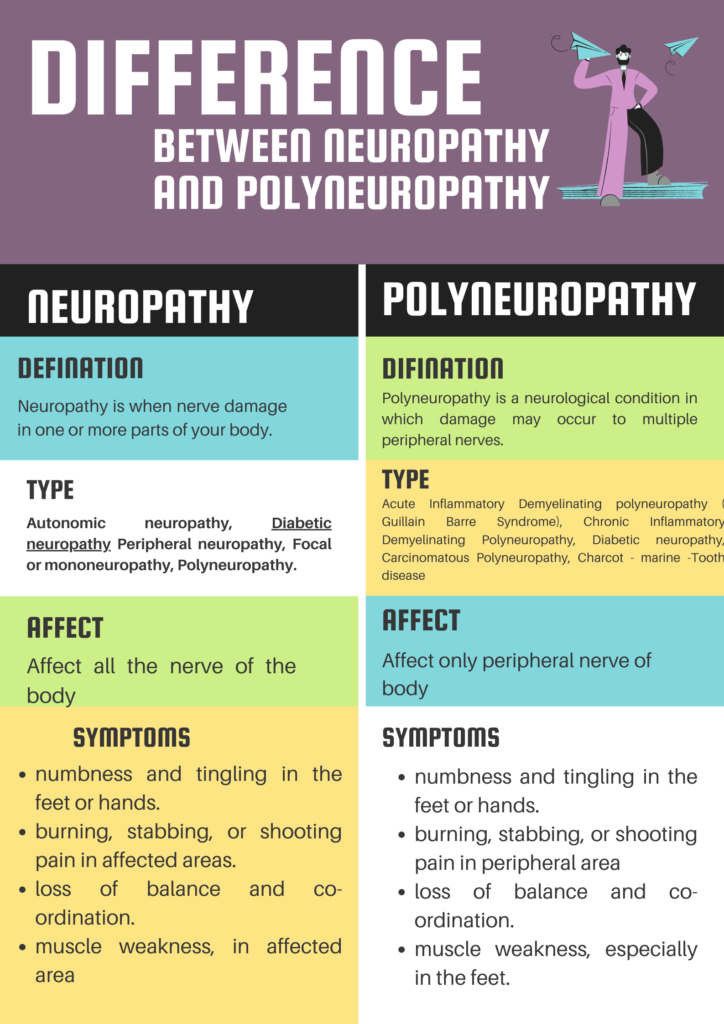
Difference Between neuropathy and polyneuropathy ?

Difference between neuropathy and polyneuropathy ?

What is  Neuropathy (Mononeuropathy)?

Neuropathy is neurological condition in which their is damage to a single peripheral nerve.It is a Focal damage to a limited area supplied by one nerve (e.g., wrist, foot, hand).
Example: Carpal Tunnel Syndrome (Median nerve), Foot drop (Peroneal nerve).

Neuro” = nerve

Pathy” = disease or disorder

So, neuropathy = disease of the nerves.

Main symptoms and clinical findings

Symptoms seen in patient totally depends on the area of nerve supply leading to motor, sensory, or both types of symptoms. Some common symptoms seen in mononeuropathy

  • Numbness or Tingling: The affected area may feel numb, or you may experience a tingling sensation like “pins and needles.”

  • Burning Pain: Some people feel a burning or sharp pain along the path of the damaged nerve.

  • Muscle Weakness: The muscles controlled by the affected nerve may become weak, or in severe cases, may not move at all.

  • Loss of Reflexes: The normal reflex responses in that area may be reduced or completely lost.

  • Skin Changes: The skin over the affected part may become dry, or you may notice changes in sweating and temperature sensitivity.

Common Causing Neuropathies are
  1. Carpal tunnel syndrome
  2. Cubital tunnel syndrome
  3. Saturday night palsy
  4. Peroneal nerve palsy
  5. Bell’s palsy
What are the Treatment Option Find in Neuropathy ? 

The treatment  is based on the cause of neuropathy, Usually localized cause like compression, trauma, or entrapment (e.g., Carpal Tunnel Syndrome) → treated by removing pressure or treating injury

Medical management

Anti-inflammatory drugs, corticosteroid injections, or surgical decompression (if compression neuropathy).

Physiotherapy management

Physiotherapy management focuse on one limb/region – nerve gliding, strengthening, pain relief, posture correction

Electrotherapy: TENS for local pain, faradic stimulation for weak muscle


What is  Polyneuropathy?

Polyneuropathy is a neurological condition in which their is damage to a multiple peripheral nerve.It is spreads Symmetrically and distal to both sides, feet → hands). “Stocking–glove pattern.”
Example: Diabetic polyneuropathy, Alcoholic neuropathy.

‘Poly” = many

Neuro” = nerves

Pathy” = disease or disorder

So, polyneuropathy = disease of many nerves.

Main symptoms and clinical findings
  1. Sensation of furriness and numbness
  2. Tingling, burning,
  3. cold parasthesia
  4. Burning pain,
  5. stinging,
  6. electric shock-like pain
  7. Gait instability,
  8. falls
  9. Weakness, muscle loss
  10. Muscle cramps,
  11. fasciculations
  12. Dry skin
  13. Body hair loss,
  14. skin changes
  15. Sensation of glare
  16. Bladder dysfunction
  17. Diarrhea
  18. Rapid heartbeat
  19. Gastrointestinal symptoms
  20. Urogenital symptoms (e.g., impaired micturitionerectile dysfunction)
How to diagnose polyneuropathy?

Some Laboratory tests used to diagnose Polyneuropathy CRP, differential blood count, electrolytes, liver and kidney function, protein electrophoresis, immunofixation, ‧Bence Jones proteins, TSH, HbA1c, CDT, vitamin B12.

Imaging investigation are Nerve ultrasound and MR neurography. Biopsy done in this condition Nerve biopsy, skin biopsy.

What are the Treatment Option Find in Neuropathy ? 

The treatment  is based on the cause of polyneuropathy,Usually systemic cause like diabetes, toxins, autoimmune, infection → treated by controlling systemic disease (e.g., glucose control in diabetic neuropathy)

Medical management

Systemic medications for nerve pain (e.g., Gabapentin, Pregabalin, Duloxetine), vitamin therapy (B1, B6, B12), treat underlying cause (e.g., diabetes, hypothyroidism).

Physiotherapy management

Physiotherapy management applied on Whole-body approach – balance training, gait training, proprioception, strengthening multiple muscle groups.

Electrotherapy: TENS for widespread neuropathic pain, IFT for circulation improvement.