Cerebral palsy : Types & Causes
Table of Contents
Introduction
Cerebral Palsy(CP) refers to a group of conditions characterized by neuromotor dysfunction due to permanent non-progressive damage in brain at or around birth. If any person suffer from cerebral palsy then it affect person ability to move , muscle tone , Balance and gait pattern.
What are the Causes of cerebral palsy?
The causes of cerebral palsy are many and they are grouped under three headings: prenatal, perinatal and postnatal.
Prenatal Causes
The prenatal period starts from conception until the setting of labor pains. Some books and many websites also denote the Prenatal as the Antenatal period. There are innumerable causes such as,
- Maternal viral infections such as TORCH infections (Toxoplasmosis,
Rubella, Cytomegalovirus varicella, or Herpes simplex) - Metabolic disorders in the mother such as diabetes, heart ailments,
hyperthyroidism or severe asthma or anemia - Poor prenatal care
- Rh incompatibility between partners
- Abdominal injury, smoking, or drinking during pregnancy
- Trauma to the mother
- Exposure of the mother’s abdominal area to repeated X-ray radiation
- Prolonged use of medications like steroids by the mother can cause cerebral palsy.
Perinatal Causes
The perinatal period starts shortly before birth and up to a month after birth. Some books and many websites also denote the Perinatal as Neonatal period.
- Premature babies are more prone to brain damage either due to trauma during delivery or later on due to immature respiratory and cardiovascular systems they are likely to develop hypoxia and low blood pressure also, they are more likely to develop low blood sugar, jaundice, and hemorrhage because of liver immaturity.
- The closing or blocking of a blood vessel of the internal carotid or mid cerebral artery
during the birth can on many occasions lead to hemiplegia. - Trauma can occur due to disproportion, breech delivery, forceps delivery, rapid delivery, distortion of the head or tearing of the tentorium.
- Multiple deliveries can cause asphyxia (when the umbilical cord is around the neck of the baby causing hypoxia ) in the second or third infant.
- Neonatal Meningitis
Postnatal Causes
- Delayed cry: Causes asphyxia to the brain causing cerebral palsy.
- Severe jaundice: The presence of high levels of bilirubin cause basal ganglia damage leading to athetoid cerebral palsy and high tone deafness.
- Trauma: Fall of the baby after birth
- Infection: Infections of the central nervous system such as meningitis, encephalitis, tuberculosis and brain abscesses cause cerebral palsy.
- Vascular insufficiency: Thrombosis or hemorrhage.
- Hydrocephalus.
Types of Cerebral Palsy

The topographical classifications based on physical feature of affected side in cerebral palsy is divide into:
Quadriplegia: Involvement of four limbs.
Diplegia: Involvement of four limbs with legs more affected than
the arms.
Double hemiplegia: same as above but with arms affected more
than legs.
Paraplegia: Involvement of both legs.
Triplegia: Involvement of three limbs.
Hemiplegia: One side of body is affected.
Monoplegia: One limb is affected.
The clinical classification based on the various sign and symptoms CP are divided into:
Spastic Cerebral Palsy
When any person have spastic cerebral palsy he /she will have spasticity which usually change with change in position, which means that spasticity, may vary from supine to prone. In spastic cerebral palsy , the damage occur in motor cortex of brain.
- The Tone of muscle increases .this condition is called as Hypertonia.
- Increase in tendon jerks, clonus in ankle and sometimes in patella and wrist.
- Babinski sign (when we stroking at sole of foot of child , the big toe of foot moves upward) is positive.
- The person might feel difficulty in initiating the movement or difficulty may be felt during different parts of range and often a movement is performed in an abnormal manner.
- Normal walking is flexion, adduction and external rotation. Where as in spastic we see extensions, adduction and internal rotation. This pattern is called Scissoring/ scissor gait.
- Contractures and deformities in muscle.
- The spastic CP child also has low IQ leaving.
- Hypochromatolysis can lead to visual problems, problems of perception, epilepsy.
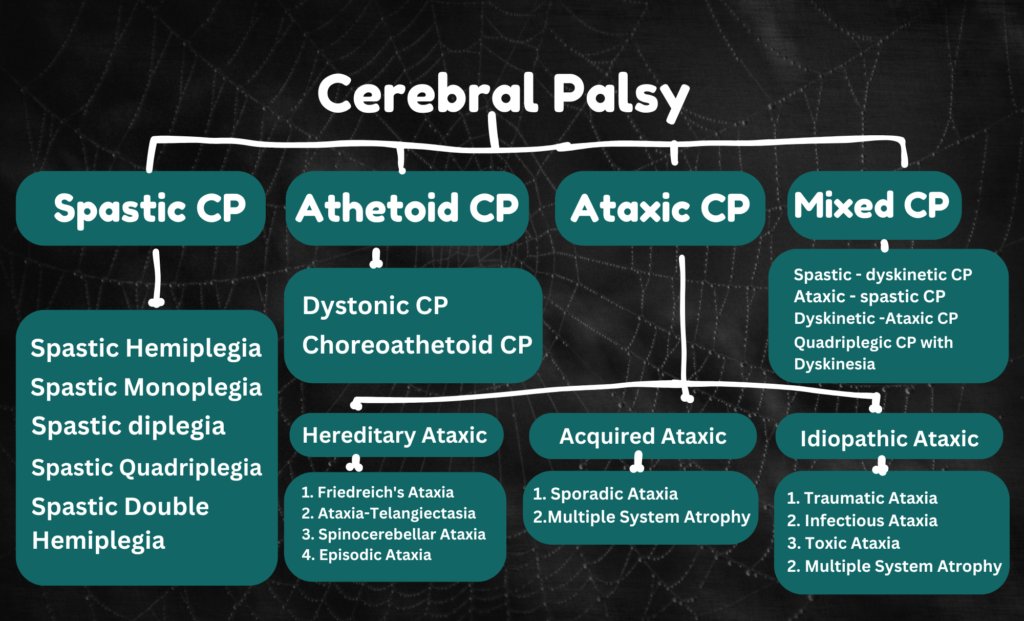
Subdivision of Spastic Cerebral palsy
Spastic Hemiplegia: Affecting one side of the body (arm and leg )
Spastic Monoplegia: Affects only one limb (arm or leg )
Spastic diplegia: Primarily affects the legs sometimes arms may be mildly affected.
Spastic Quadriplegia: Affecting all four limbs (both arms & legs)
Spastic Double Hemiplegia: Affects both sides of the body, with one side more severely affected .
Athetoid Cerebral Palsy
The child with Athetoid CP children exhibits slow, purposeless, worm like, involuntary movements which flow into each other. It occurs due to basal ganglia damage commonly seen in children who suffers from jaundice.
- Involuntary movements (Athetoid Dance) are present at rest and increase with excitement, fear and effort.
- The tone of muscle in these children generally fluctuates and very often there is dystonia which is a twisting type of movements.
- The child is very high Intelligent quotient (IQ) which is positive factor.
- The athetoid CP have extrovert personality, dysarthria and paralysis of gaze.
Subdivision of Athetoid CP
Dystonic Cerebral palsy: The patterned sustained muscle contraction.
Choreoarthetoid CP: The rapid irregular muscle contraction.
Ataxic Cerebral Palsy
Ataxia in CP occurs due to cerebellar damage. Voluntary movements are clumsy and dissymmetric. They usually have hypotonia unless they are associated with the spasticity as seen in mixed type of cerebral palsy.
- Ataxic CP children have nystagmus, diadokokinesia, dysarthria, intentional tremors and tendon jerks are pendular.
- The IQ is low; there is a visual and hearing problem, perceptual difficulties but however it is very rare to see a pure ataxic cerebral palsy.
Subdivision of Ataxia CP.
Hereditary Ataxic: Ataxia causes by any genetic changes in DNA . Such as friedreich Ataxia, Spinocerebellar Ataxia, Episodic Ataxia etc. .
Acquired Ataxic: Ataxia occurring during the period of life of person , due to an external cause, such as an injury, infection, or substance exposure.
Idiopathic Ataxic: When their is cause is unknow or due to family history.
Mixed Cerebral Palsy
Mixed CP is a type when any person shows the sign and symptoms of more one type of cerebral palsy which is described above . the most common type of mixed CP are as follows:
- Spastic -Athetoid Mixed CP: A combination of spasticity and dyskinesia.
- Spastic- Ataxic Mixed CP: A combination of ataxia and spasticity.
- Athetoid -Ataxic CP: A combination of dyskinesia and ataxia.
- Quadriplegic CP with Dyskinesia: Combination of quadriplegia and dyskinesia

Why My Knee Hurt and Fix It?
Why My Knee Hurt and Fix It? Knee hurt is a common problem that can affect your daily routine, especially when walking, running, or climbing

Understanding ALL about Rheumatoid arthritis
Rheumatoid arthritis Rheumatoid arthritis (RA) is a disease of synovium (a thin, soft connective tissue membrane that lines the inner surface of synovial joints) characteristics

Different menstrual cycle phases
Stages of menstrual cycle Phases Let’s start this article with my story of mensturation , I was 15 when I got my first period and

What is pain scale & how it works
What is pain scale & how it works ? What is a Pain scale? A pain scale is a tool developed by therapists and doctors
What should we eat during periods to reduce pain?
Home During period, the right food choices can make a huge difference in how your body feels. Warm, comforting drinks like ginger tea or turmeric
How to perform Neurological assessment ?
Home Download a PDF of Neurological Assessment sheet- Click on this Every Neurological assessment starts with taking the demographic data from patient. A demographic data