
Table of Contents

Introduction

The wrist joint consists of two compound joints : theย radiocarpal and the midcarpal jointsย , referred to collectively as wrist complex . The wrist complex as whole is considered biaxial with motion ofย flexion and extensionย around a coronal axis andย radial deviation/Ulnar deviationย around anteroposterior axis .

Normal ranges of the wrist complex are carried as a varying 65 degree to 85 degree of flexionย , 60 degree to 85 degree of extension ,ย 15 to 21 degree of radial deviation ,ย and 20 to 45 degree.

Radial and ulnar deviation
radial deviation/Ulnar deviation
Flexion and extension of wrist complex
flexion and extension

Structures of radiocarpal joints

The radiocarpal joints is formed by :

  • Distal radius
  • Scaphoid , Lunate , Triquetrum
  • Radio-ulnar disc
  • Triangular fibrocartilage complex
  • some contact with lunate in the neutral wrist .

Proximal and distal structure of radiocarpal joints

The proximal joint surface is composed of

  1. The lateral radial facet that articulates with the scaphoid.
  2. The medial radial facets that articulates with the lunate.
  3. The triangular fibrocartilage complex that articulate predominantly with the triquetrum , although it also has some contact with the lunate in the neutral wrist .
Wrist Joint
radiocarpal joints
Ulnarly oriented

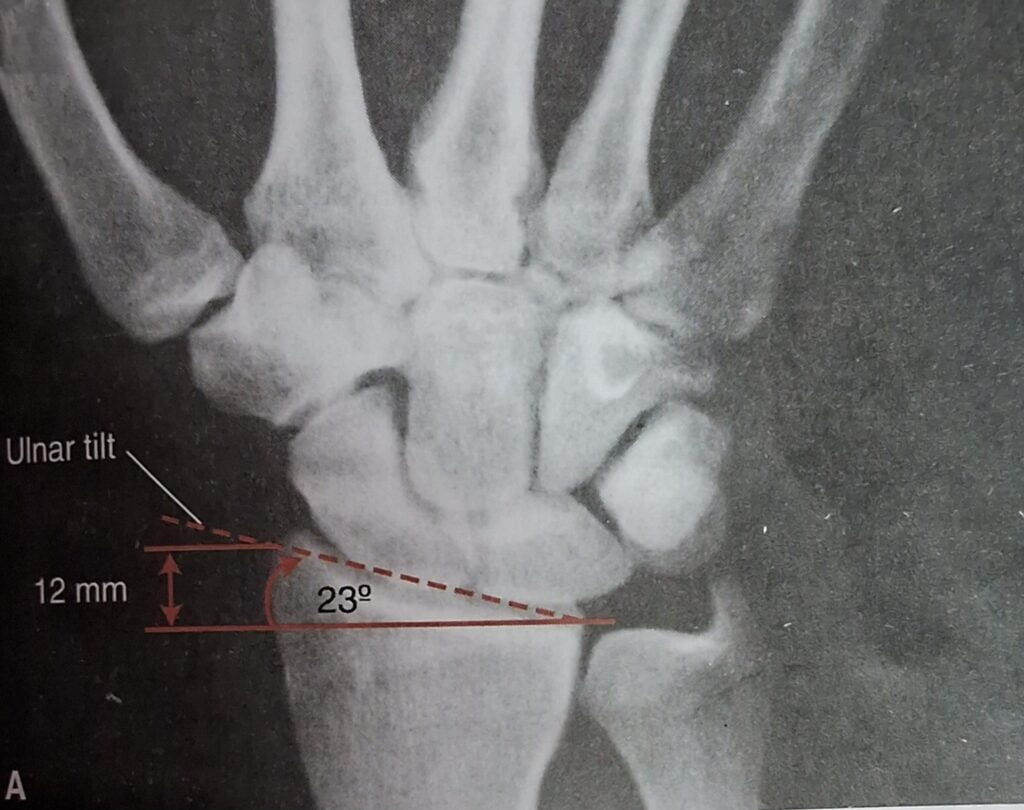
The proximal joint surface is oblique . The average ulnar tilt of the distal radius is 23 degree .This inclination occurs because the radial length ( height )is 12 mm greater on the radial side than on the ulnar side .

ulnarly orientation
Ulnarly oriented
Volarly oriented

The distal radius is also tilted 11 degree volarly with the dorsal radius slighly longer than the volar radius .

Distal end consist of carpel bone ( scaphoid ,Lunate , triquetrum) . These ligament are the scapholunate interosseous, and the lunotriquetral interosseous ligament .

The pisiform , anatomically part of the proximal row , does not participate in the radiocarpal articulation and functions entirely as a sesamoid bone , presumably to increase the moment arm of the flexor carpi ulnaris ( FCU) tendon that envelops it.

it don’t have well articular surface .

volarly oriented
Volarly oriented

Properties of Joint

    1. Incongruency

The concept of articular incongruency is supported by the finding that the overall contact between the proximal and distal radiocarpal surfaces is typically only about 20 % of available surface , with never more than 40% of available surface in contact at any one time .

Joint incongruency and the angulation of the proximal joint surface result in greater range of radiocarpal flexion than extension and in greater radiocarpal ulnar deviation than radial deviation .

  • Variants

Ulnar negative variance is describe as a short ulna in comparison with the radius at distal end , whereas in ulnar positive variance , the distal ulna is long in relation to distal radius .

Structure of midcarpal joint

The midcarpal joint is the articulation between scaphoid ,Lunate , triquetrum proximally and the distal carpal row composed pf trapezium , trapezoid , capitate , and hamate . These are not pure anatomical joint but a functional joint

Triangular Cartilage

Triangular Fibrocartilaginous is a cartilaginous and ligamentous structure .It divide the distal radioulnar joint from the radiocarpal joint .

Components of Triangular fibrocartilage

    • Triangular fibrocartilage / articular disc / radioulnar disc

Triangular fibrocartilage has apex and base . The pheriphery of structure is very thick and vascular whereas a thin at centre (avascular ).They have two articular surface , distal and proximal . It has two lamina such as

Upper lamina – volar and dorsal ligament

Lower lamina – Triquetrum , Hamate , metacarpal .

  • Volar and radioulnar ligament
  • Meniscus homologous
  • Ulnolunate and Ulnotriquatrum
  • Extensor carpi Ulnaris tendon

Ligaments of wrist complex

Wrist complex have two major ligament volar carpal ligament and dorsal carpal ligament . In general , the dorsal wrist ligament are described as thin , whereas the more numerous volar ligament are thicker and stronger .

Volar carpal ligament

The composite ligament known as having three distinct bands : the radioscaphocapitae (radiocapitate) , short and long radiolunate ( radiounotriquetral ) and radio scapholunate ligaments

The two volar ligament are the scapholunate interosseous ligament and lunotriquetral interosseous ligament .

Dorsal carpal ligament

Dorsally , the major wrist ligament is the dorsal radiocarpal ligament . This ligament, as is true of the volar radiocarpal , varies somewhat in description but is obliquely oriented . A second dorsal ligament is the dorsal intercarpal ligament , which courses horizontally from the triquetrum to the lunate , scaphoid , and trapezium . Thee two dorsal ligament contribute to radiocarpal stability , notably stabilizing the scaphoid during wrist ROM .

Ligament of wrist complex

Function of wrist joint

  1. It help in force transmission.
  2. It help in absorption of force.
  3. It increases the ROM
  4. It help to stabilize the radioulnar joint
  5. It has effective load bearing structure
  6. It help to separate joints
  7. It provide articulation surface.

ย 

Recent Article post