
Cardiac tumors

Table of Contents

Heart tumors CancerΒ 

When tumors cause in any region of heart is called cardiac tumor .Tumors of the heart are classified into primary and secondary, the latter being more common than the former.

Β 
Cardiac tumours , cardiac tumor
Cardiac tumours

Primary Cardiac tumors

Primary tumors of heart are quite rare, found in 0.04% of autopsies. In decreasing order of frequency, the benign tumors encountered in the heart are: myxoma, lipoma, fibroelastoma, rhabdomyoma, haemangioma and lymphangioma. The malignant tumors are still rarer, the important ones are: rhabdomyosarcoma, angiosarcoma and malignant
mesothelioma.

Secondary Cardiac Tumors

Metastatic tumors of heart are more common than the primary tumors. About 10% cases with disseminated cancer have metastases in the heart.

Heart tumor symptoms

  • heart failure.
  • heart murmurs.
  • palpitations, rapid heart rate, or arrhythmia.
  • shortness of breath or difficulty breathing.
  • breathing problems when changing position or lying flat.
  • Stroke (slurred speech, weakness, vision loss)
  • Pericardial effusion (fluid/blood/tumor within sac that surrounds the heart)
  • Constitutional symptom (fever, weight loss, elevated inflammatory markers, anemia)
  • dizziness, lightheadedness, or fainting.
  • chest pain or chest tightness.

Types of primary cardiac tumors

  • Β Atrial myxoma -most common primary cardiac tumor. Account for approximately 50% of primary cardiac tumor.
  • Papillary fibroelastoma – most common cardiac tumor to affect cardiac valves. Mean age at diagnosis is 60 years old. These tumors are associated with embolization (breaking off and traveling in blood stream) resulting in stroke or less commonly heart attack.
  • Rhabdomyoma – most common cardiac tumor in the infants and children. Typically multiple and originating from ventricular wall. Associated Tuberous Sclerosis is seen in 1/3 of patient.
  • Fibroma – commonly occur in the infants and children. Typically located within ventricular wall. Associated with arrhythmia (irregular heart beat) and risk for sudden cardiac death.
  • Lipoma – tumor made up of fat cells. Diagnosis can be made non-invasively by cardiac MRI.
  • Hemangioma – tumor made of abnormal blood vessels. Diagnosis can be made either invasively on coronary angiography or non-invasively on cardiac CT or MRI.

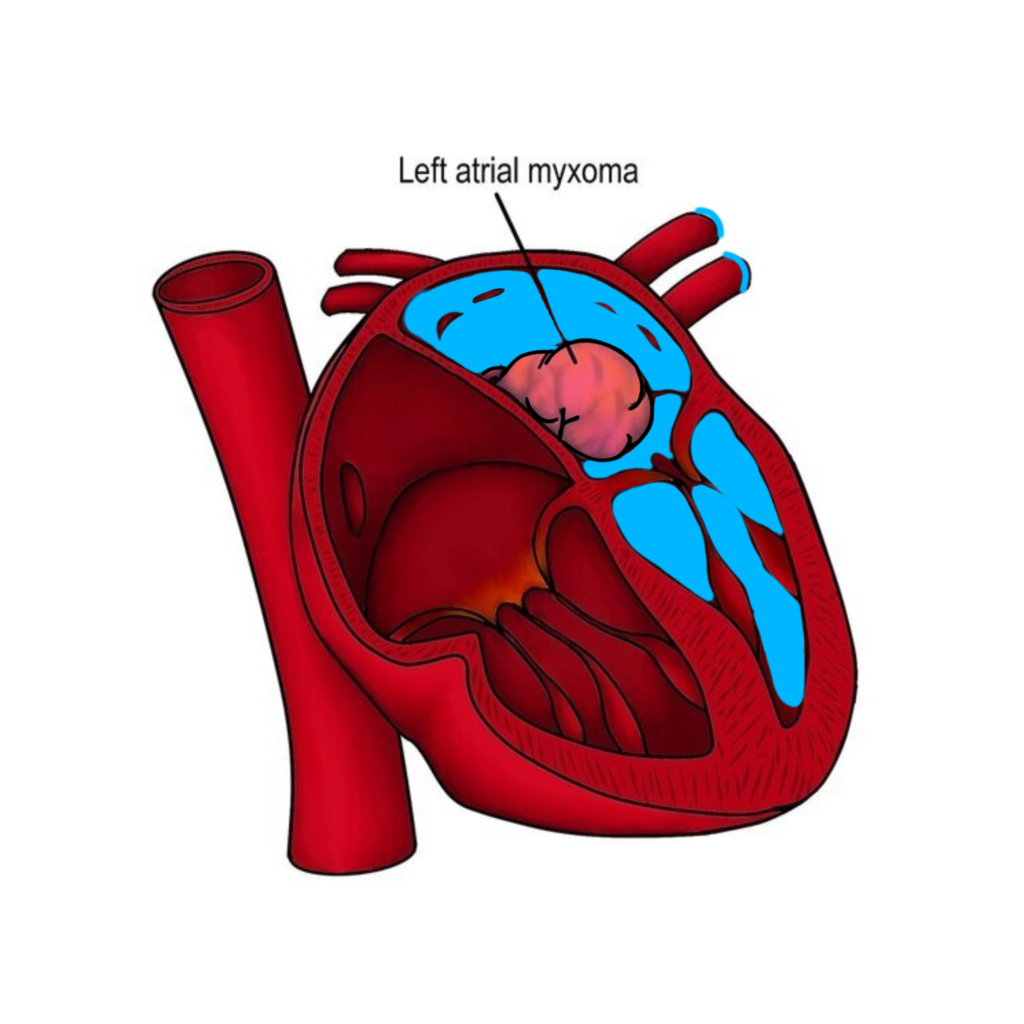
Atrial myxoma

This is the most common primary tumour of the heart comprising about 50% of all primary cardiac tumours. Majority of them occur in age range of 30 to 60 years. Myxomas may be located in any cardiac chamber or valves, but 90% of them are situated in the left atrium.

Pathophysiology

Myxomas most commonly arise in the LA as single or multiple polypoid tumours, attached by a pedicle to interatrial septum. They are usually gelatinous but may be solids and even calcified, with superimposed thrombus.

Examination

  • On examination, the first heart sound is usually loud, and there ay be a murmur of mitral regurgitation with a variable diastolic sound (tumor β€˜plop’) due to prolapse of the mass through the mitral valve.

  • The tumor can be detected incidentally on echocardiography, or following investigation of pyrexia, syncope, arrhythmias or emboli. Occasionally, the condition present with malaise and features suggestive of a connective tissue disorder, including a raised ESR.

Management

Treatment is by surgical excision. If the pedicle is removed, fewer than 5% of tumors recur.

Various treatment optionΒ 

Treatment options are dependent upon several factors including types of tumor, tumor size and location, presence or absence of systemic metastases and patient’s overall health status.
  1. Heart transplantation
  2. heart reconstructive surgery heart replacement therapy withΒ left ventricular assist device (LVAD)Β 
  3. chemotherapy.
  4. radiation therapy .
  5. Open-Heart Surgery