
Table of Contents
What is the Rotator cuff muscle?
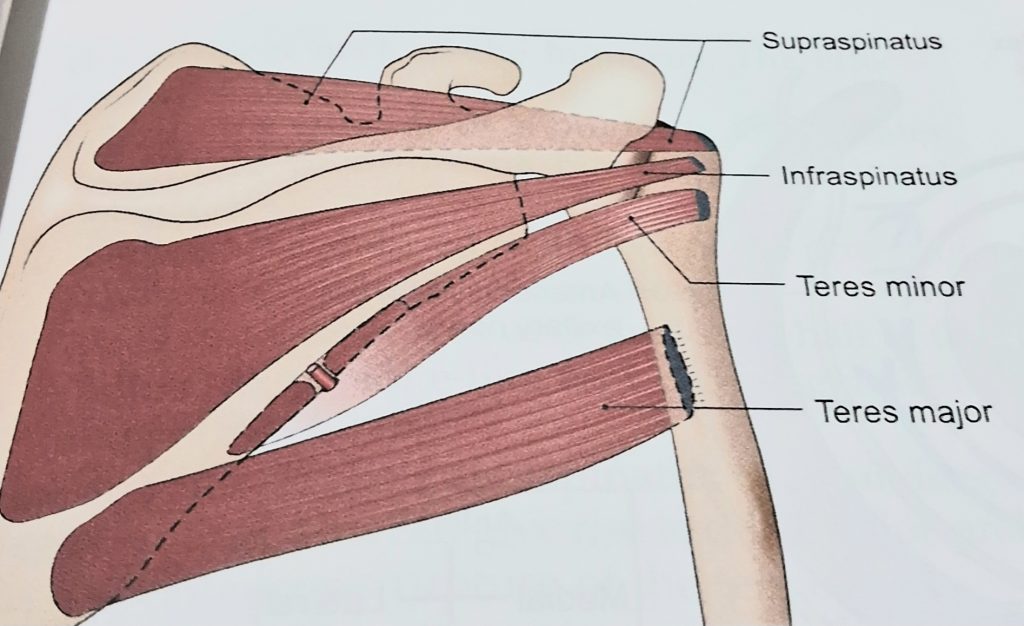
The rotator cuff muscle is a fibrous sheath from by 4 flattened tendons that blend with the capsule of the shoulder joint and strengthen it. This is called a Musculotendinous cuff. The muscles from the Rotator cuff are as follows :
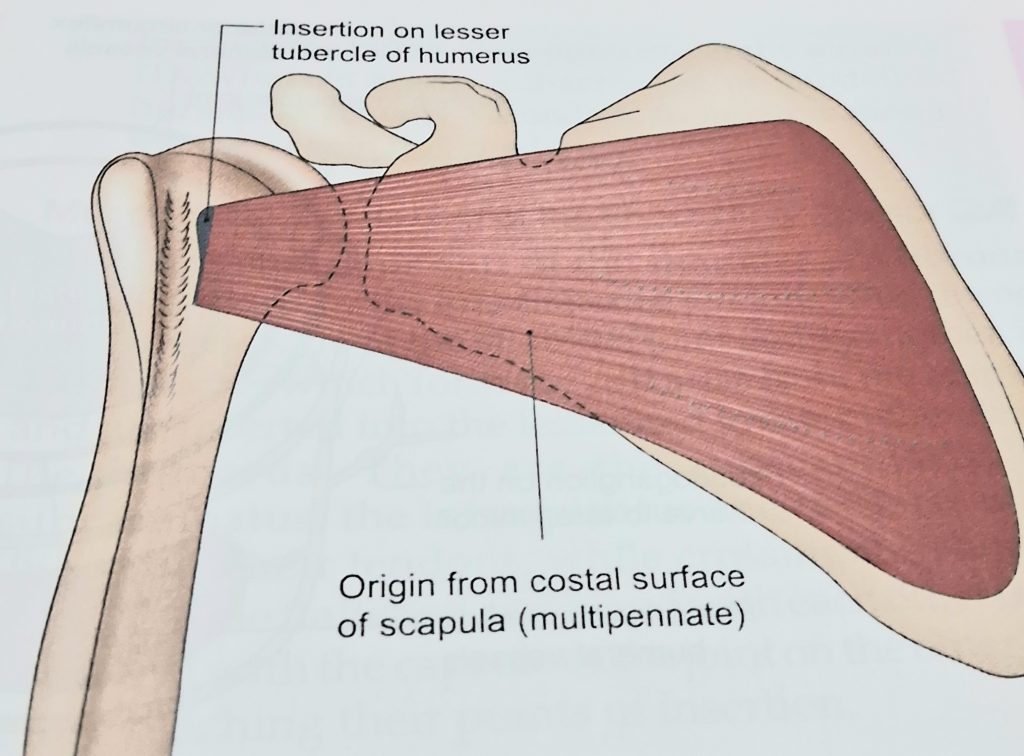
- Subscapularis
- Supraspinatus
- Infraspinatus
- Teres minor
These muscles arise from the scapula and insert into lesser & Greater tubercles of the humerus. Their tendons, while crossing the shoulder joint, become flattened and blend on one hand and with the capsule of the joint on the other hand, before reaching their points of insertion. This rotator cuff gives strength to the shoulder joint except inferiorly that’s why dislocation of the humerus occurs most commonly in a downward direction.
Mnemonics make it easy to learn
The mnemonics help us to learn many things through tricks and norms such as this learned as ” SITS ”
S = Supraspinatus
I=Infraspinatus
T=Teres Minor
S=Subscapularis


Subscapularis
Origin: Medial Two – Third of the subscapular fossa.
Insertion: Lesser tubercle of humerus
Nerve supply: Upper and lower subscapular nerve.
Action: Medial rotator and adductor of arm
Supraspinatus
Origin: Medial two-thirds of the supraspinous fossa of the scapula. The muscle laterally beneath the coracoacromial arch blends with the capsule of the shoulder joint.
Insertion: Upper impression on the greater tubercle of humerus
Nerve supply: Suprsscaular nerve (C5, C6)
Action: Abduction of shoulder joint0-15 degree
Infraspinatus
Origin: Medial two-thirds of the infraspinous fossa of the scapula.
Insertion: On the greater tubercle of humerus.
Nerve supply: Suprsscaular nerve (C5, C6)
Action: Lateral rotator of the arm.
Teres Minor
Origin: Upper two-thirds of the dorsal surface of the lateral border of the scapula as 2 slips.
Insertion: On the greater tubercle of humerus.
Nerve supply: Axillary Nerve (C5’C6)
Action: Lateral rotator of the arm.
The function of Rotator Cuff Muscle
- Stabilization of glenohumeral joint by compressing humeral head against the glenoid.
- A protective musculotendinous collar surrounds the posterior, superior, and anterior aspects of the joint, only the inferior aspect is not protected. It makes it easy to dislocate the joint inferiorly.
- Shoulder luxation
- The rotator cuff muscle prevents to sliding of the head of the humerus. It allows a full range of motion.
Disease & Disorder
Rotator Cuff Syndrome
The injury or tear of the rotator cuff muscle due to overuse, overhead motion, falls, or sports causes pain during motion in the shoulder joint.
Rotator cuff (RC) Tendonitis
The inflammation of the tendon of the Rotator cuff muscle is often caused due to impingement, simple contusions, and tendonitis to chronic tendinopathy, partial tears, and full-thickness tears.
Shoulder Impingement
The structural narrowing of subacromial space causes a painful condition of the upper extremity a condition called shoulder impingement.
Full-thickness rotator Cuff Tears
The complete tear of the Rotator cuff tendon leads to Recurrent pain, Grating or cracking sounds when moving your arm, Limited ability to move your arm, and Muscle weakness.
Related Articles
Rotator cuff injury: Physiotheraphy Management – physiobia
Rotator cuff injury is a medical condition where the injury occurs in the Rotator cuff muscle or tendon. There are Four Rotator cuff muscles and their major.
Glenohumeral Joint: Bones, ligaments, movement
The glenohumeral joint also called as shoulder joint is a ball and socket type of synovial joint with three rotatory and three translatory degree of freedom.
Recent Post

Why My Knee Hurt and Fix It?
Why My Knee Hurt and Fix It? Knee hurt is a common problem that can affect your daily routine, especially when walking, running, or climbing

Understanding ALL about Rheumatoid arthritis
Rheumatoid arthritis Rheumatoid arthritis (RA) is a disease of synovium (a thin, soft connective tissue membrane that lines the inner surface of synovial joints) characteristics

Different menstrual cycle phases
Stages of menstrual cycle Phases Let’s start this article with my story of mensturation , I was 15 when I got my first period and

What is pain scale & how it works
What is pain scale & how it works ? What is a Pain scale? A pain scale is a tool developed by therapists and doctors
What should we eat during periods to reduce pain?
Home During period, the right food choices can make a huge difference in how your body feels. Warm, comforting drinks like ginger tea or turmeric
How to perform Neurological assessment ?
Home Download a PDF of Neurological Assessment sheet- Click on this Every Neurological assessment starts with taking the demographic data from patient. A demographic data