
Strength Training
Table of Contents
What is Strength training?
Strength training, also known as strengthening exercises, is the systematic practice of using muscle force to control heavy external loads manually or mechanically to promote or maintain health and physical well-being and reduce the risk of injury.
Strength training also has various other names, such as resistance training or resistance exercises, It is an essential element in rehabilitation programs for persons with impaired function.
The most common adaptation of strength training is an increase in the maximum force-producing capacity of muscle which results in neural adaptation and increased muscle fiber size ( also called increased muscle mass ).
What are common myths regarding strength training?
- Strength training is only for young and fit people
There are so many research studies mentioning the beneficial effects of strength training after 60 years of age. The elderly population must undergo strength training because of its long-term effect makes an individual live longer and independently.
- For strength, a person needs to spend hours in the gym.
There are various ways of undergoing this training the most effective strength training can be done in 30- 45 min per session. It does not need long hours in gyms and workouts.
- The Strength training is only for athletes and bodybuilders
Strength training is for every individual and every age group. Yes, athletes and bodybuilders indeed benefit from this training more than a normal individual but it is very important for anyone who is looking to improve overall health, function(endurance ), or fitness.
- Strength training makes you muscular
Yes, Strength training increases muscle mass but to have a muscular body it is necessary to require specific training, nutrition, and genetics. Nutrition is needed because adequate protein intake is essential for muscle growth.
A progressive overload is a key factor in being muscular as our muscles need to be challenged regularly to adapt and grow. Sometimes some individuals may require more time, effort, or specific training than only their muscles grow.
- I do not have the equipment to do strength training
Strength training can be performed with no equipment such as Push Ups( 3reps of 10 reps), Squats ( 3reps of 10 reps), Lunges ( 3reps of 10 reps per leg ), Planks( 3reps of 30-second hold), Dips (Using a chair), Sit-ups ( 3reps of 10 reps), Leg raise ( 3reps of 10 reps). If you do not have no weights, use household objects such as water bottles, cans, Books, Stairs, etc. It is also noticeable that there are equipment that are not costly such as Resistance bands ($5-10), Dumbells ($10 -20), Jump rope ($5-10), Medicine balls ($10-20), Exercise Ball($10-20), Hand Grips ($5-10).
How to perform Strength training?
We are only guiding you on a general way to perform the training every exercise has its ways to perform. It depends on the trainer and individual body.
Preparation
- Initially, the person should consult a healthcare professional or certified trainer. He/she can ask any question regarding training method, duration, benefits, and side effects.
- Set a SMART GOAL. It is Specific, Achievable, Measurable ,Relevant , and time-bound
- When you consult a doctor or trainer ask them to make a training program or workout routine. It will help you to manage the consistency regarding training and manage time.
- Warm Up(5-10 min) before the training (Warm-up ) and Cool down (5-10 min)after the training (post–cooldown )
- Follow Training principles :
- Progressive Overload: Gradually increase weight, resistance, or reps over the time.
- Specificity: Train specific muscle groups or movements.
- Variety: Incorporate different exercises, sets, reps, and rest periods.
- Consistency :Aim for regularly training sessions(2-3 times per week)
- Rest and recovery: Allow time for muscle recovery between sessions.
General Workout structure
- Warm up: 5-10 min of light cardio and dynamic stretching exercise.
- Strength training: 30-40 min which includes: 3-5 sets per exercise, 8-12 reps per sets, 60 -90 seconds rest between sets . Always start with compound exercises such as Squats, deadlifts, bench presses, Rows, and lunges.
- Cool–down: 5 to 10 min for stretching.
Note
- Start with lighter weights and slowly progress gradually to heavy ones.
- Incorporate variety into your routine.
- Train with a partner or spotter.
- Stay hydrated and fueled.
- Get enough sleep and recovery time.
- Consistency and patience are key.
What are common Strength Training exercises?
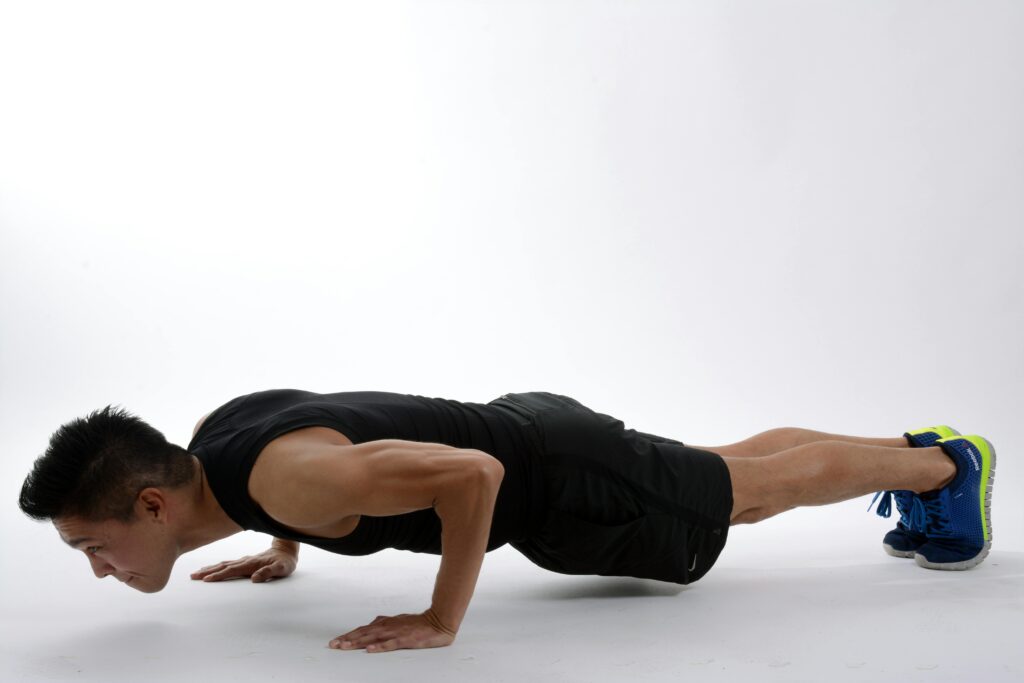
Push –Up
Push–up is an upper body exercise that targets the chest muscles, Anterior deltoid muscle, Triceps, Serratus anterior, and core muscle of the body.
Proper technique
- Starting Position: A person can form a prone push-up with hand and feet on the floor, with hands shoulder-width apart, and arms straight.
- Maintain a straight line from the head to heel
- Slowly lower the body until the chest almost touches the ground, keeping the elbow close to the body (45-degree angle)
- Push back to starting position, extending your arms fully.
- Breathe naturally.
Variations in Push up are any incline board, therapy ball, or on the floor with an elevated platform to shift greater body weight to the upper extremities, etc.
Deep Squats
Deep Squats are a lower body exercise that helps to strengthen the lower extremity. This exercise also improves the dynamic stability of the trunk and balance.
Proper technique
- Starting Position: In a bilateral stance with feet a comfortable distance apart, have the patient perform a deep squat by flexing the hips and knees.
- Keep body weight distributed posteriorly and be sure to keep the lower legs as vertical as possible to the floor so that the knees do not move anteriorly to the toes.
- Hold the position and then return to the standing position.

Pushing/Pulling Exercise
The pushing and pulling exercises are upper extremity strengthening exercises which are useful functional tasks that require concentric and eccentric control of shoulder, elbow, and forearm musculature.
Depending on the size of the object to be moved, an exercise may be performed bilaterally and unilaterally.
Proper technique
- Perform the pushing and pulling motions against any resistance of the elastic band or any heavy objects.
- Adjust the direction, speed, and arc of motion to replicate various functional tasks.
- Reposition the heavy object on a level surface by pulling or pushing it from one place to another.
Lifting and lowering exercise
The lifting and lowering exercises are upper extremity strengthening exercises which are useful functional tasks that require concentric and eccentric control of shoulder, elbow, and forearm musculature.
Proper technique
- Lift a weighted crate or a heavy book from the surface of the table, hold it close to the body, and lower it to a different position on the table.
- Lift and lower a heavy object to and/or form high and low surfaces.
Indication and Contraindication of Strength training
Strength training is a strengthening exercise that is a systematic practice of using muscle force to control heavy external load manually or mechanically. It has various indications and contraindications. In this blog, we explain why you should perform. And Why not to perform?
Indication of strength training
Injury Rehabilitation
Strength Training is a method that helps to restore muscle function, strength, and range of motion after an injury. Rehabilitation programs need to improve joint stability, reduce pain, and promote recovery. For example: A person with an ACL injury can undergo strength training exercises like Lunges, squats, and leg press to strengthen surrounding muscles and improve knee stability.
Prevent Chronic diseases
The most important indication of Strength training is for the management of chronic diseases like:
- Diabetes Patient: Help to Improve insulin sensitivity and glucose control( Resistance band exercises)
- Hypertension: Lowers blood pressure and improve cardiovascular health
- Heart Disease: Enhance cardiovascular function and reduce risk factors.
Improve Athletic Performance
Strength training enhances muscular power, speed, and endurance, benefiting athletes by:
- Improve muscle function
- Enhancing neuromuscular coordination.
- Increase muscle strength and power.
Example: A Football player can benefit from lower extremity strength training with balance and coordination like Seated push-ups in a long sitting position with hands on an unstable surface, Ball “walk–out” on hands with lower extremities rolling on a large therapy ball, etc.
Muscle Weakness
Strength training helps correct muscle weakness caused by muscle imbalance. For example: A person with shoulder pain can benefit from strength training exercises like shoulder rotation and scapular stabilizations for muscle strengthening.
Improve Bone density
Resistance training is another name for strength training that helps improve bone density, reducing the risk of osteoporosis and fracture.
Example: A person with osteoporosis can benefit from strength training exercises like weight-bearing exercises, resistance band exercises, or bodyweight exercises to improve bone density.
Obese Patient
An overweight patient undergoing strength training for weight management and improved body composition by increasing muscle mass, enhancing metabolism, and reducing body fat.
Elder individuals
The elderly age group population should do strength training a lot of research study evidence that strength training is most effective over 60. It helps them to live longer disease-free and independently. A country with a larger population is promoting strength training as a basic need so that they can be independent and live longer.
Contraindications of Strength Training
Strength training has many benefits, but there are also potential disadvantages to consider:
Injury Risk
In Strength training, there are weights, and bands if any person overstrains himself in an improper posture with excessive load can lead to injury. There is a situation where the person does not consult a professional and starts with 3kg or 5 kg weight can lead to a minor or major injury.
Overtraining
Overtraining is majorly seen in athletes, to improve performance they over-train themselves in the hope that it might help in games but many studies say that overtraining results in insufficient recovery time and can cause muscle fatigue, decreased performance, and increased injury risk.
Acute Injury
In any acute condition avoid strength training, as it can exacerbate the condition. For example: If you recently sprained your ankle joint, it’s best to avoid strength training exercises that involve the ankle, such as calf raises or squats, until the injury has fully healed.
Recent Surgery
Avoid strength training after recent surgery, as it can interrupt the healing process, For example: If you recently underwent knee surgery avoid heavy squats, and lunges until the doctor asks you to do so.
Severe Cardiovascular Diseases
Individuals with cardiovascular system disease should avoid high–intensity strength training. For example: If you have severe heart failure, heavy weightlifting or high-impact aerobics may be too strenuous. Instead, go for low–intensity exercises such as yoga or light stretching, etc.
Medications
A person, who is taking certain medications such as beta-blockers, may be contraindicated with strength training. For example: A high blood pressure patient under beta-blocker medication cannot perform strength training it might increase blood pressure and can lead to other complications.
Pregnancy complication
It is rarely seen that pregnancy becomes a complication for strength training but possible. Here are some potential risks to consider:
In the First Trimester (Week 1-12): Miscarriage is common due to High-impact exercises, Hypertension occurs due to an increase in blood pressure.
Second Trimester (Week 13-26): Placenta abruption, Preterm labor.
Third Trimester (Week 27-40): Back pain, Pelvic floor dysfunction
We can safely perform strength training with the advice of healthcare professionals or specialists.
Guidelines
- Consult your healthcare provider before starting or continuing strength training.
- Avoid high-impact exercises (e.g., contact sports, high jumps).
- Choose low-impact exercises (e.g., yoga, swimming, cycling).
- Monitor body temperature and stay hydrated.
- Avoid lying flat on your back after 12 weeks.
- Focus on core and pelvic floor exercises.
Strength Training Adaptation in body
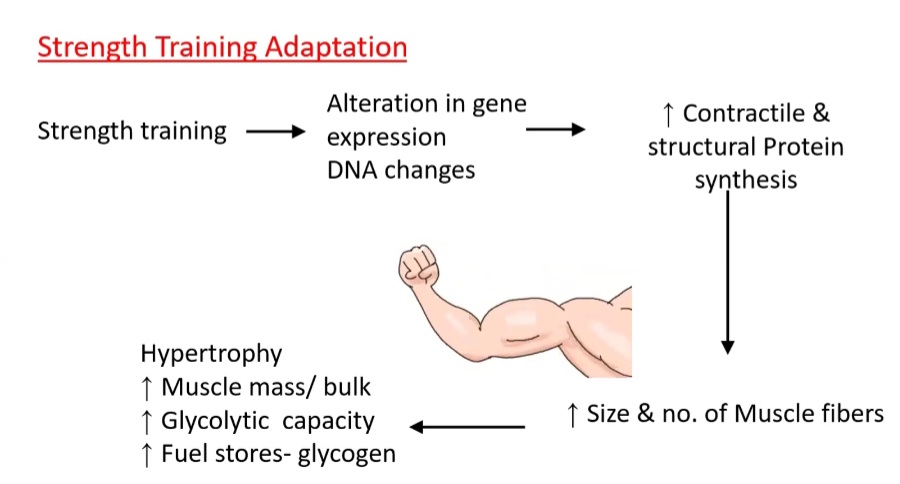
A person who undergoes strength training will have various adaptations in their body such as:
- Selective increase in muscle fiber of fast twitch fibers.
- Selective increase in the size of muscle mass /bulk (hypertrophy).
- Alteration in the person’s genes or DNA.
- The number of mitochondria in muscle increases or decreases.
- Glycolytic capacity of any muscle increases.
- Intramuscular glycogen, ATP, PCr (Phosphocreatine ) storage increase in muscles
- Type II (fast twitch) muscle fibers increases. During, High intensity training type IIa muscle fibers increases whereas in high intensity explosive training type IIX fibres increases.
- During strength training, there is firing of a faster Motor Unit.
- Adaptation of Strength training for men and women are same as the force produced by per muscle fiber is equal in both.
- Why men have more power? , Because the capacity to increase muscle fibre (mass) is much more in man then women .Testosterone (20-30% more then women) level is responsible for this process.
- Testosterone has anabolic effects on the body which lead to hypertrophy and produces more strength and increased force production.