
Neuron
Table of Contents
Definition
The primary cells present in nervous system are called Neuron . It is also commonly denoted as nerve cells .The two different properties of neurons that make them different from other cells are :
- The neuron has branches or processes called the axons and dendrites.
- Neuron do not have centrosomes. So, it cannot undergo division.
Classification of Neuron
Neurons are classified by three different methods.
A. Depending upon the number of poles
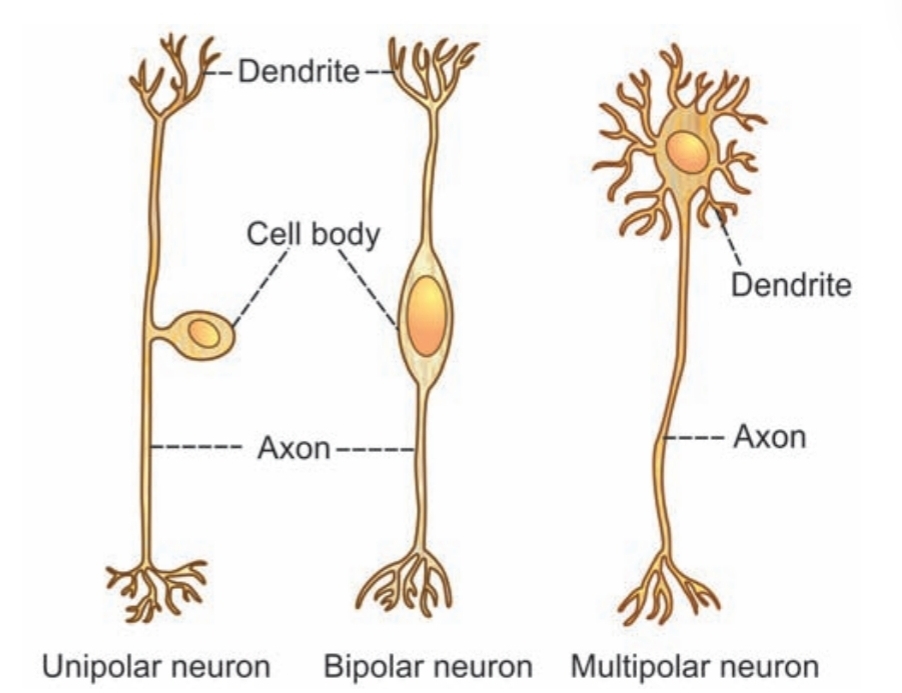
Based on number of poles from which the nerve fibers arise, neurons are divided into three types:
Unipolar neurons: the neurons that have only one pole is called unipolar have both axon and dendrites.
Bipolar Neurons: the neuron having two poles are called bipolar neurons in which axon arises from one pole and dendrites arise from the other pole.
Multipolar Neurons: the neurons that have many poles. One of the poles gives rise to an axon and all other poles give rise to dendrites.

B. Depending upon the function
Based on function, nerve cells are classified into two types:
Motor or Efferent Neuron: the neurons that carry the motor impulses from the central nervous system to peripheral effector organs like muscles, glands, blood vessels, etc.
Sensory or Afferent Neurons: the neurons that carry the sensory impulses from the periphery to the central nervous system.
C. Depending on axon length
Depending on axon length, neurons are two types such as,
1. Golgi Type I Neurons: These neurons have long axons
2. Golgi Type II Neurons: These neurons of this type have short axons.
Structure of Neuron

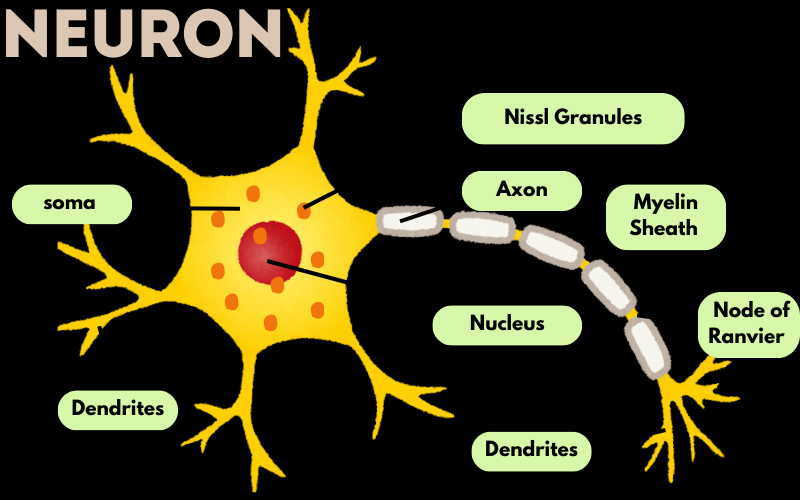
The neuron is made up of three parts:
1. Nerve cell body
2. Dendrite
3. Axon
Nerve cell body
The nerve cell body is irregular shape soma constituted by a mass of cytoplasm called neuroplasm, which is covered by a cell membrane. The cytoplasm contains large nucleus, Nissl bodies, neurofibrils, mitochondria, and Golgi apparatus. Nissl bodies and neurofibrils are found only in neurons and not in other cells.
Dendrite
Dendrite is the branched process of neurons and it is branched repeatedly. Dendrite may be present or absent. If present, it may be one or many. Dendrite has Nissl granules and neurofibrils. Dendrite transmits impulses toward the nerve cell body.
Axon
Axon is the longer process of nerve cells. Each neuron has only one axon. The axon transmits impulses away from the nerve cell
body.
Organization of Neurons
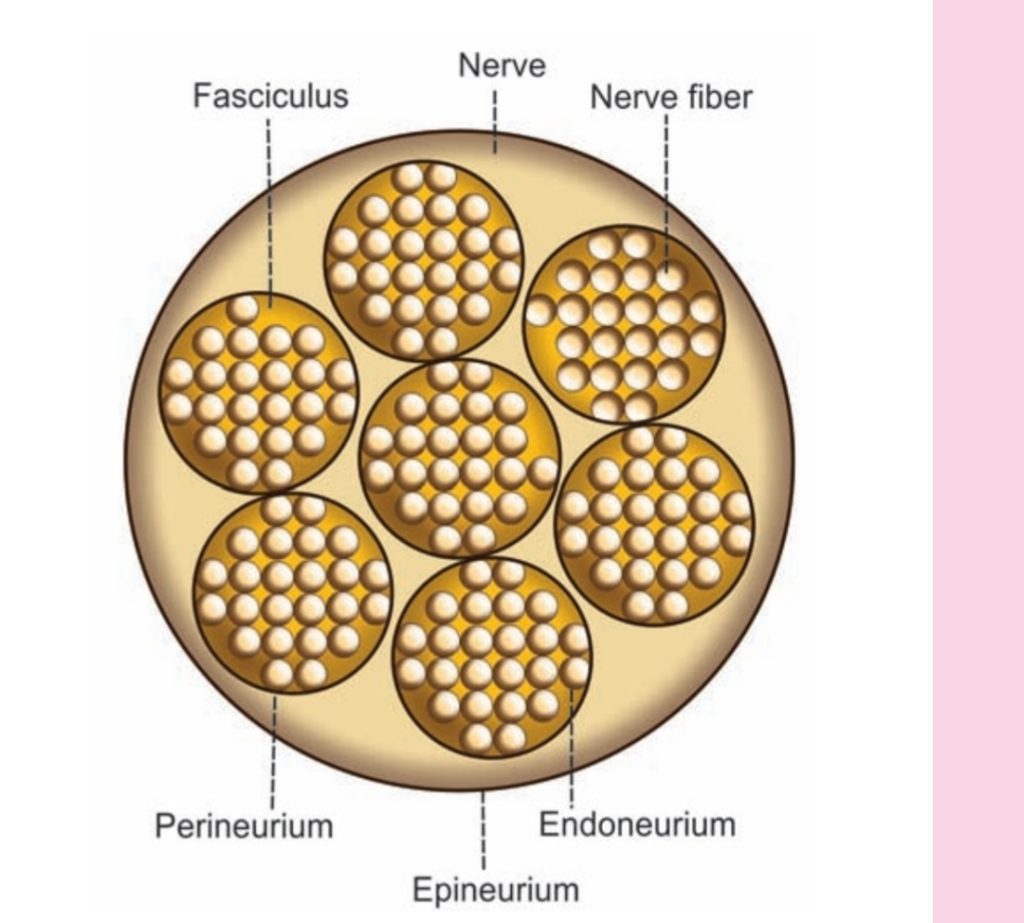
Each nerve have many bundles of nerve fibers and single bundle called as fasciculus .
Coverings of Neurons
The whole nerve is covered by a tubular sheath, which is formed by a areolar membrane. This sheath is called epineurium. Single nerve fiber bundle called as fasciculus is covered by perineurium . Single nerve fiber (axon) is covered by endoneurium.

Internal Structure of Axon – Axis Cylinder
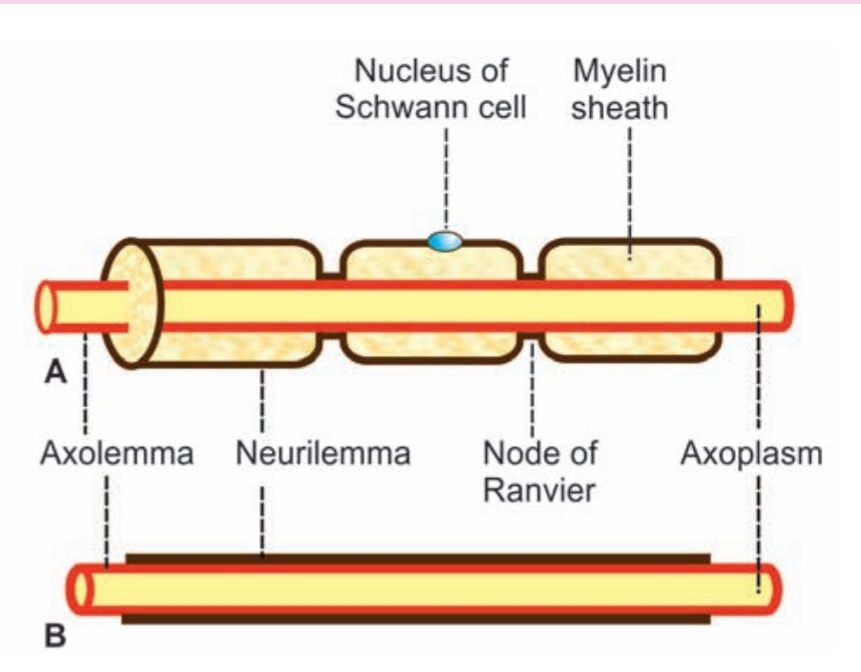
Axon has long central core of cytoplasm called axoplasm. Axoplasm is covered by tubular sheath-like membrane called axolemma. Axolemma is the continuation of the cell membrane of the nerve cell body. .
Non-myelinated Nerve Fiber: The nerve fiber described above is the non-myelinated nerve fiber, which is not covered by myelin sheath.
Myelinated Nerve Fiber: Nerve fiber which is insulated by the myelin sheath is called myelinated nerve fibers.

Myelin sheath
Myelin sheath is a thick lipoprotein sheath that insulates myelinated nerve fiber. Myelin sheath is not a continuous sheath. It is absent at regular intervals. The area where the myelin sheath is absent is called the node of Ranvier. A segment of the nerve fiber between two nodes is called an internode. Myelin sheath is responsible for the white color of nerve fibers.
Neurilemma
Neurilemma is made up of a thin membrane, which is surrounded by axis cylinder. It is also called neurilemmal sheath or sheath of Schwann which consist of Schwann cells.
Recent Post

Understanding ALL about Rheumatoid arthritis
Rheumatoid arthritis Rheumatoid arthritis (RA) is a disease of synovium (a thin, soft connective tissue membrane that lines the inner surface of synovial joints) characteristics

Different menstrual cycle phases
Stages of menstrual cycle Phases Let’s start this article with my story of mensturation , I was 15 when I got my first period and

What is pain scale & how it works
What is pain scale & how it works ? What is a Pain scale? A pain scale is a tool developed by therapists and doctors
What should we eat during periods to reduce pain?
Home During period, the right food choices can make a huge difference in how your body feels. Warm, comforting drinks like ginger tea or turmeric
How to perform Neurological assessment ?
Home Download a PDF of Neurological Assessment sheet- Click on this Every Neurological assessment starts with taking the demographic data from patient. A demographic data
5 Desk Exercises for Neck Stiffness Prevention
5 Desk Exercises for Neck Stiffness Prevention Table of Contents Neck tilt exercise The neck tilt exercises include five essential movements — Forward Neck