Goniometry of shoulder joint

Table of Contents

Introduction

Shoulder  joint 

Type of joint: Ball and socket joint with three degrees of freedom allowing for flexion/extension, abduction/adduction, and internal/external rotation in the shoulder joint . The anatomic axis is through the center of the head of the humerus.

Shoulder Flexion

Planes/axis of movement: Motion occurs in the sagittal plane around a transverse axis through the head of the humerus.

Range of motion:

0 degrees to 180 degrees

Goniometric alignment:

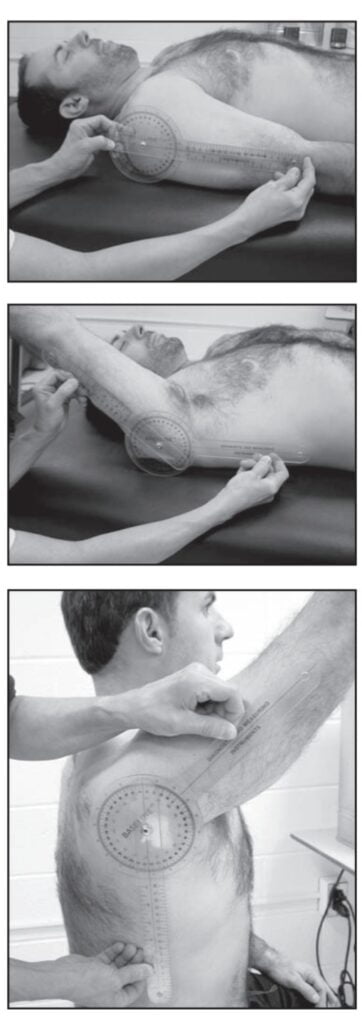
  • Axis: Near the acromion process, through the humeral head
  • Stationary arm: Align with the midaxillary line of the trunk
  • Moving arm: Align with the lateral midline of the humerus sitting the lateral epicondyle of the humerus

Stabilization: The scapula must be stabilized against a supporting surface by the weight of the trunk to prevent elevation, upward rotation, and posterior tilting. The clinician may use his/her hand to stabilize the scapula if the subject is in sitting.

Substitutions: Common substitutions in an attempt to gain more shoulder flexion may include lumbar hyperextension, shoulder abduction, or scapular elevation. These substitutions may occur because of limitations at the glenohumeral joint or as a result of pain during testing

Goniometry of shoulder joint

Shoulder Extension/
Hyperextension

Planes/axis of movement: Motion occurs in the sagittal plane around a transverse axis through the head of the humerus. The extension is the reverse action of flexion. As the arm passes the trunk in the anatomic position, hyperextension occurs.

Range of motion:
  • 180 degrees to 0 degrees of extension (from full flexion)
  • 0 degrees to 40 to 60 degrees of hyperextension

Goniometric alignment:

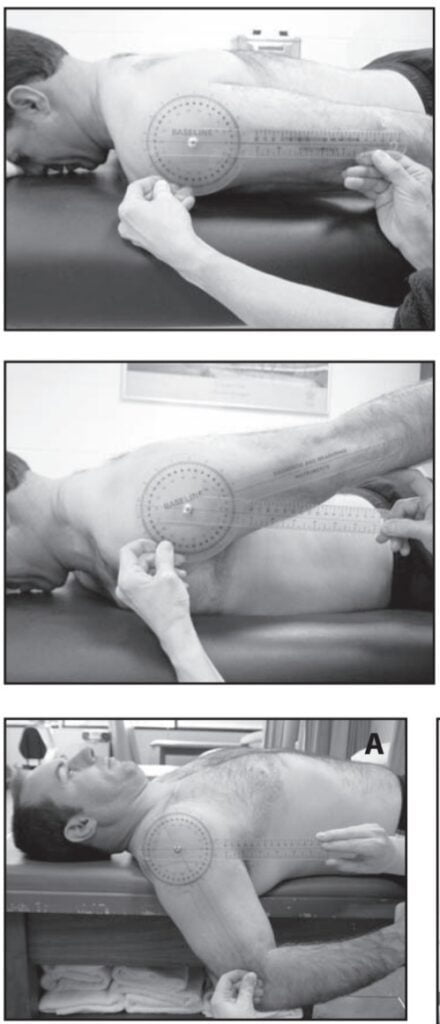
  • Axis: Near the acromion process, through the humeral head
  • Stationary arm: Align with the midaxillary line of the trunk
  • Moving arm: Align with the lateral midline of the humerus sitting the
    lateral epicondyle of the humerus

Stabilization: The scapula should be stabilized against a supporting surface by the weight of the trunk to prevent anterior tilting and elevation. The clinician may use his/her hand to stabilize the scapula if the subject is in sitting.

Substitutions: The subject may try to extend the trunk or abduct the shoulder to complete the motion or avoid pain during testing.

Goniometric alignment:

Shoulder Abduction

Planes/axis of movement: Motion occurs in the frontal plane around an anterior/posterior axis.

Range of motion:

0 degrees to 180 degrees

Goniometric alignment:
  • Axis: Close to the anterior aspect of the acromion process through the center of the humeral head
  • Stationary arm: Align parallel to the midline of the sternum along the lateral aspect of the trunk
  • Moving arm: Align along the medial midline of the humerus sitting the medial epicondyle of the humerus

Stabilization: The scapula must be stabilized against a supporting surface by the weight of the trunk. The clinician may also use his/her hand to stabilize the clavicle and scapula if necessary to prevent elevation and upward rotation.

Substitutions: The examiner should not allow the subject to elevate the scapula or laterally flex the trunk to the contralateral side during testing in an attempt to gain more range of motion. Allow the shoulder to externally rotate during testing.

Goniometry of shoulder joint

Shoulder Adduction

Planes/axis of movement: Movement occurs in the frontal plane around an anterior/posterior axis. It is discontinued by contact of the upper arm with the body.

Range of motion:

180 degrees to 0 degrees (from full abduction)

Goniometric alignment:
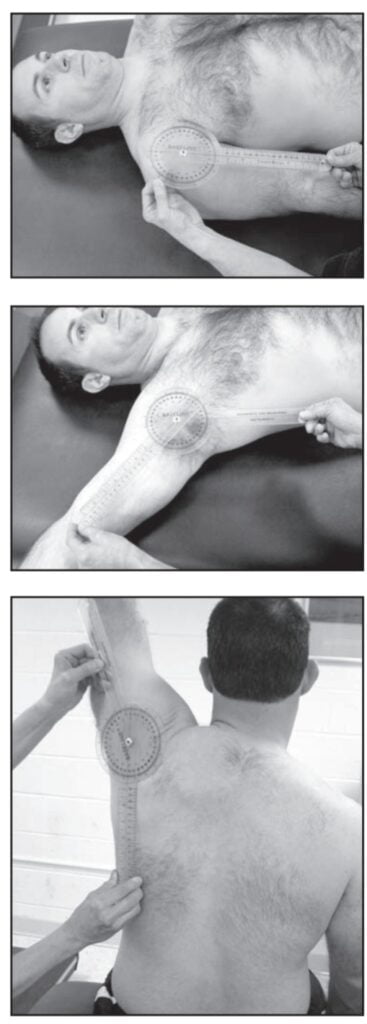
  • Axis: Anterior aspect of the acromion process, through the center of the humeral head.
  • Stationary arm: Align along the lateral aspect of the anterior surface of the trunk in parallel with the midline of the sternum.
  • Moving arm: Align with the midline of the humerus sitting the medial epicondyle of the humerus.

Stabilization: Stabilize the thorax against a supporting surface and encourage subject compliance to prevent ipsilateral flexion. Allow the shoulder to internally rotate.

Substitutions: The subject may try to laterally flex the trunk toward the tested side to gain more motion or avoid pain during testing.

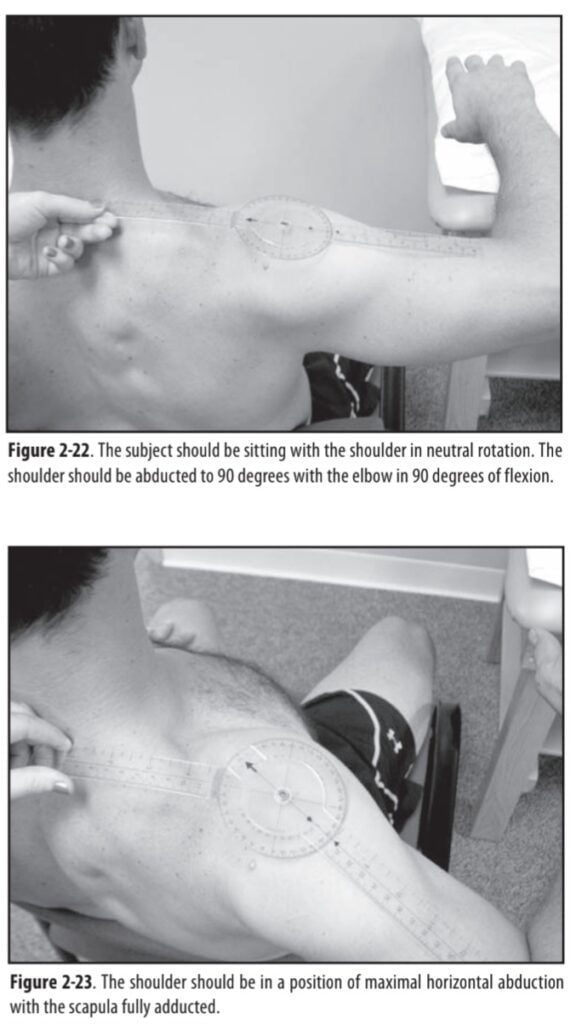
Shoulder Horizontal Abduction

Planes/axis of movement: Movement occurs in the transverse plane around a vertical axis. The scapula adducts on the thorax during movement.

Range of motion:
  • 0 degrees to 45 degrees from neutral
  • 0 degrees to 135 degrees from a fully horizontally adducted position
Goniometric alignment:
  • Axis: The superior aspect of the acromion process through the head of the humerus
  • Stationary arm: Align along the midline of the shoulder sitting at the base of the neck
  • Moving arm: Align along the midline of the humeral shaft, siting the lateral epicondyle of the humerus

Stabilization: The thorax must be stabilized against the back of a chair to prevent trunk rotation.

Substitutions: The subject may attempt to rotate the trunk or laterally flex to the opposite side to gain more movement. The scapular elevation is also another substitution seen during testing.

Goniometry of shoulder joint

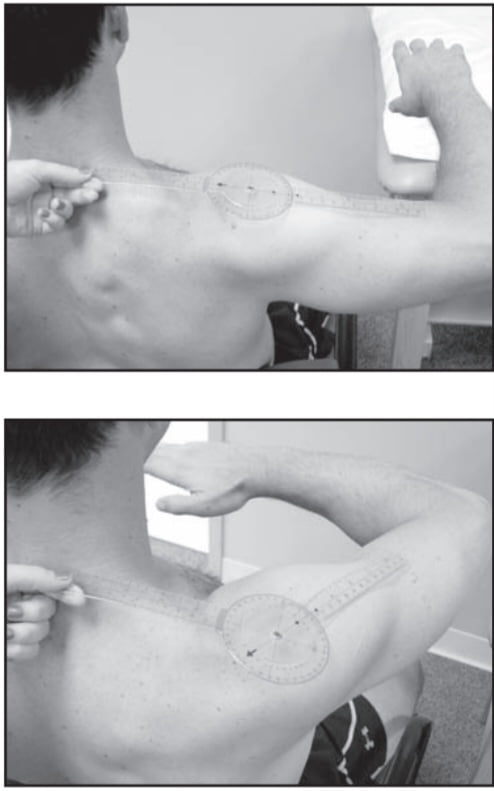
Shoulder Horizontal Adduction

Planes/axis of movement: Movement occurs in the transverse plane around a vertical axis. The scapula abducts the thorax during the movement.

Range of motion:
  • 0 degrees to 90 degrees from neutral
  • 0 degrees to 135 degrees from a fully horizontally abducted position

Goniometric alignment:

  • Axis: The superior aspect of the acromion process of the scapula, through the head of the humerus.
  • Stationary arm: Align along the midline of the shoulder sitting at the base of the neck.
  • Moving arm: Align along the midline of the humeral shaft, siting the lateral epicondyle of the humerus.

Stabilization: The thorax must be stabilized against the back of a chair or supporting surface to prevent rotation.

Substitutions: The subject may try to rotate the trunk to obtain more motion during testing

Goniometry of shoulder joint

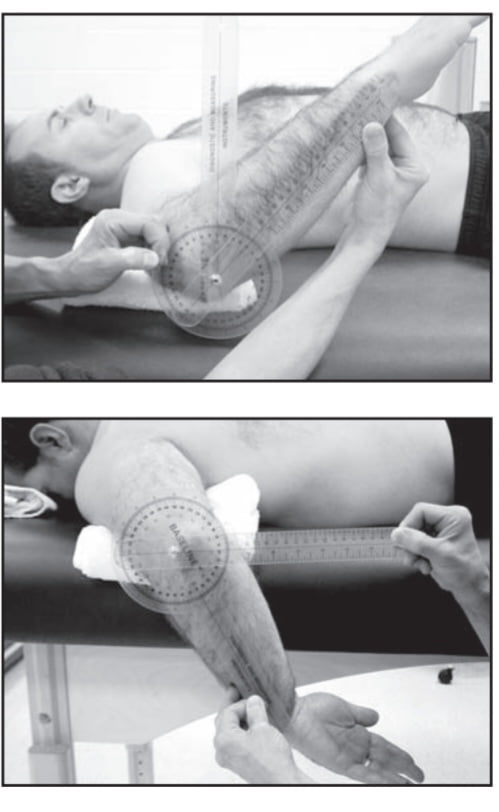
Shoulder Internal (Medial)
Rotation

Planes/axis of movement: Movement occurs in the transverse plane around a longitudinal axis through the head and shaft of the humerus.

Range of motion:
  • With the shoulder stabilized: 0 degrees to 75 degrees
  • Universally accepted range of motion: 0 degrees to 90 degrees
Goniometric alignment
  • Axis: Over the olecranon process of the ulna
  • Stationary arm: Align perpendicular to the floor
  • Moving arm: Align with the shaft of the ulna, siting the styloid process of the ulna.
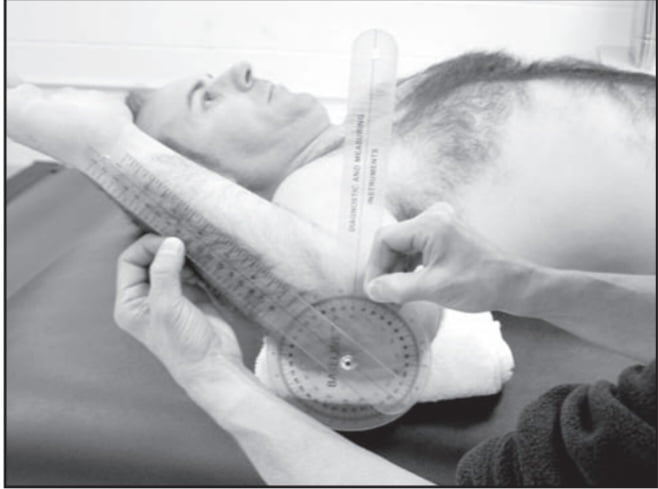
  • Shoulder External (Lateral)
    Rotation

    Planes/axis of movement: Motion occurs in the transverse plane around a longitudinal axis through the head and shaft of the humerus.

    Range of motion:

    0 degrees to 90 degrees

    Goniometric alignment:
    • Axis: Over the olecranon process of the ulna
    • Stationary arm: Align perpendicular to the floor
    • Moving arm: Align with the shaft of the ulna, siting the styloid process of the ulna

    Stabilization: Make sure the distal end of the humerus is stabilized against a supporting surface and the trunk does not rise during movement.

    Substitutions: The examiner should watch carefully to make sure the subject does not extend the trunk or move the shoulder out of 90 degrees of abduction to avoid movement. Elbow flexion or extension is another commonly seen substitution to avoid shoulder external rotation.

Goniometry of shoulder joint

Recent Article post