
Poliomyelitis
Table of Contents
Introduction
Poliomyelitis is a viral infection of nerve cells in the anterior horn cells of the spinal cord(anterior gray matter ), or cranial nerve nuclei in the brainstem leading in many cases to temporary or permanent paralysis of muscles that they activate. It is caused by infection with virus of which at least three types have been identified as
type I (Brunhilde),
type II (Lanchi)
type III (Leon)
Pathology of Polio Virus
Poliomyelitis is caused by poliovirus which is an enterovirus, so named because of its ability to multiply in the gastrointestinal tract. The infection occurs by ingestion and the organism infects the epithelial cells in the mucosa of the gastrointestinal tract, and submucosal lymphoid tissue of the tonsils. While infected patients may remain asymptomatic, about 5% of cases develop fever, Malaise, Sore throat, myalgia, and headache. Let me understand briefly,
The disease occurs in 3 stages.
Alimentary Stage
After gaining access to the body through nasopharynx or the GIT, the virus multiplies in the epithelial cells of the intestinal mucosa.
Viremic Stage
The virus spreads into the bloodstream and after a sort of conflict between the virus and the antibodies, in case the virus turns victorious then it leads to the third stage.
Neural Stage
The virus finds its way to the anterior horn cells of the spinal cord and sometimes to nerve cells in the brainstem. According to virulence of the infection, the cells may escape serious harm or they may be damaged or killed. If cell are damaged there is paralysis of the corresponding muscles but recovery is possible. However, if cells are killed then the paralysis is permanent
Transmission:
Poliomyelitis is spread from one person to another through fecal contamination (oro fecal) routes in countries where hygiene is poor and by droplet infection where sanitation is good.
Incubation Period of Virus:
It is the period from the entry of the virus to the visible symptoms on the body. It varies from 3 to 30 days, but 7 to 14 days is the most common interval between infection and clinical illness.

Signs and Symptoms of polio
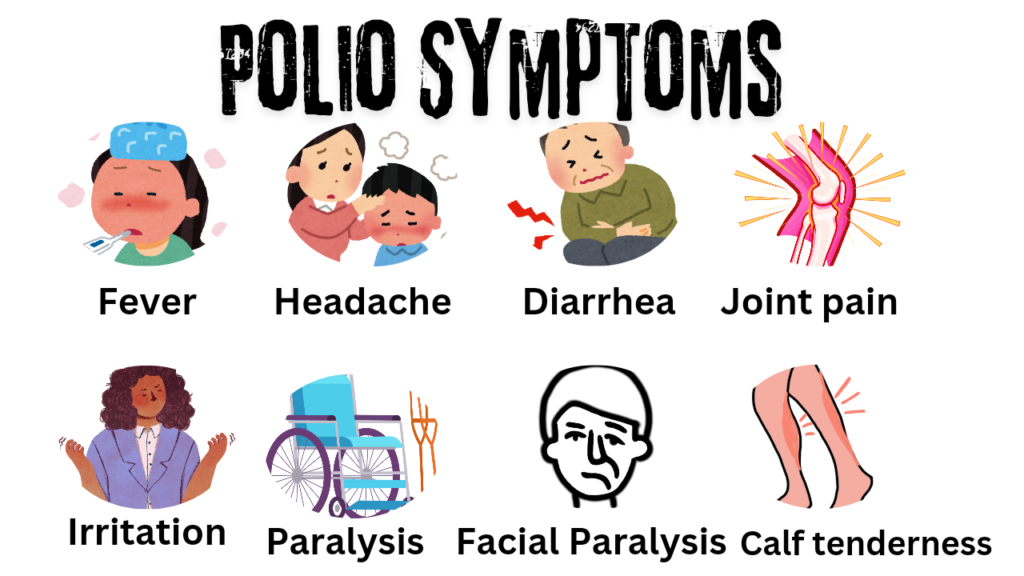
The Most common sign of Poliomyelitis
- headache
- sore throat
- Malaise
- slight cough
- diarrhea
- constipation
- backache
- joint pains
- pyrexia
- Mild neck stiffness
- neck irritability
The disease process may be staged as,
Stage I Acute stage (of Paralysis)
Stage II convalescent Stage
Stage III Residual Paralysis.
The signs and symptoms are in the very acute stage of poliomyelitis. Duration: 3 to 6 weeks from onset of Poliomyelitis. Here most of the signs and symptoms remain similar to the prodromal stage but are more pronounced especially the following:
- Fever—variable in both duration and severity
- Diarrhea, nausea and vomiting
- Irritability
- Limb and joint pains — This is due to pain in the surrounding muscles. There is never any swelling or redness of joint. This is an important differentiating point from acute arthritis
- Muscle tenderness is most important sign seen in this stage. We test the tenderness by pressing the calf muscles when the child is quiet. If he cries it means he has tenderness. The child will always prefer a sleeping position and he /she cannot tolerate any change of position. Many a time seen that the child can have upper respiratory tract infection also.
Convalescent Stage where there is actual paralysis. The duration of this stage is 3 month. Here the signs and symptoms are very variable in both duration and severity. Thus the effects may lead to paralysis which may take on one of these form:
Spinal Type: In this type, the anterior horn cells of the spinal cord are affected leading to Lower motor lesions. The various polio symptoms in this type are :
- Paralysis of lower motor neuron type with asymmetrical flaccid paralysis and normal sensation.
- The most common affected muscle are lower limb muscles which are more often involved than the upper limb muscles. The involvement of muscles is very asymmetrical.
- Paralysis contracture These contractures eventually lead to deformity which is particularly seen in the lower limbs.
Bulbar Type: In this type, there is paralysis of pharyngeal paralysis. The various polio symptoms in this type are :
- The most important sign of bulbar paralysis is inability to swallow due to pharyngeal paralysis.
- The patient chokes on both solid and liquid food and cannot swallow his saliva.
- The patient cannot cough properly due to the paralysis of larynx.
- He also has difficulty in speaking due to paralysis of palate.
- The respiratory muscles (intercostals and diaphragmatic) swallowing muscles or both are affected and thus the patient requires urgent treatment to save his life in the form of ventilatory support for respiration and intubation with Ryle’s tube for feeding.
Spinobulbar Type: In this type, there is a combination of both spinal and bulbar types of poliomyelitis. Some patients may have a predominant spinal presentation and less bulbar in which case it is called a spinobulbar. Some patients may have more bulbar signs and fewer spinal signs in which case it is called bulbospinal type.
Postencephalitic Type: This is a rare type and is usually associated with bulbar paralysis. The various polio symptoms in this type are:
- Paralysis of the facial muscles
- Symptoms similar to meningitis like headache, vomiting, neck stiffness, etc.
- Urinary retention
Deformity seen in Poliomyelitis
Lower Limb
Flexion deformity in both knees with equines which is measured with the hip extended as much as possible to avoid error due to tight hamstrings.
The common deformities at knee include subluxation, genu recurvatum, and rotation of the tibia
Spinal Deformity
Scoliosis of spine in polio is usually due to an imbalance of the lateral flexors of the trunk.
Lordosis is usually an attempt by the patient to balance a weak spine on a weak pelvis.
Ankle Deformity

Equinus, varus, valgus, cavus, pes planus
Pelvic Tilt
A limb length discrepancy can cause a pelvic tilt leading to compensatory changes in spine.
Upper Extremity
Common upper limb deformities are Adduction and subluxation of the shoulder, Flexor deformity of the elbow, and Dislocation of the head of the radius.

Why My Knee Hurt and Fix It?
Why My Knee Hurt and Fix It? Knee hurt is a common problem that can affect your daily routine, especially when walking, running, or climbing

Understanding ALL about Rheumatoid arthritis
Rheumatoid arthritis Rheumatoid arthritis (RA) is a disease of synovium (a thin, soft connective tissue membrane that lines the inner surface of synovial joints) characteristics

Different menstrual cycle phases
Stages of menstrual cycle Phases Let’s start this article with my story of mensturation , I was 15 when I got my first period and

What is pain scale & how it works
What is pain scale & how it works ? What is a Pain scale? A pain scale is a tool developed by therapists and doctors
What should we eat during periods to reduce pain?
Home During period, the right food choices can make a huge difference in how your body feels. Warm, comforting drinks like ginger tea or turmeric
How to perform Neurological assessment ?
Home Download a PDF of Neurological Assessment sheet- Click on this Every Neurological assessment starts with taking the demographic data from patient. A demographic data