
Sprain vs Strain
Table of Contents
Definition Of Sprain and Strain
Sprain and strain are both soft tissue injuries but of different structures. Sprain is an injury to the ligaments and capsule of joints, whereas strain is an injury to either the muscles or tendons, sometimes both.
American College of Sports Medicine (ACSM) has classified the injury degree as sprain vs strain .
In Sprain
Grade 1: Mild or no ligament tear
Grade 2: Moderate with partial torn ligament tear.
Grade 3: Sever with a complete ligament tear.
In Strain
Grade 1: Mild torn in muscles or tendon, Mild tenderness with no limitation in Range of motion.
Grade 2: Moderate torn in muscle or tendon, Moderate tenderness with painful Range of motion.
Grade 3: Sever torn in muscle or tendon, severe pain, and no motion is possible.
In Sprain vs Strain, a sprain is classified based on a tear whereas a strain is classified based on tear, tenderness, and Range of motion.
Other common names
There are other names with which Sprain vs Strain are denoted such as, Sprain is also called Torn ligament, distortion whereas Strain is also called Torn muscle, muscle strain, and pulled muscle.
Causes in Sprain vs Strain
Sprain
Sprains occur when there is excessive force on the ligaments of joints. The most common cause is overuse of ligaments while in repetitive activities mainly in the knee joint, wrist, shoulder joint, and ankle joint.
Other causes are age, genetics, high-intensity contact sports (football, ice hockey, martial arts, etc. )
Strain
Strain occurs when there is any imbalance in body mechanics during activities such as contact sports or heavy lifting of objects. When muscles and tendons undergo overstretching or more physical stress than they can withstand can induce mechanical trauma or injury. The most common location in the human body is foot, leg muscle ( hamstring ), shoulder, and back muscle.
Signs and symptoms Of Sprain and Strain
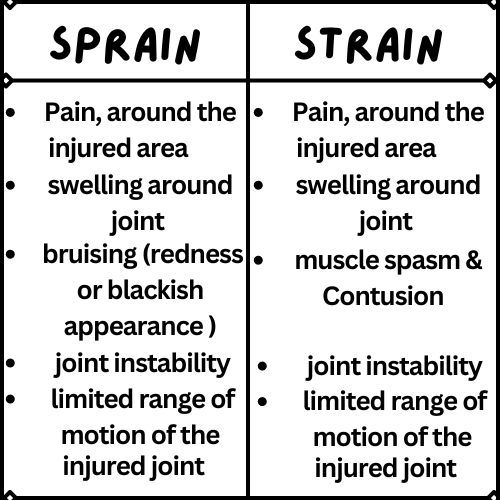
The signs and symptoms are very similar in both conditions as they both are confused by professionals in many terms. The only difference found is that strain does not have bruising around the injured joint, You may observe spasm whereas sprain will have bruising in the injured joint.
Table 1.1 below represents the sprain vs strain based on its signs and symptoms
Diagnosis
In sprain vs strain, the diagnosis is very confusing for doctors. Initially, a brief physical examination is taken along with history, the doctor recommends taking an X-ray to differentiate the tear or fracture.
If the diagnosis is still not confirmed by X-ray then the doctor can ask for an MRI. MRI gives a very detailed and clear view of soft tissues around the joint.
What to do immediately in this condition?
The first-line treatment protocol is similar in both sprain vs strain conditions. The new method for management of soft tissue injury is the PEACE AND LOVE protocol. It stands for ;
P=Protection: Protecting the injured area from any further injury. Restrict the movement for 3-5 days. It helps to decrease bleeding and prevent it.
E=Elevation: Elevation of the affected part of body up to above the heart level to reduce swelling and increase blood flow.
A=Avoid anti-inflammatory modalities: DO NOT use NSAIDs and ice. Until unless you are in severe pain.
C=Compression: Compress the area with the help of compression bandages or taping. It helps to reduce swelling.
E=Education: Patient education is very important it helps to understand the injury and what precautions to be taken. It helps form prevention from further injury.
After some days, the LOVE protocol can be used.
L =Load,
O= Optimism,
V=Vascularization,
E= Exercise.
These methods are very helpful in grade 1 and grade 2 injury initially. The old traditional method which is now replaced by peace & love is the RICE protocol.
Some studies show that platelet-rich plasma (PRP) injections are a very effective treatment that promotes early recovery from muscular injuries. whereas in Sprain continuous passive motion machines and cryocuffs both help in increasing the ranges of limbs and reduction of swelling.
Rehabilitation for Sprain and Strain
After the PEACE & LOVE protocol, the second line of treatment method for sprain vs strain is not different, doctors move to physical therapy for early recovery in their day-to-day activities, strengthening, and prevention. Rehabilitation is done by a combination of exercises, electrotherapy, manual therapy, aquatic therapy etc.
Manual therapy for sprain vs strain
Manual therapy consists of mobilization, soft tissue massage, and stretching. It works differently in sprain vs strain because structurally the muscle or tendon is different from the ligament. Manual therapy is a very effective hands-on technique that targets a specific area.
Electrotherapy for Sprain vs Strain
In electrotherapy doctors use modalities for the treatment of these conditions such modalities are TENS (Transcutaneous Electrical Nerve Stimulation) and ultrasound they contribute to the reduction of inflammation, enhanced blood flow, and accelerated recovery process in patients.
Aquatic therapy for Sprain vs Strain
Aquatic therapy is a method of intervention where buoyancy and resistance of water are used for the treatment of patients.
Gait Training for Sprain vs Strain
Gait training is very important in knee sprain or ankle sprain conditions. It is used to improve walking patterns and body mechanics. Any abnormalities in muscle or other structures can cause abnormal walking patterns.
Exercises in sprain vs strain
Exercises such as theraband exercise ( for upper body strengthening) and strengthening exercises such as planks, bridges, leg curls, Ankle dorsiflexion, and Ankle circles.
Prevention of Sprain and Strain
Every patient needs proper education about how to prevent injury from further damage . Prevention taken before, during, and after treatment is highly prioritized. In sprain vs strain, preventions taken are similar.
- EXERCISE REGULARLY: consistently helps maintain strength.
- NO LONG LASTING BED REST: Inactive can increase the risk of injury
- WARM UP: Before doing any exercise warming up the body can prevent further injury.
- WEAR PROTECTIVE EQUIPMENT: The right protective instrument is needed in sports and can help them in early recovery.
- AVOID WHEN TRIED: When you are tired or having pain from doing exercises then stop immediately.
- WEAR PROPER SHOES: Good shoes in good condition are necessary for the recovery phase.
- DON’T OVERUSE BRACES: Wearing braces for a very long period can be harmful.It causes redness, decreased blood flow, and Tightness.
- BALANCE DIET: A proper balanced diet to keep muscles healthy and fit.
- FALLING: Prevent from falling hazards.