
Stomach

Table of Contents

Definition of Stomach

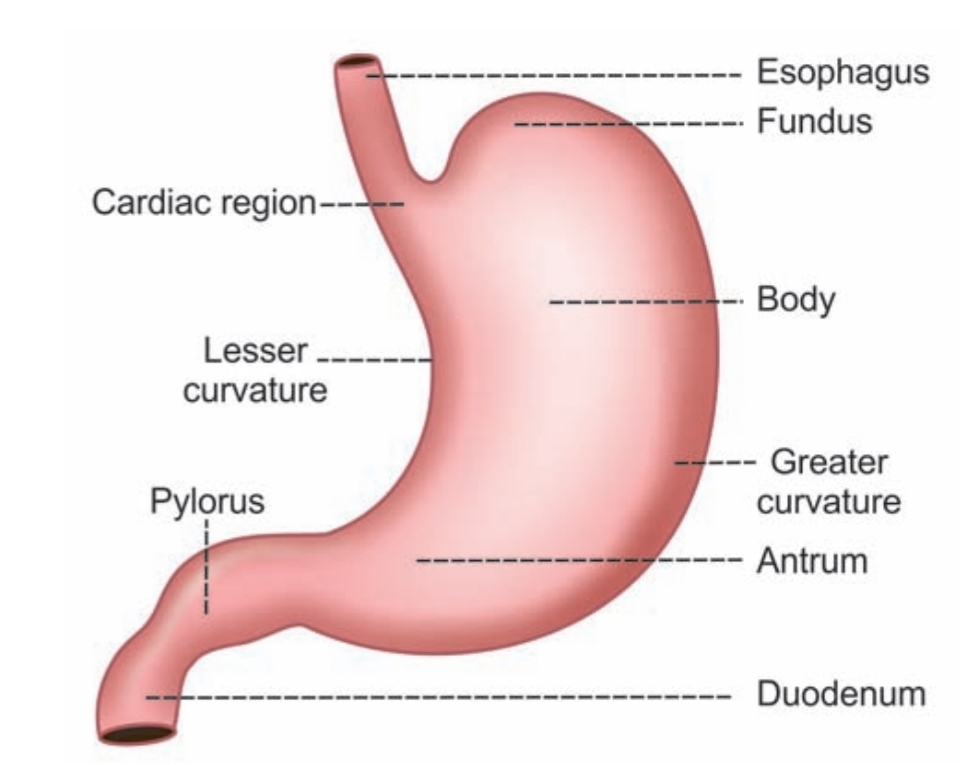
The stomach is a hollow J – shaped organ situated just below the diaphragm on the left side of  abdominal cavity. It produces enzymes (substances that create chemical reactions) and acid (digestive juices). 
Stomach diagram
Parts of stomach

Volume of stomach

The volume of the empty stomach is 50 mL. Under normal conditions, it can expand to accommodate 1 L to 1.5 L of solids and liquids. However, it’s capable of expanding still further up to 4 L.

What are the parts of the stomach?

In humans, the stomach has four parts:

1. Cardiac region

2. Fundus

3. Body or corpus

4. Pyloric region.

Cardiac region

The cardiac region is the upper part of the stomach where the esophagus opens. The opening is guarded by a sphincter called the cardiac sphincter, which opens only towards stomach.

Fundus

The fundus is a small dome­ shaped structure. It is elevated above level of esophageal opening.

Body or Corpus

The body is largest part of stomach forming about 75% to 80% of the whole stomach.

Pyloric Region

The pyloric region has two parts, the antrum and the pyloric canal.
The body of the stomach ends in an antrum. Pyloric
canal opens into first part of the small intestine called the duodenum.

Curvature of Stomach

The stomach has two curvatures. One on the right side is less curvature and the other on the left side is greater curvature.

What is the structure of the stomach wall?

The stomach wall is formed by four layers of structures:

1. Outer serous layer: Formed by peritoneum

2. Muscular layer: Made up of 3 layers of smooth muscle fibers, namely inner oblique, middle circular, and outer longitudinal layers

3. Sub-mucus layer: Formed by areolar tissue, blood vessels, lymph vessels, and Meissner nerve plexus.

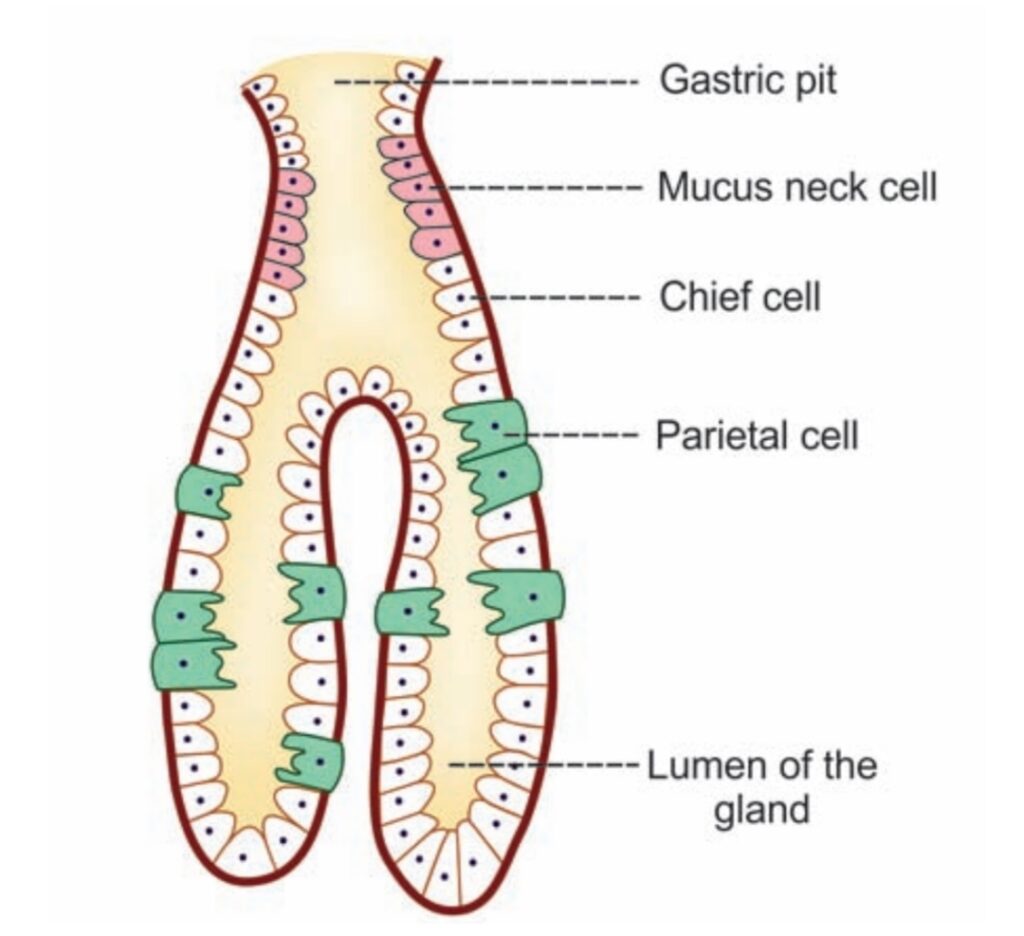
4. Inner mucus layer: Lined by mucus-secreting columnar epithelial cell. The gastric gland are situated in this layer.

What are the glands in stomach?

Gastric gland
Gastric Glands

Gastric glands in the stomach are classified into three types

  • Fundic glands or main gastric glands or oxyntic glands: Situated in the body and fundus of the stomach
  • Pyloric glands: Present in pyloric part of the stomach
  • Cardiac glands: Located in the cardiac region of the
    stomach.

What are the functions of the stomach?

    • Storage Function

Food is stored in the stomach for a long period, i.e. for 3 to 4 hours, and emptied into the intestine slowly. The maximum capacity of the stomach is up to 1.5 L.

    • Formation of Chyme

Peristaltic movements of stomach mix the bolus with gastric juice and convert it into semisolid material known as chyme.

    • Digestive function

Gastric juice acts mainly on proteins. Proteolytic enzyme of gastric juice are pepsin and rennin. they help in digestion.

    • Protective function

Mucus help in protection of inner linning of stomach from HCL .

    • Excretory function

Many substances like toxin, alkaloids and metals are excreted through gastric juice.

    • Homepoietic function

Intrinsic factor of Castle, secreted by parietal cells of gastric glands plays important role in erythropoiesis. It is necessary for the absorption of vitamin B12 (which is called an extrinsic factor) from the GI tract into the blood

What are the disorders of the stomach?

How to keep your stomach healthy?

If you want to keep your stomach healthy then initially change your lifestyle to keep your stomach and digestive system healthy.

  • Drink alcohol only in moderation.
  • Drink at least 50 ounces of water daily, depending on your activity levels and size.
  • Eat 25 to 35 grams of fiber 
  • limit your intake of food 
  • Management of stress
  • Quit smoking 
  • Exercise regularly.