
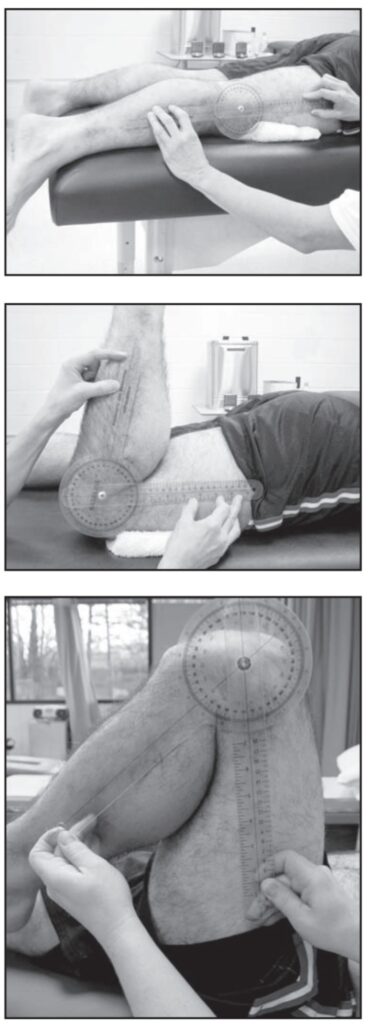
Goniometry of knee
Goniometry of knee
Type of joint: The knee joint is a hinge joint with two degrees of freedom, allowing for flexion and extension with an axial rotation.
Knee Flexion
Planes/axis of movement: Motion in knee flexion occurs in the sagittal plane around a
coronal axis. Axial rotation occurs in the transverse plane when the knee
is flexed.
Range of motion:
• 0 degrees to 120 degrees (with the hip extended)
• 0 degrees to 135 degrees (with the hip flexed)
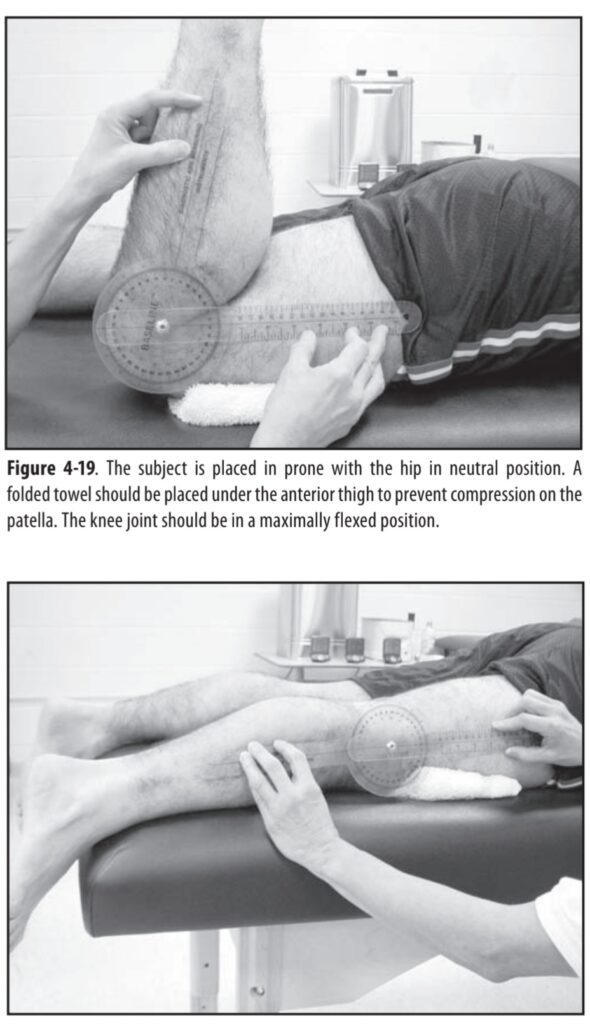
Goniometric alignment:
Axis: Center over lateral epicondyle of the femur
• Stationary arm: Align with the lateral midline of the femur, siting greater trochanter
• Moving arm: Align with the lateral midline of the fibula, siting the lateral malleolus
Stabilization: The pelvis should be stabilized against a supporting surface
and the femur should be stabilized by clinician’s hand if necessary to prevent any hip movement.
Substitutions: The subject may try to rotate hip to avoid pain.

Knee Extension
Planes/axis of movement: Motion in knee extension occurs in the sagittal plane around a
coronal axis. Extension is the return motion from knee flexion.
Range of motion:
• 120 degrees to 0 degrees (from knee flexion with the hip extended)
• 135 degrees to 0 degrees (from knee flexion with the hip flexed)
Goniometric alignment:
• Axis: Center over the lateral epicondyle of femur.
• Stationary arm: Align with the lateral midline of femur, siting greater trochanter
• Moving arm: Align with the lateral midline of the fibula, siting the lateral malleolus
Stabilization: The pelvis should be stabilized against a supporting surface
and the femur should be stabilized by clinician’s hand if necessary to prevent any hip movement
Substitutions: The subject may try to rotate hip to avoid pain with movement.
Alternate method/position for testing: The subject may be placed in side-lying with leg to be tested on top.
Indications
A goniometer is device that measures an angle or permits rotation of an object to definite position. In orthopedics, the former description applies more. The art and science of measuring joint ranges in each plane of joint are called goniometry.
The goniometer is used in the following:
- Presence of dysfunction related to muscles, tendons, or joints.
- Establishing a diagnosis
- Developing treatment goals
- Evaluating progress or the lack of it
- Modify treatment based on the progress
- Fabricating orthoses
- Measurement for research purpose

How to Cure Insomnia Naturally ?
How to Cure Insomnia Naturally If you’re struggling with insomnia, the good news is that effective treatment doesn’t always require medication. Research shows that several
Understanding your back problems at once
Understanding your back Problems at once Introduction Because you clicked on this article, it is likely that you have had firsthand experience of how frustrating
What is the best diet to lower LDL cholesterol?
What is the best diet to lower LDL cholesterol? Introduction If you are concerned about high cholesterol, especially elevated LDL (Low-Density Lipoprotein) cholesterol, making the
What is best diet for high cholesterol ?
What is best diet for high cholesterol ? Maintaining healthy cholesterol levels is essential for protecting the heart and reducing the risk of cardiovascular

Best 25 Heart Healthy Foods to Eat
Best 25 Heart Healthy Foods to Eat Heart disease remains one of the leading health concerns worldwide, but many risk factors can be managed through
Sharp Pain in the Heel of My Foot: Causes and Treatment
Sharp Pain in the Heel of My Foot: Causes and Treatment Pain in the heel of my foot is one of the most common foot