Goniometry of knee

Goniometry of knee

Type of joint: The knee joint is a hinge joint with two degrees of freedom, allowing for flexion and extension with an axial rotation.

Knee Flexion

Planes/axis of movement: Motion in knee flexion occurs in the sagittal plane around a
coronal axis. Axial rotation occurs in the transverse plane when the knee
is flexed.

Range of motion:

โ€ข 0 degrees to 120 degrees (with the hip extended)

โ€ข 0 degrees to 135 degrees (with the hip flexed)

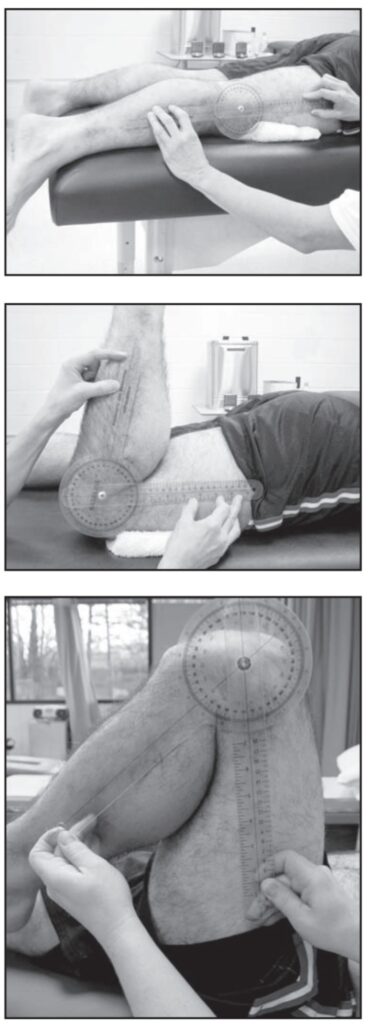
Goniometric alignment:

Axis: Center over lateral epicondyle of the femur

โ€ข Stationary arm: Align with the lateral midline of the femur, siting greater trochanter

โ€ข Moving arm: Align with the lateral midline of the fibula, siting the lateral malleolus

Stabilization: The pelvis should be stabilized against a supporting surface
and the femur should be stabilized by clinicianโ€™s hand if necessary to prevent any hip movement.

Substitutions: The subject may try to rotate hip to avoid pain.

Goniometry of knee flexion .

Knee Extension

Planes/axis of movement: Motion in knee extension occurs in the sagittal plane around a
coronal axis. Extension is the return motion from knee flexion.

Range of motion:

โ€ข 120 degrees to 0 degrees (from knee flexion with the hip extended)

โ€ข 135 degrees to 0 degrees (from knee flexion with the hip flexed)

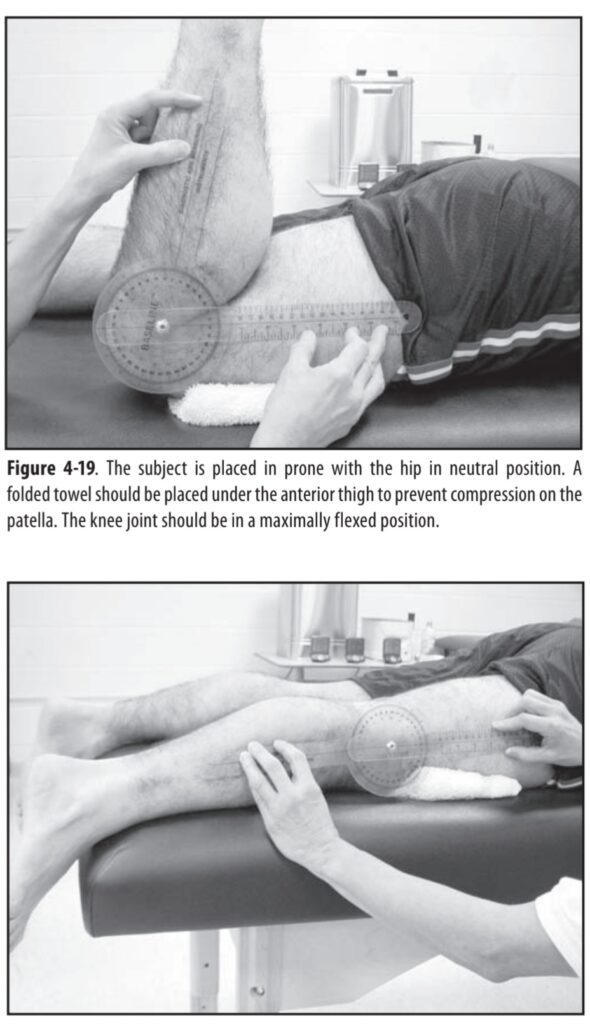
Goniometric alignment:

โ€ข Axis: Center over the lateral epicondyle of femur.

โ€ข Stationary arm: Align with the lateral midline of femur, siting greater trochanter

โ€ข Moving arm: Align with the lateral midline of the fibula, siting the lateral malleolus

Stabilization: The pelvis should be stabilized against a supporting surface
and the femur should be stabilized by clinicianโ€™s hand if necessary to prevent any hip movement

Substitutions: The subject may try to rotate hip to avoid pain with movement.

Alternate method/position for testing: The subject may be placed in side-lying with leg to be tested on top.

Indications

A goniometer isย  device that measures an angle or permits rotation of an object to definite position. In orthopedics, the former description applies more. The art and science of measuring joint ranges in each plane of joint are called goniometry.

The goniometer is used in the following:

  1. Presence of dysfunction related to muscles, tendons, or joints.
  2. Establishing a diagnosisย 
  3. Developing treatment goalsย 
  4. Evaluating progress or the lack of itย 
  5. Modify treatment based on the progressย 
  6. Fabricating orthosesย 
  7. Measurement for research purpose
Goniometry of knee extension